2025 Change Maker of the Year: AJ Hawkins
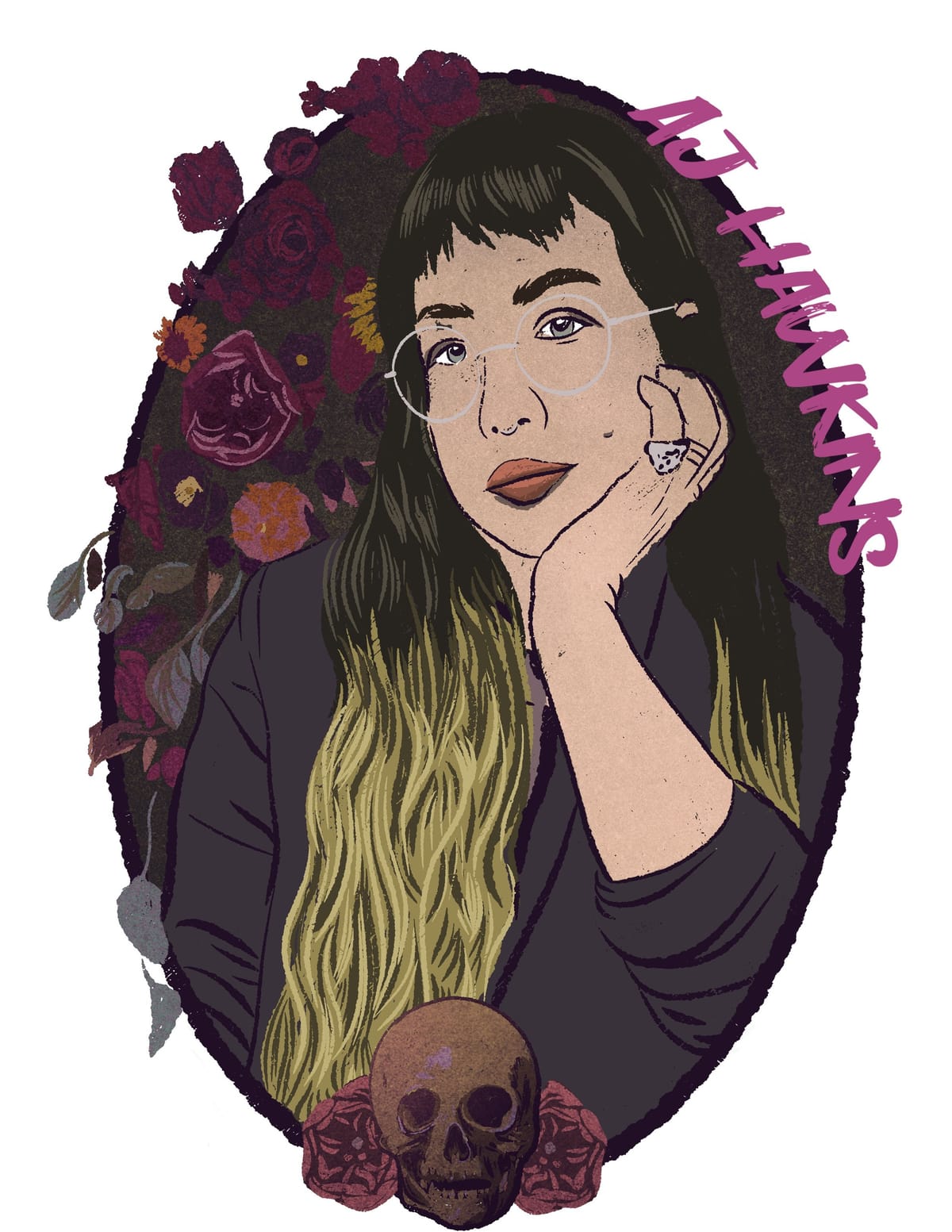
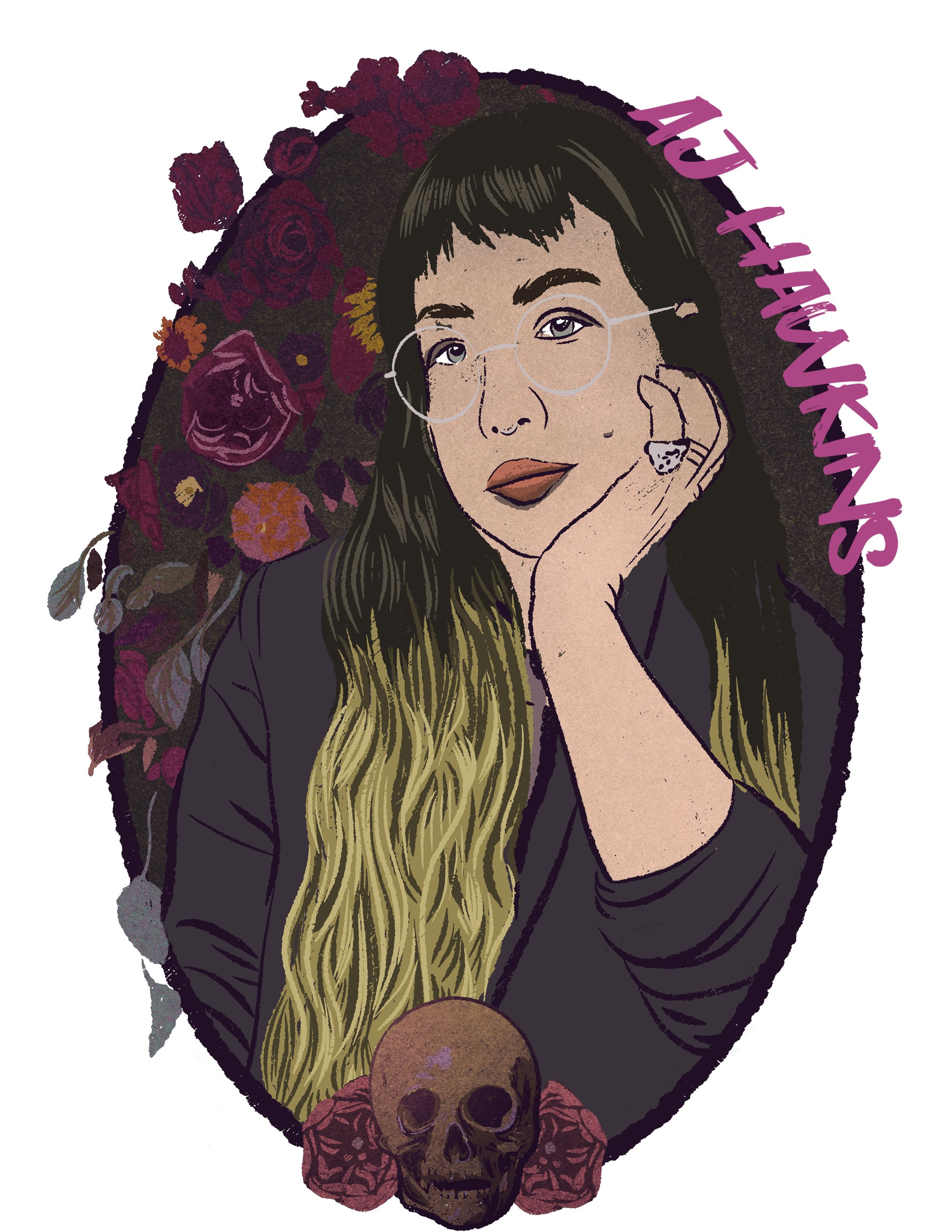
By Angela Downs
AJ Hawkins is the owner of Kalma, a death-positive retail store in downtown, with a community space called the Parlor. She was nominated as a Change Maker of the Year by many people who have felt the positive impact of her deep care for the community and commitment to advocacy and education around death positivity, grief, and disability.
Hawkins began with selling her own designs online called “It’s Ok to Decay”, which later grew to sell vintage clothes and handmade goods from others. Living with disability is a long-term grief experience, Hawkins explained, recognizing what has to be given up and demanding a new way of doing things. She looks back at her life and sees what she has built in the wake of what she has had to let go of.
Her online store grew with her social media platform. The online community of death-positive people and people with disabilities includes 25 countries and all 50 states, and has led to the brick-and-mortar reality that now exists, which Hawkins refers to as an experiment in community building. The geographically diverse online community is primarily peer education. Hawkins shares her personal experience with chronic illness and her findings in the community Parlor experiment.
Hawkins has had thousands of conversations about death, grief, and disability. From these conversations, Hawkins has a database of pattern recognition of individual waves and cadences and shared responses. She's noticed a pervasive theme of vulnerability. People are craving comfort and nostalgia.
“The desire for safety and comfort feels like the most dominant thing,” Hawkins said. "Those are small words for really big tasks, because there's not just physical safety or financial safety, but social safety is such a nuanced thing.”
Young adults have told Hawkins that the Parlor is where they feel most at home. While these are her most proud moments so far, she also feels the weight of the responsibility of being a steward of a community space. She works with vigilance in how she cares.
After two years in the space on Water St., Kalma is moving to 821 Washington St. in February 2026. Based on what she has noticed in the community's needs, she is designing the new space to foster a sense of safety where people can bring their whole selves.
Taking the two years of brick-and-mortar experience and two years of community-building experiments, she hopes the new space meets needs beyond their predictions while carrying what has become so special and immutable about what was created on Water St.
Hawkins wants to continue hosting a space where people can develop skills to navigate conflict and help fulfill the needs of a community that once relied on institutions that largely no longer exist. Hawkins feels navigating conflict is essential to transformative justice and a healthy community, especially to survive adverse circumstances.
“Grief work is my favorite form of that. It’s really hard to share grief with somebody and not start to see them as a person,” Hawkins said. “That feels really powerful as a tool for community building and for Conflict Resolution.”
In a time where so much of our human social needs have been outsourced to an insufficient online world, there’s developed an impulse to cancel and exile, dehumanizing one another. The community experiment of the Parlor is an effort to undo these habits, where grief work is central to restructuring.
“The more time I've spent online, the more important it feels that we don't bring those social skills into the three-dimensional world. I'm very interested in forms of labor that, I don't know if I coined this word, but what I call it in my head, re-humanization labor– different efforts that help us see each other as whole beings.”
Hawkins is continually impressed by the gentle energy people bring to the store and Parlor. A new culture of kindness is emerging, where people interact with an effort to treat one another well. In a world where normal interactions can feel harsh, this new culture can be surprising.
Hawkins said she is looking forward to the stability of the new space. The design process is an opportunity for her to return to her roots as a fabricator, and she has a goal to create the conditions that allow her to return to her painting again for one day a week. In her experience, art is essential for living with a chronic illness, even though it may not always be accessible.
Her portraits that decorate the walls of the Water St. space will go to the new Washington St. space. They are records of her 5-6 years of chronic, debilitating illness, where she and her partner went without community. These artworks also serve as a research medium, exploring grief and mortality. Painting is a tool for processing, and the “medicalized experience needs processing,” Hawkins said.
“In the five or six years that I was dealing with really serious health issues, we didn't have anybody make us a meal, or call to ask how things were doing with the bills,” Hawkins said. “That was this layer of grief on top of the medical experience that I was having that was really big and took a long time to process.”
Hawkins sees a similarity in grief and illness, where in our Western culture, both often do not have community care. Exactly two years ago, Kalma was moving into Water St., a very lonely experience for Hawkins. Because of the Parlor, “I now live in a world where people bring soup,” Hawkins said.
Hawkins has a keen awareness of the displacement experience that people with chronic illness so often feel. So, in the process of moving spaces, Hawkins wants to include the community, so the change doesn’t feel so hard. Keep an eye out as the move unfolds for opportunities to join in rituals of gratitude and reverence for transition.
Hawkins decided to donate to OWL 360 and the Nest because of their comprehensive care, especially for youth, and how special they are to a lot of the people who feel comfortable at Kalma.