Artist Takes on Bureaucracy for Passion Project

[caption id align="alignnone" width="1080"]
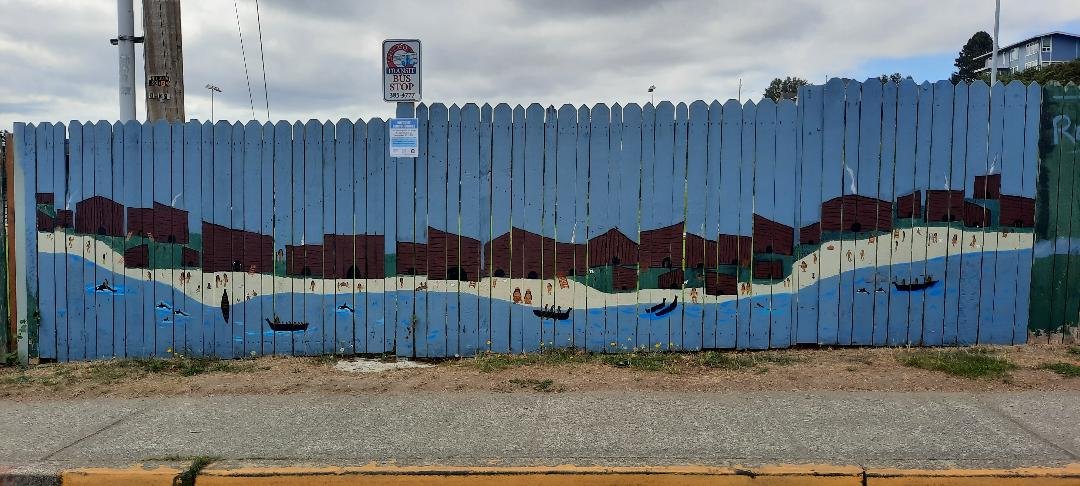
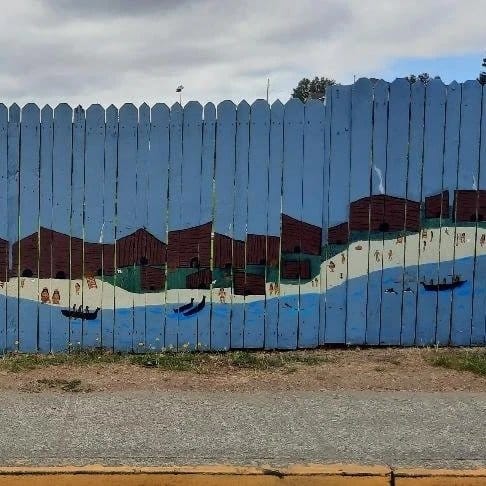
A mural of the original indigenous village occupying the Memorial Field site is depicted by native artist Naiome Krienke. Photo by Kathie Meyer [/caption]
Art News by Kathie Meyer
It took Alexandra “Alex” Anagnostopoulos two years to get approval for the Outsiders Street Art Project at Port Townsend’s Memorial Field. Now she’s scrambling to rally artists of all types to fill a three-block-long canvas with 80 panels before the weather turns. But it’s a happy and grateful scramble, if a little sleepless, to finally see her vision a reality.
During the month of September, and perhaps another week into October, different local artists and artist groups are painting designated fence panels that surround Memorial Field on Washington Street. Artists, poets, writers, and just about anyone who wants to contribute have been invited to join in. A GoFundMe.com account to raise money for art supplies is titled “Support Port Townsend’s 1st Outsiders Street Art Project.”
[caption id align="alignnone" width="1080"]
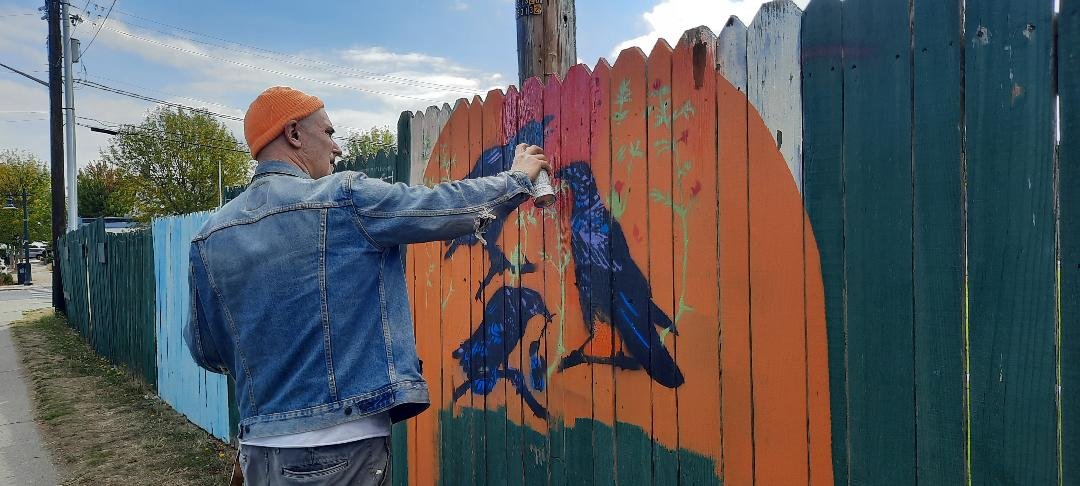
Project participant Trey Whisman is a stencil artist who grew up in Port Townsend. His dad helped open up Fort Worden State Park in the ‘70s. Photo by Kathie Meyer [/caption]
People can still sign up, and the deadline listed on the website is no longer enforced, Anagnostopoulos said. “No one will be turned away. If they come on the last day, we’ll still try to find them a place.” For more information, go to https://tinyurl.com/ypv92kpc. More volunteers to help artists are also needed.
The project is solely the brainchild of Anagnostopoulos, who first entered the public art sphere through graffiti in Chicago. There, letting artists have a field day on walls, fences, etc., was quite common. She wondered if she could find a way to make that happen in Port Townsend. She eyeballed spaces here and there and settled on Memorial Field’s fence.
She began to peddle her idea around town, preaching the benefits of public art projects like this one. She researched the mental health benefits of public art and found credible sources that gave public art credit for stress reduction and developing a shared identity, among other things. Mainly, she sees the fence art as community building and reaching out to artists that live here who are not normally seen in the galleries. She defended the idea to those who associated the project with graffiti and gang warfare.
“We do not have to worry about these kinds of issues here; legitimizing a wall for free expression takes the crime out of the art, creating safety for artists to offer their perspective and craft,” Anagnostopoulou wrote in her proposal.
[caption id align="alignnone" width="612"]
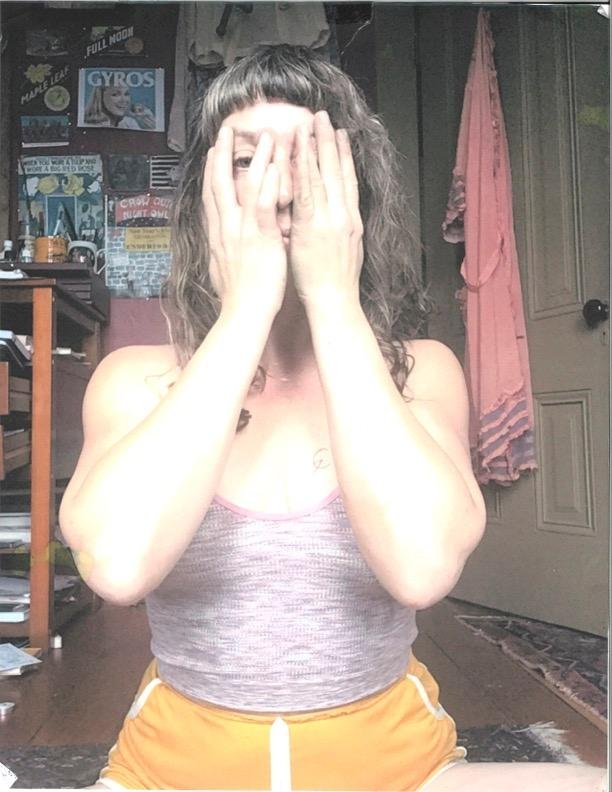
Alexandra “Alex” Anagnostopoulos offered this self-portrait in the spirit of this project being a platform for us to show ourselves as we want to be seen. Photo by Alexandra Anagnostopoulos [/caption]
“People have been painting on walls for thousands of years. Archaeologists study these pictures of the past to learn of the cultures and peoples of those times. We are no different, here, in this time,” Anagnostopoulos said. The word "graffiti" is the plural form of the 19th-century Italian word "graffito," meaning to scratch or scribe a surface. Let’s scratch our surface and see what’s inside.”
Initially, she presented her idea to the Port Townsend Arts Commission, and found that while they had great support for her idea, they didn’t have the capacity to take it on as a commission project. In addition, it had been decades since the city’s artistic mural guidelines had been discussed. Besides, the fence is on county,not city, property. Somewhat discouraged, at least for a time, the project sat on Anagnostopoulos’s back burner.
After a trip to Greece, where she observed art as ubiquitous in public spaces, she renewed her commitment to her idea. More determined than ever, she contacted County Commissioner Heather Dudley-Nollette, who immediately saw the project’s value. “We really need something to connect us here,” Anagnostopoulos wrote to her public official.
Dudley-Nollette responded positively and understood what needed to be done. “This space is complex,” said Dudley-Nollette. “It is county property, but it is within the city of Port Townsend, so it needs to be respectful of both the city’s and the county’s needs.
“I was just so sure that this was something that we needed as a community, while at the same time I understood the capacity issues,” she said.
Regardless of its merits, the project had hoops to jump through. There was a presentation needed to get the city’s Parks and Recreation Department on board. Katy Goodman, the city’s arts and culture coordinator, jumped in and helped Anagnostopoulos, a self-described “low-techie,” get started with PowerPoint. Finally, when the project began to look feasible, County Administrator Josh Peters was brought in as well.
“I was just so sure that this was something that we needed as a community, while at the same time, I understood the capacity issues.”
— Heather Dudley-Nollette, County Commissioner
Potential artists also have to jump through the hoop of submitting their idea(s) before being accepted; however, the process is not necessarily rigorous.
Anagnostopoulos also wanted to honor the indigenous people who first lived here within the project and remember their history.
Consequently, on Monroe Street, indigenous artist Naiome Krienke, a member of the Chemakum tribe, depicts the original longhouses of qatáy, the Native village which was located on this land. In 1871, the federal government under Ulysses S. Grant ordered the S’Klallam village on-site to be burned to the ground, much to the dismay of Port Townsend’s European settlers who had lived peaceably side-by-side with these neighbors for decades already.
Never once did Anagnostopoulos complain about the arduous bureaucratic process she had seemingly unwittingly entered. She did say she sometimes felt like an insurance salesperson, though.
“She just looked at it as part of what we do as a democracy,” Dudley-Nollette said. “She got really curious about how her voice could be heard. And that was something I really wanted to support and lift up.”
Port Townsend Arts Commission Chair Alexis Arrabito praised the project, saying, “This is a very good example of a nimble co-operation between the city and the county. Also, nothing happens by accident. Her tenacity is what led to the fruition of the project.”
Arrabito hopes to see more of this kind of engagement by artists who she invites to join the arts commission or attend the next NEXUS gathering. NEXUS gatherings are monthly for local creatives held January through October. The next meeting is scheduled for Wednesday, September 24, from 6:00 to 7:30 p.m. at The Nest, 1119 Lawrence Street. Arts commission meetings are held on the first Thursday of each month at 3 pm in the City Council Chambers at 540 Water Street.
The Outsiders Street Art Project will remain in place all winter until spring, when the fence is scheduled for removal. So far, no decision has been made about the fate of the fence panels at that time.