Building Homes with a Sense of Place, Mutual Support, Economic Resilience and …Sociocracy?

[caption id align="alignnone" width="1414"]
Photo courtesy of Newt’s Crossing [/caption]
News by Scott France
Eva Holm and Denise Shephard brim with enthusiasm as they lay out a vision for their planned cohousing community just outside of Port Townsend. “Our heart and soul is in it,” Holm said. “There are all kinds of ways to live with people in a loving, gentle way,”
Holm and Shephard’s vision, called Newt Crossing, is well along its path to fruition, including a site plan for the community, which will consist of eight houses and a large common house on 17 acres where Holm now lives. Six homes have been claimed, and the community is seeking two more households. The group has formed a development LLC, which will soon purchase the 17 acres.
Cohousing is a type of intentional community that combines private homes with shared common spaces (like kitchens, gardens, and community rooms). It started in Denmark in the 1960s, where approximately 10% of the population now live in some form of cohousing. There are almost 200 established cohousing communities in the United States, with dozens more in development, according to the Cohousing Association of the United States. Port Townsend boasts two cohousing communities, Rosewind and Quimper Village.
Designing for Community
“The property has been designed for interaction all around it,” Holm said. “ There will be a workshop, kid play area, fire pit, garden, art facility, trails and more.”
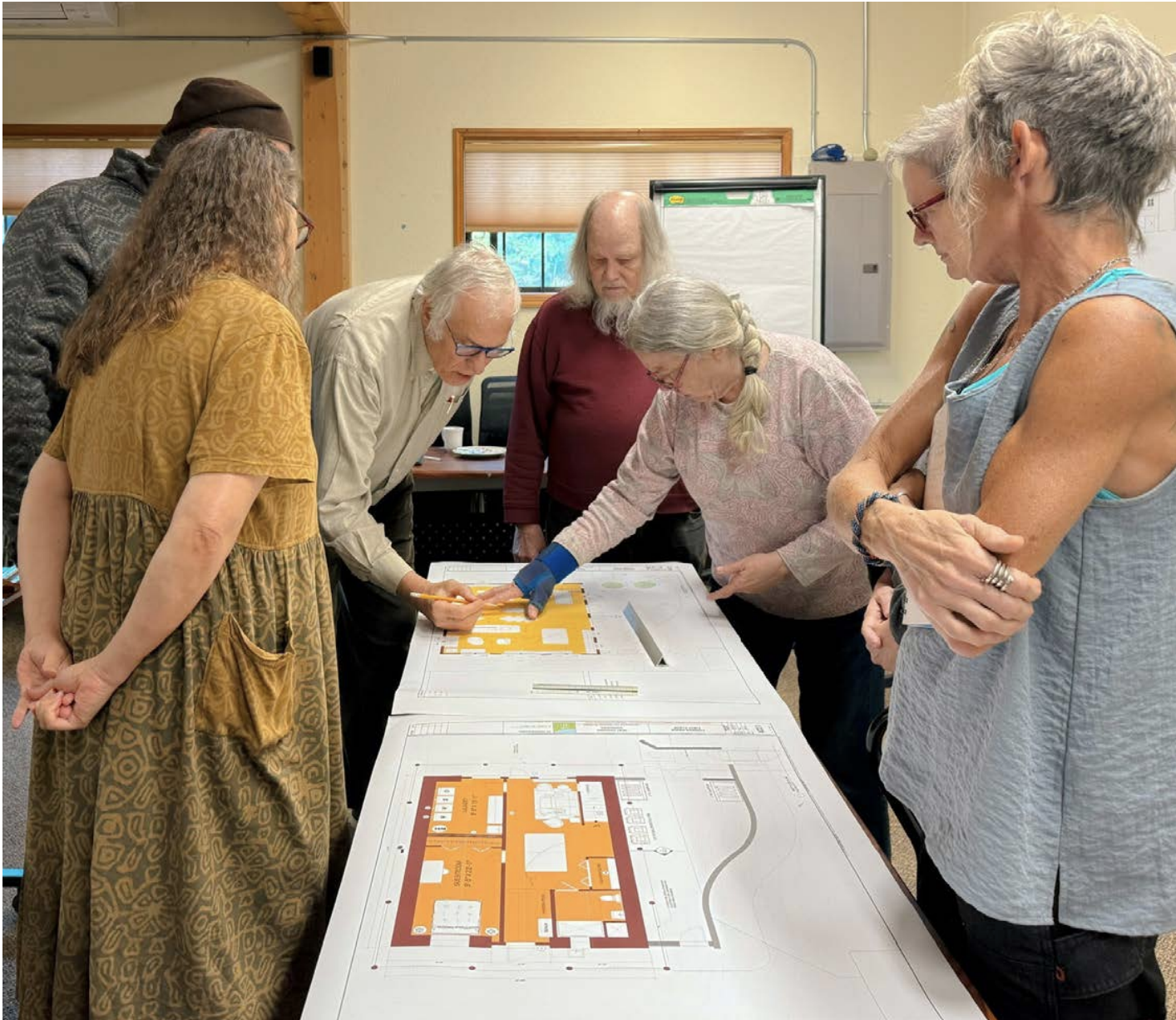
“The current homeowners created the designs with economies of scale in mind,” Shephard said. “We started a design process by looking at a village concept – how much will we do together?” Holm said.
The design process for the cohousing site plan was led by Charles Durrette, who founded the Cohousing Company. Durrette coined the term cohousing, based on the Danish term, bofællesskaber, which translates to “living communities”. Durrette and his team built the first cohousing community in the United States, in Davis, California in 1985, and have designed 55 other cohousing communities.
Durrette and his team led the homeowner group through a number of workshops that enabled them to integrate Durrette’s team’s extensive experience with the homeowners’ visions.
The primary feature and focal point in most cohousing communities is a common house, and Newt Crossing is no exception. An important element of its common house is that it will have a private bedroom and bathroom for overnight guests of any of the homeowners. This enables residents to accommodate their guests without having to build an extra bedroom. The common house and “all common facilities are perceived as an extension of each household’s private house,” according to Newt Crossings’ website.
The 2500 square foot common house will have a common laundry and barbecue, and a large open room for all sorts of activities, such as yoga, arts and crafts, and dancing. The room's lights may be raised or lowered, depending on the needs of the activities.
Holm and Shephard say that their preliminary cost estimates put the price of each home on par with current market prices for similar homes in Jefferson County. However, they point out myriad ways in which residents can take advantage of sharing and economies of scale to make actual living less expensive than for most homeowners.
”We’re designing in permanent affordability,” Shephard said.
Holm and Shephard say that there are many versions of sharing that make cohousing enriching and cost-effective. Car expenses are likely to be substantially reduced as carpooling, shopping runs, and car sharing will be common. Like to garden, build or repair stuff or just tinker? You’ll share the cost of those tools, equipment, and supplies with others. Wi-Fi costs will also be shared, according to Shepherd. And in a region where it can be difficult to find a skilled tradesperson or repair person when you need it, and at an affordable price, the possibilities rise substantially in a cohousing community. Want to learn or teach a new skill? The opportunities are likely to be more abundant and more accessible.
Homeowners will choose from designs for three different-sized homes: one bedroom - 630 square feet; two bedroom - 813 square feet; or three bedroom - 1200 square feet. Each home also has a small private front and back yard.
The ownership model will follow most cohousing and go with a condominium legal structure. Each household owns its own house and has equal shares in the co-owned land, gardens, common house, etc.
Building and maintaining harmonious community
Holm and Shepard are aware that cohousing arrangements can bring not only meaningful relationships, economic security, shared values, and a sense of purpose, but that other group dynamics emerge that adversely affect relationships, trust, feelings, and potentially the overall health and well-being of the community. With that in mind, Newt Crossing will adopt a principle of sociocracy, according to Holm and Shephard, which is the theory of governance that seeks to create psychologically safe environments and productive organizations, according to Wikipedia.
“How do you disagree so that it doesn’t break a relationship?” Holm said. Newt Crossing will use collaborative governance structures, giving residents a meaningful voice in decisions, Shephard said.
Holm, Shephard and the entire Newt Crossing community are passionate and intentional about building and maintaining life quality elements that are in our society, even as the needs for these are rising. Democratic decision-making, consistent social connections, environmental sustainability, resilience in crisis, economic resilience, and fun are elements that Newt Crossing hopes to build and maintain over the years.
The group hopes to break ground on the common house by fall 2025 and begin building the homes around May 2026, when the county completes its comprehensive plan, which strongly favors affordable and environmentally sustainable housing.
To learn more about Newt Crossing, or request information or a tour, go to: https://www.newtcrossing.org