
Chlorophyll Corner: A Moment for Grief with Hawthorn
Chlorophyll Corner is a monthly column exploring the cultural, ecological, and medicinal relationships between people and plants. Grounded in ethnobotany and the One Health model, it examines how traditional plant knowledge supports our access to land-based healing across diverse communities.
In Cascadia, winter has always been a season of rest painted with frost‑covered mornings, long nights, quiet soil and sleeping landscapes. But this year, Cascadia feels unsettled. Spring bulbs already pushing their way through the ground and green buds appear on branches meant to be bare.
The earth seems confused, and I feel this confusion in my body. In this liminal state, I find myself turning toward Hawthorn (Crataegus spp.) the plant associated with grief, protection and the tender work of staying soft in a world that can feel unbearably sharp.
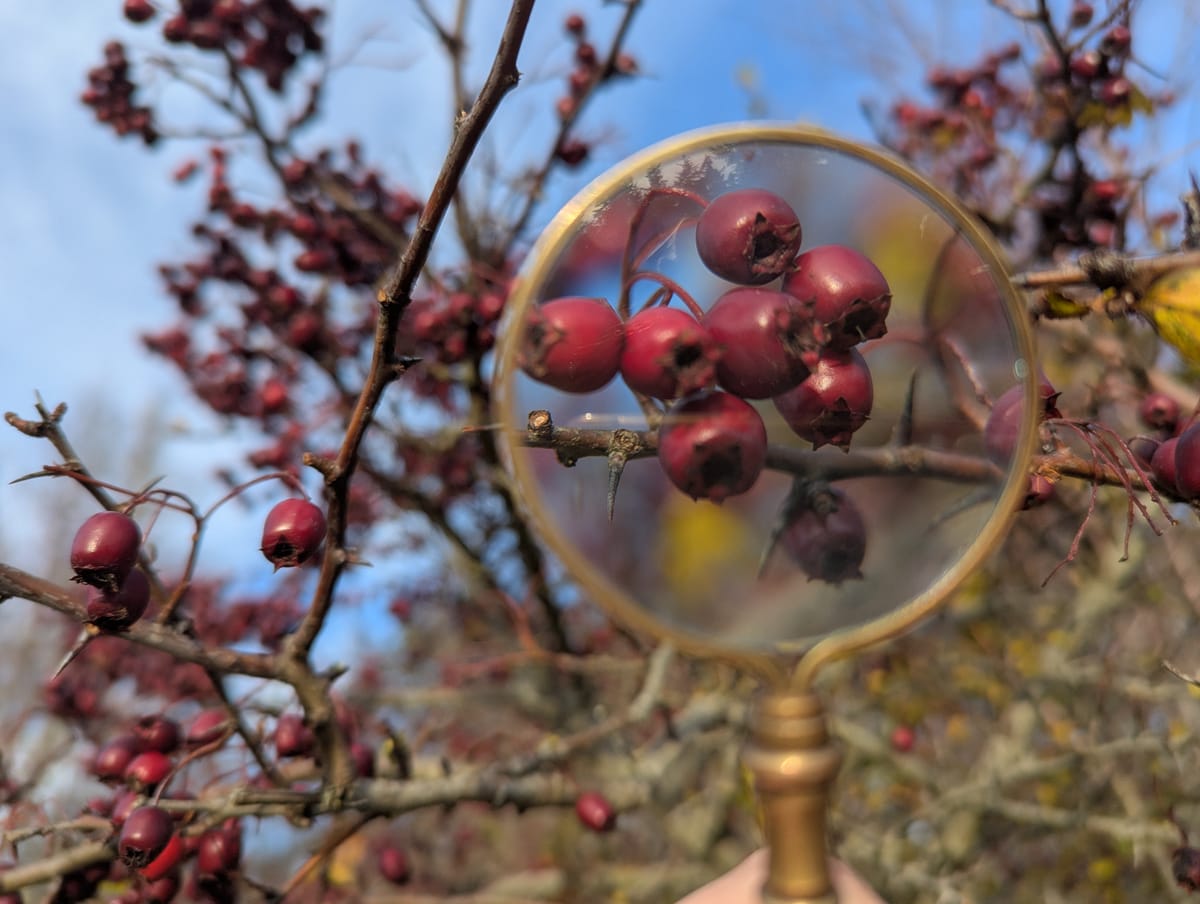
There are two kinds of Hawthorn who grow in Cascadia: the native black Hawthorn and the more common red Hawthorn. Hawthorn species are easy to recognize because of their signature small, saw‑toothed leaves. Their zig‑zagging twigs are lined with long, slender thorns and a many‑branched crown that can be rounded or flat‑topped. In late spring, the trees burst into bloom with gorgeous white blossoms, which fade into a rich pink hue nearer to the end of their lifetime.
Red Hawthorn was brought here from Europe and planted as a living barrier on farmland because of their formidable thorns.
The black Hawthorn, although native, is slow-growing. Due to its infrequency compared to red, black Hawthorns' nutrients are best left for the birds and other local wildlife who rely on native species.
Abundant red Hawthorn provides berries, blossoms, and leaves that have supported human hearts, emotionally and physically, for centuries. Across Europe, Asia, North Africa, and North America, Hawthorn has long been a companion species, growing in temperate regions and thriving in the liminal spaces where ecosystems meet.
Hawthorn grows along forest edges, a transitional zone where sunlight increases, plant diversity expands, and wildlife finds refuge. Forest edges are places of merging—neither fully open nor fully enclosed. These edges remind me of the emotional thresholds we inhabit as humans: grief lives here and so does healing.
The berries, often described as tasting like a starchy, rose‑flavored potato, lend themselves beautifully to recipes like Hawthorn ketchup or BBQ sauce. Their connection to the rose family is more than culinary as rose relatives often support the cardiovascular system, and Hawthorn is no exception. Modern research has explored Hawthorn’s potential to support healthy cholesterol levels, blood sugar regulation, and even anxiety. This current research supports centuries of traditions as many cultures around the world associate this plant with the heart.
Hawthorn’s thorns teach a similar lesson. They are sharp, protective, and unapologetic, yet the tree itself produces delicate blossoms and nutrient‑rich berries. It is a plant that embodies the paradox of being strong without hardening, guarded without closing off. When I sit with Hawthorn, I’m reminded that boundaries are not barriers to love, they are the structures that allow love to bloom safely.
Beyond its physical medicine, Hawthorn offers emotional and cultural medicine. Ethnobotany teaches us that plants are not just biological organisms; they are woven into our stories, our grief rituals, our ways of making meaning. Hawthorn has been used in protective charms, boundary‑setting rituals, and ceremonies honoring the dead. Its presence at the forest edge mirrors its role in our emotional landscapes: a guardian of thresholds, a witness to transformation.
The weight of the world has felt unbearable lately. Many of us are carrying grief that is both personal and collective—grief for lost childhoods, for violence that goes unpunished, for kidnapped neighbors and loved ones, for ecosystems out of balance, for communities navigating harm. Our grief is real, and it sits deep in the body. Yet, when I look at Hawthorn blooming early, insisting on softness even when the season is wrong, I feel a quiet resolution in me. I, too, can choose to bloom love into a world that feels fractured.
Hawthorn teaches that grief is not a sign of weakness but a sign of connection. It reminds us that healing is not linear, that protection and tenderness can coexist, and that the edges, those messy transitional spaces, are often where life is most resilient. In this moment of seasonal confusion, cultural transitions, and emotional upheaval, Hawthorn stands as an ally inviting us to breathe, to soften, and to remember that even in winter something in us is preparing to bloom.