Chlorophyll Corner: Salmonberry, Ecologies of Interconnectedness

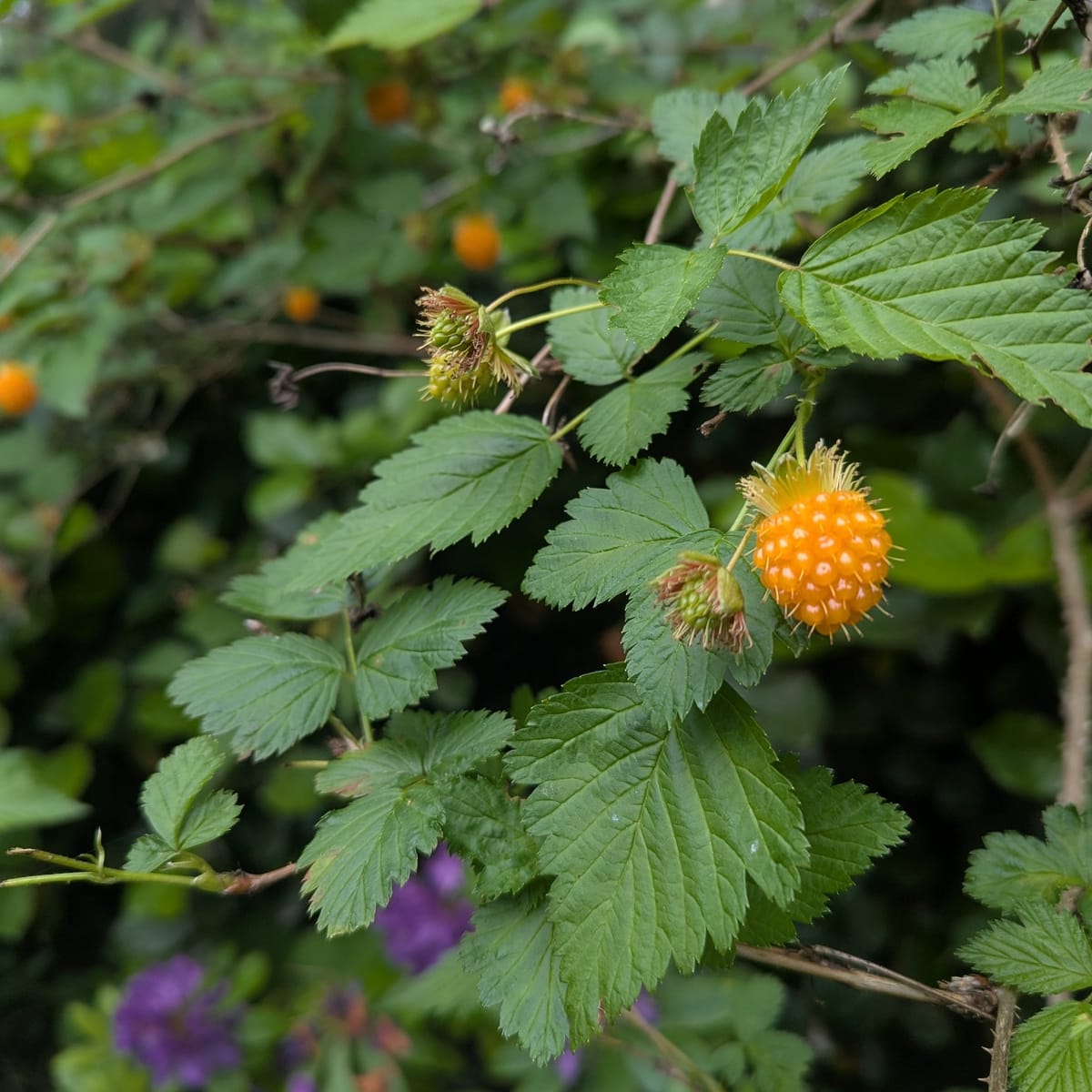
[caption id align="alignnone" width="3072"]
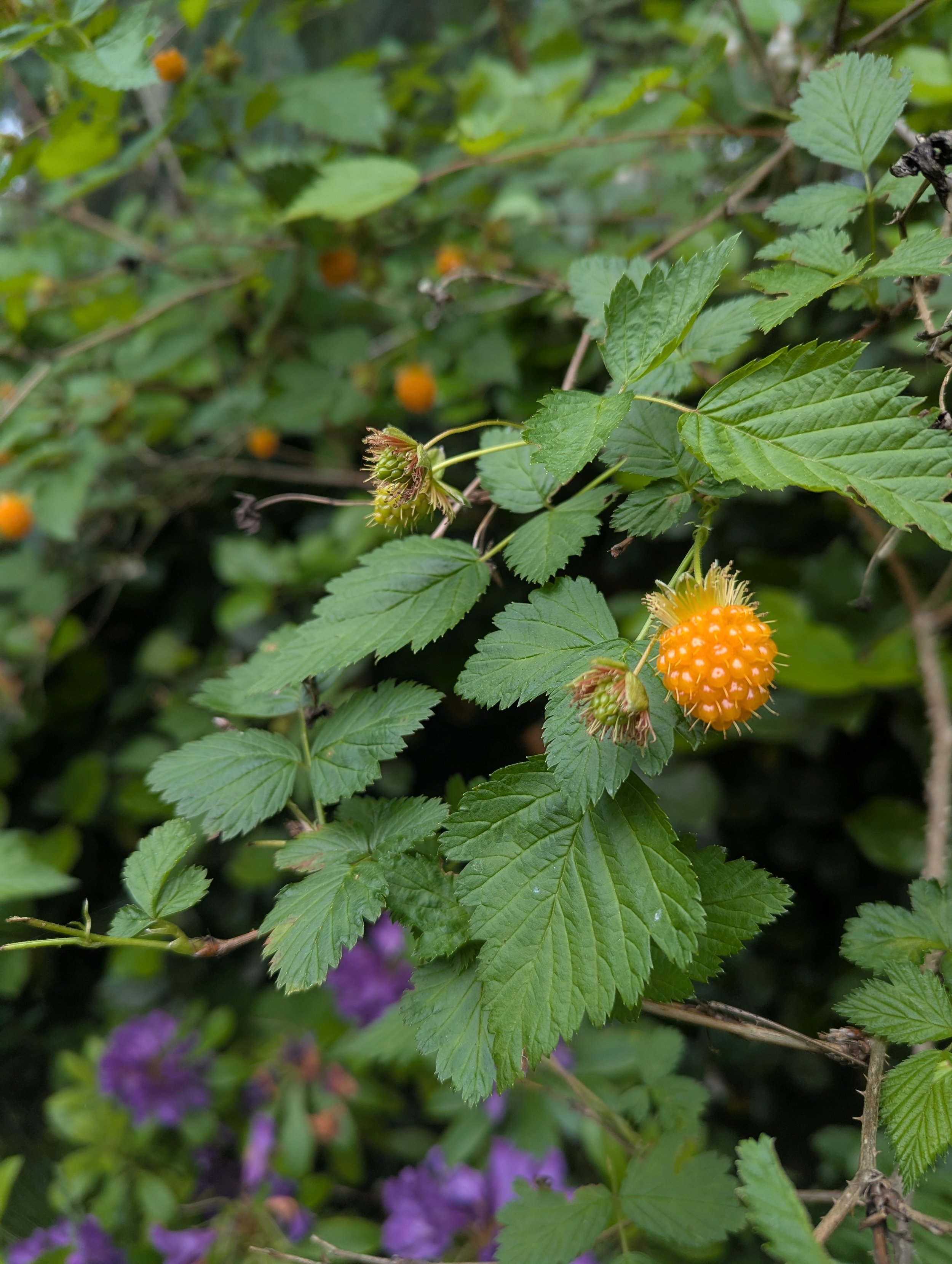
Photo by Eden Blooms [/caption]
A monthly ethnobotany column by Eden Blooms
This time of year, I’m enchanted by the song of the Swainson’s Thrush swirling through the air. These small but mighty birds are long-distance migrants, traveling from central South America to as far north as Alaska. Spring in Cascadia wouldn’t feel complete without their ethereal melodies. When I hear their song, I know berry season has arrived—as if their notes coax the salmonberries into ripeness.
Salmonberries, Riubus spectabilis, are among the first fruits of the season, growing in dense thickets along streams and wet forest edges. Their zigzagging stems, scattered with prickles, indicate they belong to the rose family. The leaves are made up of three sharply toothed leaflets, and when the top one is folded back, a butterfly shape is revealed- a helpful tool for identification before the berries and fruit have arrived.
Bright pinkish-purple flowers bloom, attracting hummingbirds, bees, and butterflies. These pollinators help the flowers transform into golden berries that deepen through orange to a rich red. At their ripest, salmonberries balance tartness with a subtle sweet flavor. If you forage, try tasting the different colored berries to appreciate their evolving flavors through maturation.
Harvesting salmonberries is a way to connect with the land of Cascadia. As we gather berries, it’s important to remember they are a vital food source for many forest creatures—bears, birds, deer, and more. While we have grocery stores, the forest is their only food pantry, so it’s important to harvest with gratitude and restraint, taking just enough to nourish our connection to nature while leaving plenty for the wild.
The berries in our grocery store, while delicious, come with a taste of sadness this year, inviting us to reflect on the migrants who sang these berries songs to ripen. Many of the migrant workers who harvest our food—following similar migration paths much like the Swainson’s Thrush—are missing this year.
Washington’s 35,000 farms and 300 crops depend on these workers from early spring through late fall. The labor of migrant workers sustains the American food systems, yet their presence in our communities is becoming increasingly vulnerable. Migrant workers, here legally on temporary work visas, are being detained and held in overcrowded ICE detention centers across the country. Their absence is felt not only in the fields that fill our grocery stores but in our communities as well.
These workers, often descendants of the original peoples of the Americas, once moved freely with food and cultural cycles. Their stories echo those of the Indigenous peoples of Cascadia. The indigenous people of Cascadia, the Coast Salish bands and tribes, have a deep cultural connection to Salmonberries.
In Coast Salish tradition, an abundance of salmonberries foretells a strong salmon run- both of which depend on healthy, flowing waters. When the salmon return to spawn, their bodies nourish the soil, feeding the very shrubs that share their name - a cycle of reciprocity and renewal.
Salmonberries remind us of the interconnectedness of ecologies between the people, plants, animals, and the land that make up our environment. By acknowledging the interconnectedness of human rights, environmental justice, and Indigenous Sovereignty, we can pave a path away from the oppression of all living beings and build a future rooted in respect for life.
We are the land, and the land is us. We honor cultural traditions, ecological rhythms, and the people—seen and unseen—who make nourishment possible.
To learn more about the deep connection between salmonberries and the Coast Salish people, read Indigenous author Cúagilákv (Jess Housty)’s article: Thriving Together: Salmon, Berries, and People at https://hakaimagazine.com/features/thriving-together-salmon-berries-and-people/