Citizen Screen: Filmmaker Zach Carver on His PTFF Residency
[caption id align="alignnone" width="1015"]
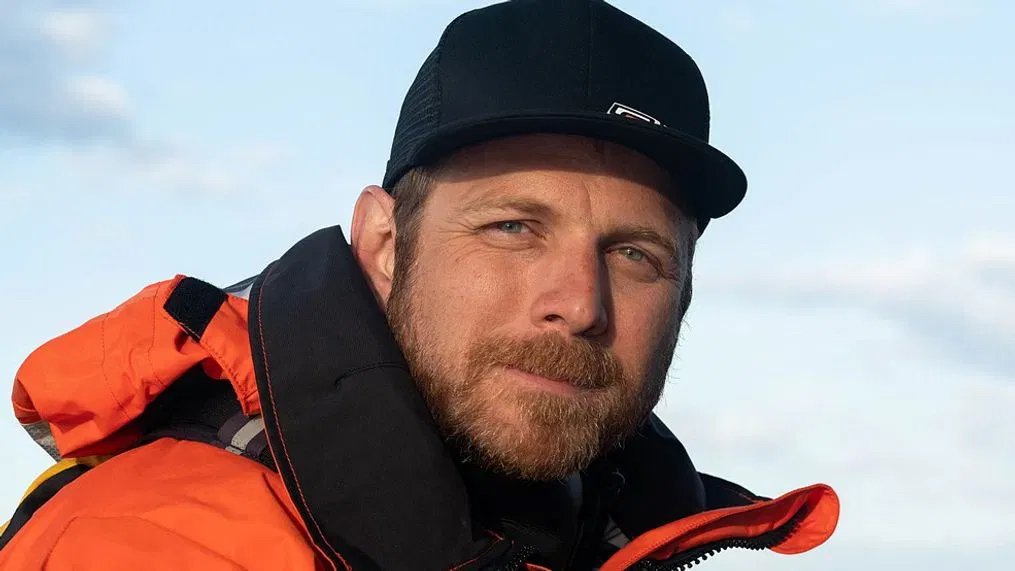
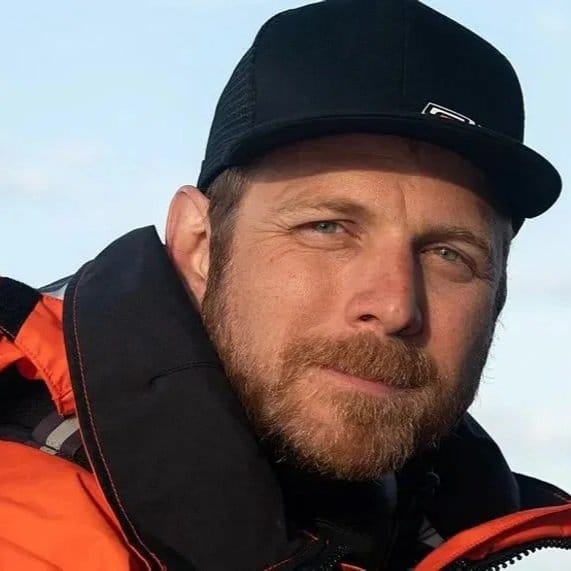
Zach Carver in his role as R2AK media boss. [/caption]
An Interview with Zach Carver
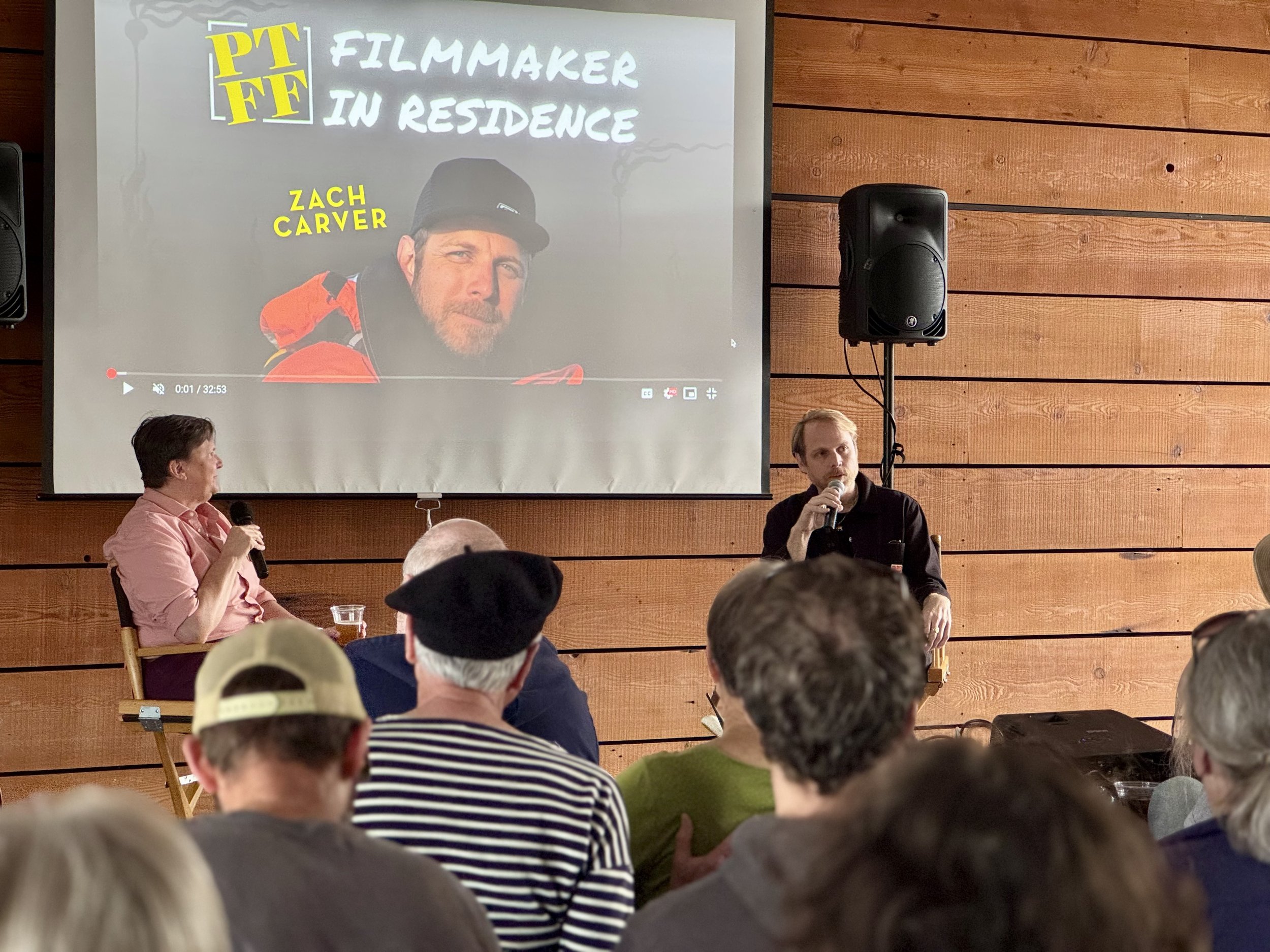
Zach Carver was the writer/director behind the 2020 PTFF Audience Award-winning film Race to Alaska. In May of 2025 he participated in the PTFF Alumni Residency program, where he developed his historical screenplay Winter Harbor. The residency program provides PTFF alumni filmmakers with workspace, accommodation, and community access to develop their projects in Port Townsend, Washington. Keith Hitchcock is Marketing & Development Director at PTFF.
Keith Hitchcock: You're a PTFF alum and you have some other films under your belt. Tell us a little bit about that.
Zach Carver: I screened my short film Sin Matador at PTFF quite a while ago. It's about a couple who get embroiled in an illegal underground bullfight in their basement in Manhattan—it's a fun comedy. More recently and notably was Race to Alaska, which is the feature film version of the eponymous boat race in the Pacific Northwest that starts here in Port Townsend.
Keith: Where are you based?
Zach: I live in Los Angeles, but I grew up in Seattle. I've been sailing all over the Northwest. I taught sailing at the Center for Wooden Boats in Seattle and ran their livery fleet, which is how I met Jake Beattie and the Race to Alaska people.
Keith: What was your intention when you applied for the residency at PTFF?
Zach: I've been working on a story titled Winter Harbor—although I'm hoping we have a better title. It takes place on a remote section of the BC coast, or the Northwest coast, 125 years ago. I really wanted to work on it in Port Townsend. Part of what pushed me further in wanting to write this story was rooting around in the Northwest Maritime Center Library and seeing some images of a logging ship tied up in a really steep cliff way up north. It had four anchors out and this jury-rigged cable system to bring logs—it just looked precarious and like a great set for an action scene. Seeing the kind of ingenuity and how people were all over this coastline made me want to write it there.
I'd started working on it before at a residency in Norway called Starlight and Storm. Then I saw the [PTFF] alumni residency pop up and thought it would be so cool to apply. It would give me space to work and some motivation to push forward on it.
Keith: What did a day in the life of your residency at PTFF look like?
Zach: I tried to make it pretty rhythmic—get up, do my morning routine, and come in and write at least in the first half of the day for two or three hours. Then I'd try to do something outdoorsy in Port Townsend or visit friends there. I have a lot of friends in the area from Race to Alaska days. If it was going well or I felt energized, I'd come back in the afternoon and write a little bit more. I kept a pretty standard weekdays work schedule.
It's usually good for me to have a writing session and then a non-distracted activity, like just going for a hike or a run or walk on the beach. It's a really nice complement and allows your subconscious to work on the stuff you've been working on more consciously when you're writing.
Keith: How did this residency compare to the one in Norway?
Zach: This was a solo residency and it was longer. Norway was like a group experience for 10 days, which was really good because I was in very early stages of that project then, so it was super generative. We'd do a group activity in the morning, work in the afternoon, and then reconvene in the evening. That was really good for kicking ideas around.
This was much more like you guys gave me a place to work, a place to stay, access to the community, and access to the outdoors. It was much less structured, much more just time for me and my process to work. In some ways that was great because it's just time to focus. In other ways, it was challenging for me because I'm very social—I like people, I like talking and interacting. It had ups and downs, but it was pretty cool.
Keith: Looking back on it, what's your assessment of how it was for you overall?
Zach: It definitely pushed the project forward in a really important way. I didn't write as many pages as I'd hoped, but I also understand the story far more deeply. I understand the characters better, I understand the "why" of it, and I think I've got a pretty tight structure now. The more I've made movies, the more I understand that structure is so vital. You have to explore and be generative and tap into whatever the ether is that allows creativity to happen, but the dramatic structure is so vital, and how the characters drive that structure. I think I'm starting to crack it pretty well.
I had the note cards arranged all over the big conference table you guys have and spent time moving everything around. I feel like I kind of got it. I also had time to experience the discomfort of being alone, which was ultimately very valuable for writing, especially because the story's whole first act is about somebody being utterly alone in the wilderness. The shadow side of that is I experienced the discomfort of that, which was pretty hard to face—much more so than I thought it would be. But getting to the other side of that felt really valuable.
Keith: What surprised you most about your time during the residency?
Zach: I used to be a fits-and-starts working person. I would crank on a deadline and then do nothing for a while. When I had something like this, I'd earmark this time away and it would be like a backlog that I would pour out in these concentrated time periods. I'm older and my brain works differently now. I was quite surprised that I had a very good rhythmic schedule—writing two, three hours a day was awesome, but the big push didn't make sense to me anymore. It was diminishing returns. That really surprised me just about process.
As far as being in Port Townsend, people drive so slow! The speed limit's 20 and people are struggling to get there. No shade—it was fine, but it was genuinely surprising. Once you get into it, it's really kind of nice, but it's a bit of a contrast to LA where I'm three blocks from the 101 and people think 85 is slow.
Keith: What other takeaways did you have from the residency?
Zach: One thing that was really interesting that I hadn't really considered was the ability to make movies on the Peninsula. I had a really good talk with Danni [Executive Director, PTFF] about some of the stuff you guys are doing to cultivate film crew talent and the new tax incentives in Washington that hit rural areas or have additive incentives to rural areas. That was an unexpected thing to start considering for this project or another one—how we could work on the Peninsula. I just met a young filmmaker who's got a story that takes place out at Shi Shi Beach area, and I'm like, "Oh, I think we can maybe make this happen and maybe based out of Port Townsend."
I also took away that every time I get cynical, I somehow forget that the creative process works. Every time I get the opportunity to do something like this residency, it becomes evidence to the contrary—it 100% works as long as you show up for it. It's like a thing you know but have to keep being reminded of. It was great after a few days to be like, "Oh, it's working again!" This is real, but it doesn't work until you show up to it and open yourself to it.
I think I started struggling with trying to achieve a certain thing. One of the nice things about the length of time was I could shift from a goal-oriented process to a process-oriented process. At first I was disappointed by the output, but as I came back and started talking to my producing partner about it, he was like, "This sounds great—you know so much more about the story." It clearly was valuable. It was nice to trust the process again.
Keith: At the very tail end of your residency, there was a public sharing of your work. How did that affect how you thought about your current project or your work as a whole?
Zach: I think this is the first time I've been encouraged to think of my work as a body of work. I've been doing this for a long time, but I also still feel like I'm kind of a fresh-faced filmmaker in certain ways. It was nice to consider it as a progression and as a body, and see and recognize these themes coming out. The task of presenting it created the reflection I hadn't done. That was kind of cool, and it's kind of cool to see people enjoy seeing that progression and understand that I'm on some path, or my subconscious that's writing this is on some path.
For me, a public presentation is a great way to crystallize an idea because I'm very comfortable giving a presentation if I understand what I'm talking about, and very uncomfortable if I don't. That made the last few days feel really important to fully understand the story and what I was going to be telling and talking about. The task of doing that verbally was really helpful for the bigger story.
Keith: Port Townsend is a creative, artistic town with all sorts of artistic organizations, some of whom host residencies either formally or informally. What would you say as a recent participant—what is the value of taking a creative or artistic residency?
Zach: I think that a residency helps give a project a life in the world before it's done. That is really valuable as a creator, especially of a big project, because for me it's easy for it to just merge with all the other weird ideas in my head and it doesn't feel concrete. The residency helps you show up for that work. It was really helpful to be introduced to some community members—I went to dinner with some new people I'd never met. It just made it live outside of me, but far before it's ever going to be a movie. Even if we got funded tomorrow, people wouldn't see this movie for a year and a half or more. So it's really cool to just see it living there.
Anyone could take a month off and go write or something, but the residency creates a viable reason in your community's mind and your family's mind. If you're asking your spouse for time to go do something, it's like, "Oh, I have a residency with this film festival. They want me to write, I want to write." It just folds into your life a lot better.
It's also just valuable to be in that creative community. People in Port Townsend are interesting and interested. It was fun to show up in this way and have people kind of wanting to know more and grateful to have me there as part of that artistic milieu.
Keith: Your current project takes place 125 years ago. What are the particular challenges of doing a period piece?
Zach: Well, I don't really know yet—I've never done one. The challenges I see are accuracy. Even if it's a completely fictional story as this one is, you still have to deal with accurate technologies, systems, language, costumes of the time. One thing that's neat about this movie is it takes place in a very remote area, so the wilderness hasn't changed much since then. Whereas a huge challenge in shooting a historical story in LA or Seattle is that even if you have an old neighborhood, you've got phone wires, buildings in the background, airplanes—it's really hard to sell that history.
Maybe one of the things I worked on the most in this residency was why tell a historical story in 2025? I struggled and really wanted to hone in on the themes that made this movie relevant now. I want to make something that feels vital and exciting and that people connect to. I did start to understand what it's about—themes of a changing technology maybe leaving people behind. That's something that's going to emerge in this, even though it's a very different technology then. I think people are looking at AI and going, "Am I going to have a job?" I think people felt similarly with gasoline in different ways, so there are some things like that to play with.
It was nice being in Port Townsend, though, because I could look out your offices and I'm just looking at this Victorian building across the way. It wasn't hard to squint and imagine that no time had passed and that I was living in that era. That was really cool.
Keith: Is there anything kind of left out of your story of the residency and what has transpired for you?
Zach: I think a big part of it is that you have an idea and it's effectively an apparition—it's just something in your mind. You start to work on this idea, you make notes and you build it. But the resting state of a film is to not exist. A movie's natural state is to not be. It's very hard to make a movie—it takes years of effort, fundraising, work. So it's very easy to let the idea just be in its resting state. To want to breathe life into it takes more. It's really helpful to have an outside force besides my will to do so.
I thought it was great to have this coming up, to know what was happening, to get prepared in a certain way. And to again have that feedback loop, to just have—it's not accountability because no one was like, "Have you done this today?" – it's more like resonance. It's like I'm playing a note and it resonates back, and it reminds me there's a bigger community and an audience that is waiting for this. And that I'm part of something else. It makes it much easier to show up for that idea and do the lift to help it become a film, which is hard.
It was a really cool opportunity, and I hope we're coming back with the movie.
Port Townsend Film Festival’s Filmmaker in Residence Program is open to PTFF Alumni filmmakers (filmmakers who have had a film presented as part of the Port Townsend Film Festival or Women & Film). For more information, go to: https://ptfilm.org/filmmakers-in-residence