
Citizen Screen: Documenting the Enduring Legacy of Reefnet Fishing in the Lummi Nation


[caption id align="alignnone" width="1450"]

Stills from The Last Reefnetters [/caption]
Citizen Screen is a monthly column dedicated to film and film-related topics, sourced and curated by Port Townsend Film Festival. This month’s column is by filmmaker Samuel Wolfe. Samuel is a husband, father, tribal member, filmmaker, and business strategist.
“Can you start at the beginning?”
I prompt subjects with the same question at the start of every interview conducted during the production of The Last Reefnetters, Fishboat Media’s new 5-part documentary series premiering on Cascade PBS this March. prompt subjects with the same question at the start of every interview conducted during the production of The Last Reefnetters, Fishboat Media’s new 5-part documentary series premiering on Cascade PBS this March.
After I pose the question to Troy Olsen, Lummi Nation fisherman and traditional knowledge holder, he rises from his chair, removes his black baseball hat, and exchanges it for another sitting on a nearby coat stand. It resembles an upside-down basket, woven together with strips of cedar.
It is a QWENELYEN reefnet captain’s hat.
[caption id align="alignnone" width="1436"]

Suhunep Husmeen, Troy Olsen. Lummi Nation. [/caption]
Reefnet fishing is an innovative fishing method developed by the Lummi Nation and other Northern Straits Salish nations thousands of years ago. More than just a means of sustenance, it is intrinsically tied to their history, identity and spirituality.
During our conversation, Troy tells me that during the early colonization of the San Juan Archipelago, one explorer remarked in his journal that upon lowering their dinghy and traveling to the shoreline, they observed the Indians operating a “crude apparatus.”
Unbeknownst to the members of that expedition, that crude apparatus was a Coast Salish reefnet. However, its simple appearance belied a sophisticated level of technological craftsmanship. Reefnets were tailor-made to harvest Fraser River Sockeye Salmon, the world’s largest single river source of sockeye, which provided vast amounts of sustenance and wealth for Northern Straits Salish nations for millennia.
By the late 19th century, however, the secret was out. Sockeye Salmon rapidly became the fragile linchpin of an expanding settler economy, netting billions of (inflation-adjusted) dollars in revenue for a fiercely competitive canning industry still in its infancy.
Today, there are only 12 captains left with a reefnet fishing license in the world, and only one of them is an enrolled tribe member. Her name is Tah-Mahs Ellie Kinley.
[caption id align="alignnone" width="1440"]

Tah-Mahs Ellie Kinley, Lummi Nation. [/caption]
Kinley is one of many Lummi Nation collaborators we spoke with. Through their words, we learn about the many twists and turns of greed, corruption, and betrayal that poisoned the abundant waters of the Salish Sea, ultimately relegating the Lummi to a place of scarcity.
However, we also have a beautiful and optimistic story to tell. We collaborated with Rena Priest, Lummi Nation author and former Washington State Poet Laureate, to write a poem for a prologue sequence. Her words provide poetic exposition to a sacred history too vast and sprawling to convey through more traditional documentary storytelling tropes.
In a moment of serendipity, we became connected with Raven Borsey, a Lummi Nation anthropologist working to publish a never-before-seen Wayne Suttles thesis paper entitled Reefnetters of the Salish Sea. Suttles was the first anthropology PhD graduate at the University of Washington.
[caption id align="alignnone" width="1430"]
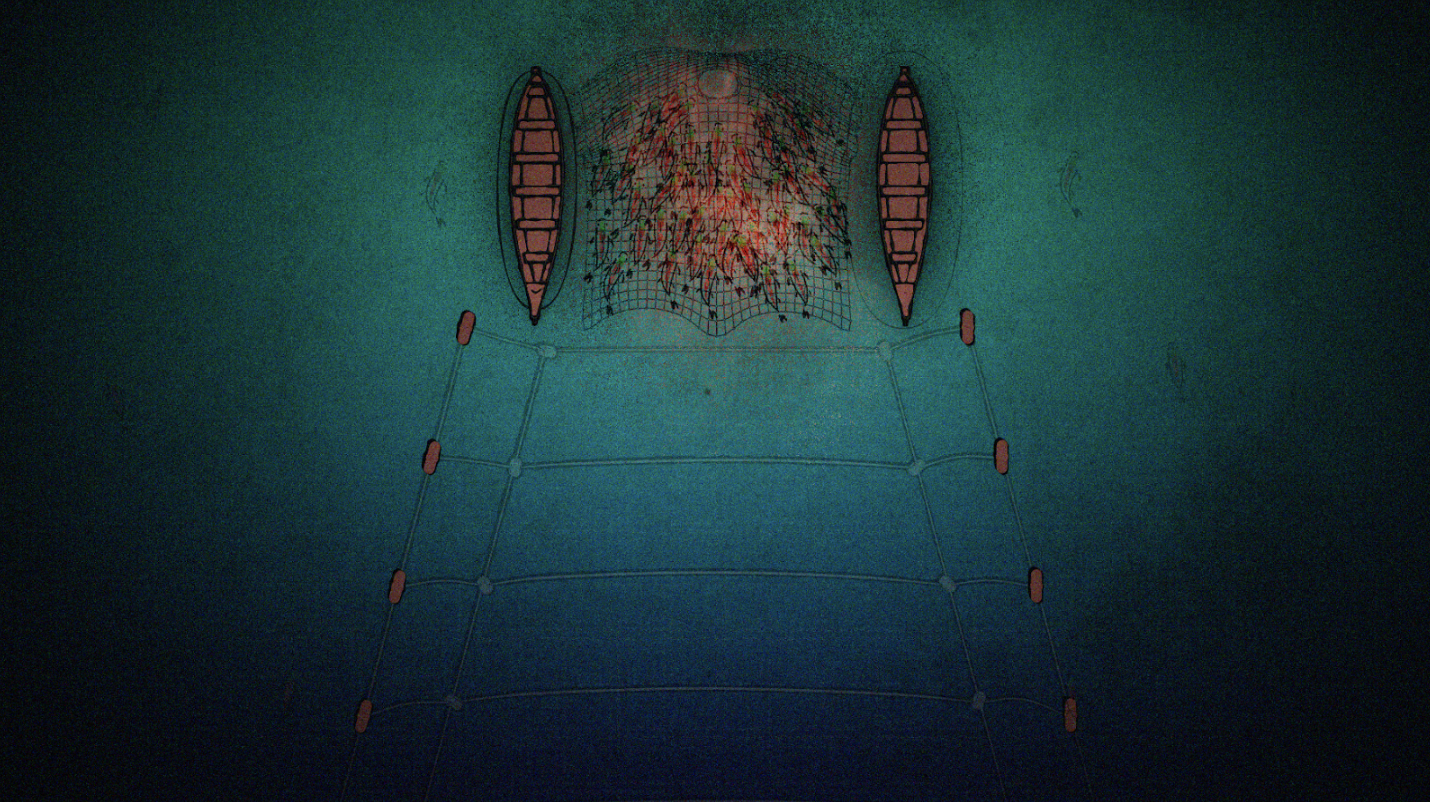
Animated depiction of a reefnet. [/caption]
Animation is another tool we used to bring this story to life. It provided a much-needed escape from the constraints of archival photography and academic diagrams, enabling us to depict reefnet fishing as more than just a technological marvel. According to Rena and other collaborators we spoke with, Lummi mythology holds the belief that the reefnet is like a womb, and the salmon within it represents the spark of life that carries their people into a new season. Although brief, an animated sequence that appears early in the series depicts that sentiment. It is one of my proudest moments as a filmmaker.
The Last Reefnetters premieres on Cascade PBS broadcast and streaming platforms on Friday March 21st at 8:50pm, with new episodes airing each consecutive Friday through April 18th.
Cascade PBS selected the Last Reefnetters as the winner of their 2024 Origins Project. The program was created to tell “stories that reflect the makeup of our region told from an insider’s perspective: stories grounded in ancestry, connection, culture, influence and rootedness. Stories that reflect our place, values and people.”
We look forward to exploring a variety of film and film-related topics in the months to come. Want to propose a topic? Send your thoughts to: info@ptfilm.org.