City Council Holding Hearings on 2026 Budget as Officials Seek More Citizen Input

[caption id align="alignnone" width="2500"]
City of Port Townsend seeks citizens willing to illuminate them on budget priorities. Photo by Jen Geo, Unsplash [/caption]
News by Scott France
The department and staff of the City of Port Townsend are finalizing the draft of their 2026 City budget and are now in the midst of a weeks-long public conversation phase, which City Manager John Mauro admits has generated underwhelming engagement.
“How do we make this real and tangible to people?” Mauro said. “Somehow, we’re missing the mark translating this to people. Not a lot of folks are getting engaged to have their say in the budget.”
Mauro and the Finance Department Director Jodi Adams have been making the rounds to service clubs and the Port Townsend Farmers Market to present an overview of the budget and its mechanics, and importantly, to hear citizens’ ideas and insights that will help inform the delivery and outcomes of city services.
“We’ve done all of the internal (staff) work, with some pieces to shuffle around a little bit.
Helping people understand when and how to have their say is important, and this is good timing because we will have tangible documents to share soon,” Mauro said
The process for developing the 2026 budget is approximately 70% complete as the City Council hearings begin. Adoption of the budget is scheduled for December, according to Adams.
The Philosophy of Budget Making
The city is charting a course to recover from many years of neglect and under-investment, while maintaining long-term financial sustainability, City officials say. “A theme we heard was to spread out our investments,” Mauro said. “How do we invest across the city? So rather than cost out one big project this year, we’re going to think about how to spread this around better. Our biggest move, financially and otherwise, is stabilizing our financial situation, making sure we’re in it for the long haul and prioritizing our basic core infrastructure over shiny initiatives.”
Mauro said that the primary categories of attention in the City Council’s long-term planning vision are housing, parks, streets and core services.
“Our duty as a public agency is to serve our constituents with stability and consistency over time,” he said.
Mauro pointed to the Council’s decision last year to raise wastewater rates by an amount that he admitted was a shock to some, but necessary to catch up from years of neglect and to position the City to better manage the long-term maintenance of the infrastructure.
Adams and Mauro addressed the oft-cited framing that the city's expenditures exceed its revenues. The officials countered that various sectors of the city budget have large rainy day funds that are shown as expenditures.
These reserves are vital for say, an unexpectedly sudden repair, such as the $50,000 to pay for replacing a pipe that broke earlier this year at the Mountain View pool — or for the inevitable replacement and repair of equipment and facilities. For example, $490,000 was set aside for replacing fleet vehicles in the 2026 budget, and $450,000 for facilities repairs.
New Projects
A few examples of large capital projects in the 2026 budget include the sewer outfall project, the Mill Road Lift Station, the many street and sidewalk projects, capital work related to the Olympic Gravity Water System (OGWS), a new playground at the Port Townsend Golf Park, and a water meter replacement campaign.
Many capital projects rely on grant funding. For example, the City September 29 and it had received a grant of $350,000 from the state of Washington Recreation and Conservation Office for a new playground at the Port Townsend Golf Park.
How it Will Affect Your Wallet
Other items of note to residents, according to the City, include:
- Utility fees will increase in January based on a rate study that was done by a consultant in 2024. The increase for residential properties will be just under 8%.
- Cities in Washington may increase total property taxes up to a limit of one percent per year. This formula is complex. Your tax bill could rise by more than one percent. Individual tax bills are based on a number of factors, including how much your property changes in value relative to other property in a taxing district, and whether voters approve tax increases beyond the levy limit.
- Planning and Community Development increases its permit fees in January each year, usually based on the consumer price index for the previous year.
- City sales tax remains the same as in 2025.
The City is not planning to ask voters for a levy lid lift or any other municipal funding mechanism in 2026, nor is it considering adding any additional general obligation debt.
Forecasting is Important - and Tricky
Because the city's sales tax is a major revenue source, Adam‘s office tries to identify potentially substantial fluctuations in that revenue. “Our revenue sources are strongly based on economic factors, so we maintain a long-term view on our finances,” Adams said.
For example, large construction projects like the just-completed hospital expansion or the planned 150-home Madrona Ridge housing Project produce large, but short-lived revenue streams from permits, sales taxes, system development fees, real estate excise taxes and business taxes. This presents a delicate balance for the city’s calculus in, for instance, hiring new staff or launching an expensive multi-year project.
An additional source of uncertainty is the larger, macroeconomic environment, and uncertain grant funding. “We have to be fiscally conservative, as we don’t know what the state and federal funding environment will be like,” Adams said.
City Councilor Ben Thomas pointed out that Washington’s highly regressive tax system “means that those with means and those without contribute similar totals and wildly dissimilar percentages of their incomes to the pot. Even local B&O and lodging taxes can be the straw that breaks that camel's back for small businesses.”
The tax system hamstrings cities from keeping up with inflation, largely by restricting them from raising property taxes more than one percent in any year.
The Association of Washington Cities, which represents 281 cities in the state, recently lobbied the state legislature to raise the property tax cap to 3%. Although it almost succeeded in passing the legislation, Governor Ferguson indicated that he had no interest in supporting it.
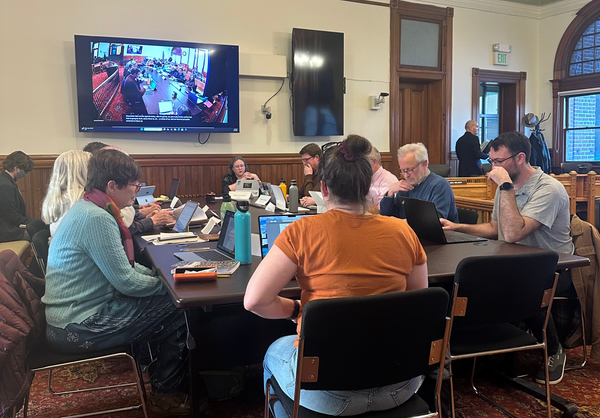
The City Council has begun hearing staff presentations on the budget, with the next one scheduled for October 20. Public hearings are expected to continue into November and potentially December.
The City is also actively engaging on the budget and other community interest items at the PT Farmers Market once a month (next on October 25), at Coffee with the City Manager events (next on November 7), and on KPTZ each Thursday from 12:30 to 1:00 p.m. Community members are also able to make written and oral public comment at each Council meeting, and can do so through this link: https://publiccomment.fillout.com/cityofpt.
This is the first of a two-part series on the 2026 City budget. Next week's edition by Angela Downs will look into more of the nuts and bolts of the budget.