City Trail System: A Uniquely Port Townsend Gem

[caption id align="alignnone" width="2268"]
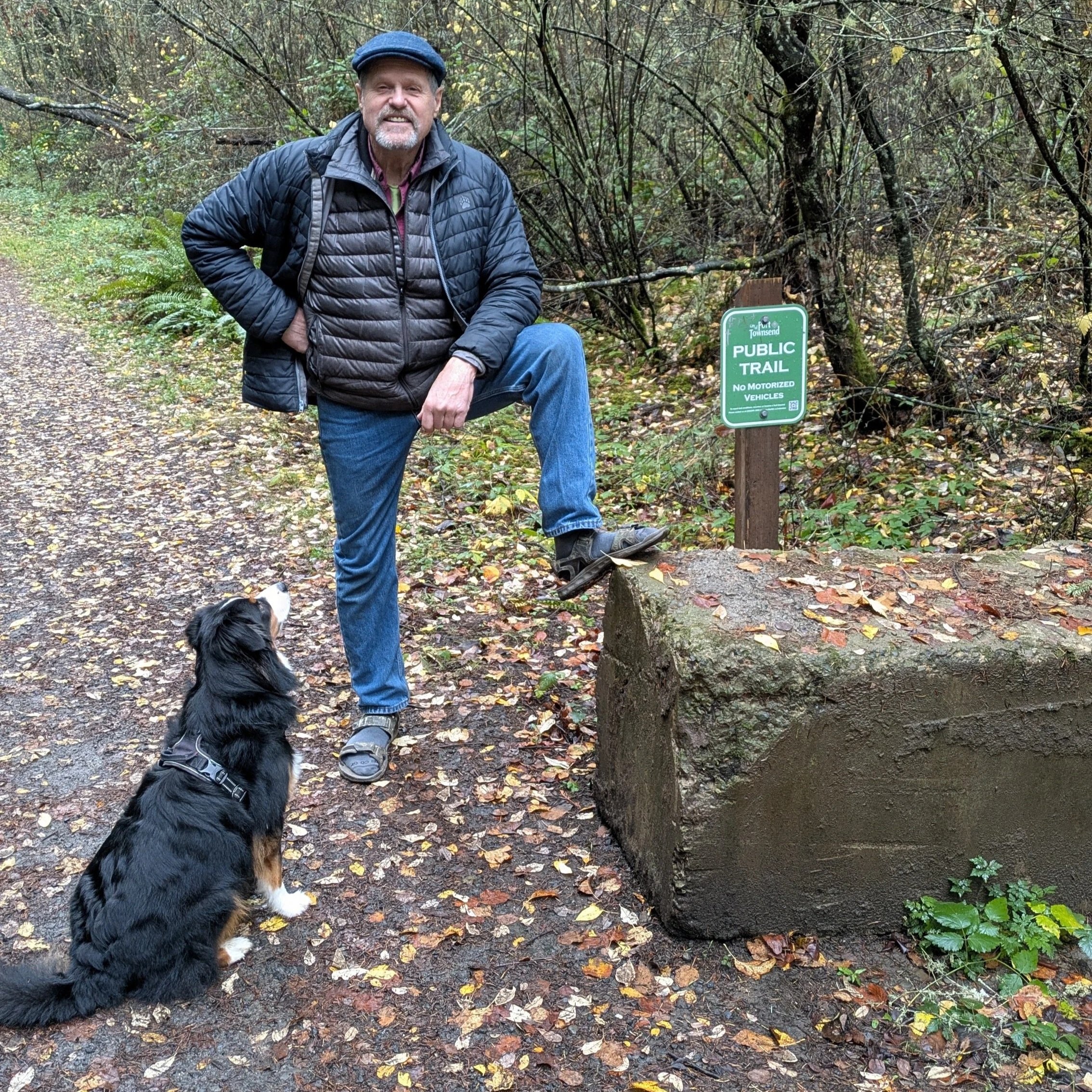
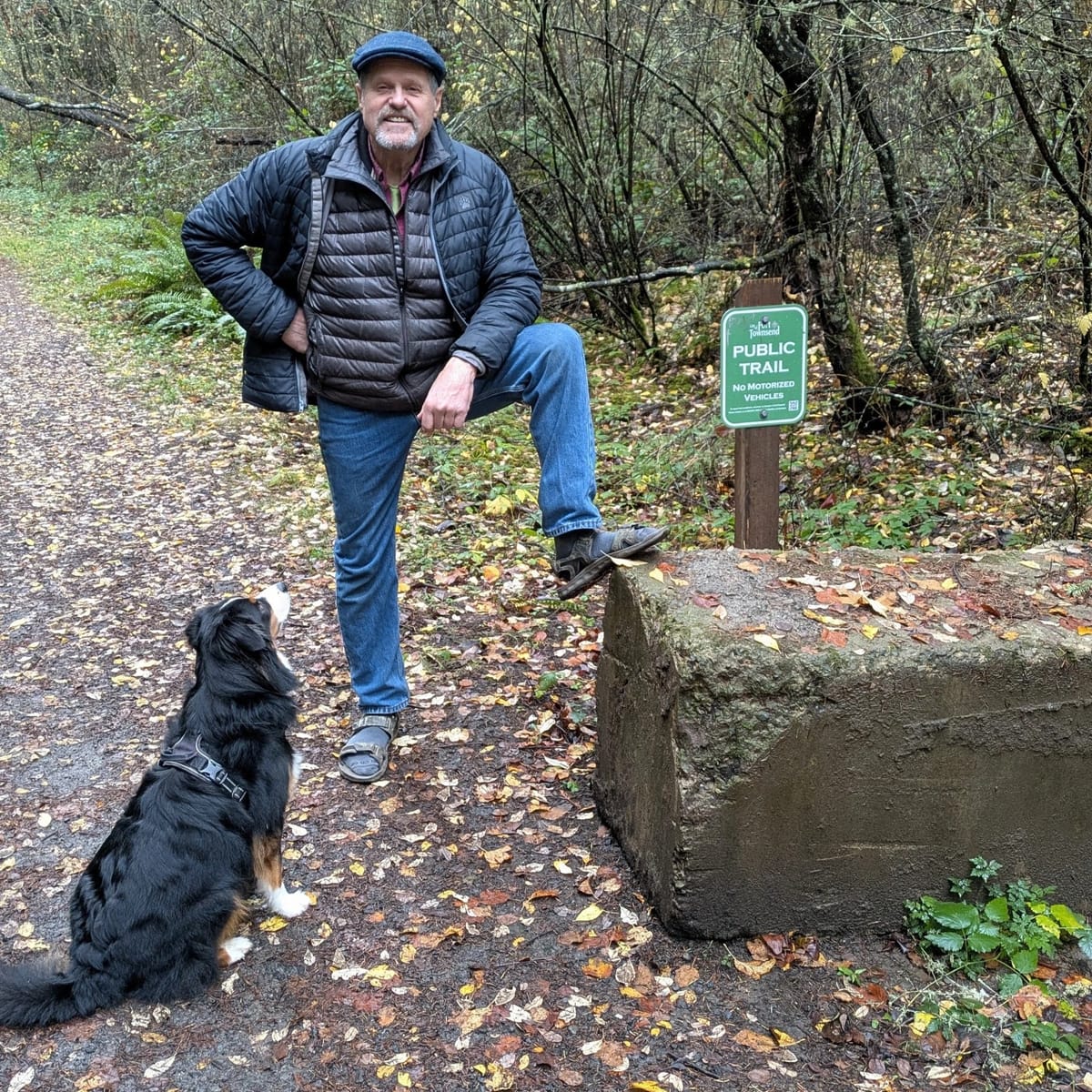
Scott Walker and Obsidian on one of the many trails of the system that Walker started almost 40 years ago. Photo by Scott France [/caption]
News by Scott France
The iconic Port Townsend city trails system was developed not through a City planning process or as a naturally occurring phenomenon, but through the synaptic spark in a man’s head.
“I had an epiphany that there were a huge number of miles of public right of ways in Port Townsend, and they could be something other than paved streets,” said Scott Walker, who, after years of planning, later brought his public trail idea to his role as a City councilor.
Walked says he had this realization around 1987, when some walkable sidewalks and paths existed in downtown and uptown, but almost nowhere else in the city. “Some of the streets, like F, had a ditch, so there was no place to walk except in the roadway,” Walker said. “So I thought, we could at least create a dirt path so people on the side of Morgan Hill could walk to uptown and downtown.”
Thus, a seed was planted, but it needed constant tending and many hands doing the sometimes grinding work. “I was crawling on my hands and knees through blackberry bushes, and throwing up my hand and yelling, am I in the right place?” Walker said, when building a trail from the end of Redwood Street along the golf course up to Walker Street.
Opposition to the proposal to build walking trails arose from many quarters. Walker recalls the head of the realtors association stating, “We don’t need more places to walk. If people want to walk, they can go to North Beach.”
Numerous homeowners expressed opposition to trails skirting their property, though all the trails were built on city rights-of-way. “One woman came out of her home crying because we were building a trail,” Walker said. “Forty years later, almost everybody, including the realtors, love it,” Walker said.
Walker knows of no other city trail system in the United States that rivals Port Townsend’s. “This is unique because we had plotted streets early on to accommodate a huge amount of expected growth that never came,” Walker said. “So the streets were already laid out with right-of-ways.”
Building Support, Then Building the Trails
The existing street layout spurred Walker and Dave McCulloch, who owned Elevated Ice Cream at the time, to form a Non-motorized Transportation Advisory Board to work with the City. Walker said that the Council was not supportive of the trails proposal when he brought it to them in 1988, though they have become enthusiastic proponents since.
In 1989, the City Council agreed to the formation of a Board to develop a non-motorized plan as support grew across the city. The school board supported it, and 23 people signed a petition to develop trails, sidewalks, and pathways along materials, so it would be safer for pedestrians and bicyclists, according to Becky Kimball, Scott’s partner. A city-wide survey found that the trails plan was the most popular of a number of project ideas
“Scott is tenacious. When he wants something, he does not give up,” Kimball said.
The bones of the system began to be hammered out one weekend by Walker and McCulloch, who at the time worked on bicycle policy at the state level. “Dave and I sat down and had a map where we drew out the trail system using existing social trails. Then we connected them with undeveloped rights-of-way, which was eventually codified into the development of the official non-motorized transportation advisory board, which then worked at developing the plan.”
After a few years, the City Council began allocating about $10,000 a year for gravel for the trail building and some staff time. The entire trail system is built by volunteers with some city staff support and very minimal cash support.
The Board adopted its transportation plan in 1989, saying that it “seeks to identify a network of pedestrian walkways and bikeways to connect neighborhoods with parks, schools, areas, and other destinations.”
The 33-mile trail system has been built by volunteers from the beginning to the present day. Prolific vegetation growth along almost every foot of the trails necessitates ongoing maintenance far beyond the City's financial or staff resource capacity.
“I don’t think the system would be possible without the amazing spirit of volunteerism,” said Melody Sky Weaver, the City’s Community Services Director. Weaver estimates that roughly 300 volunteers help maintain the trails.
Michael Todd, Facilities and Parks Manager, encourages trail volunteers to sign up with the Parks Department. “It’s important for us to track volunteers’ work,” Todd said. “It’s important for grants. The city can also provide rocks and loan out equipment. And people can adopt certain trails to maintain.”
The system includes Cappy’s Trails, which require the city to be more involved in maintenance due to the network’s distance from homes. “Two years ago, we hired the Washington Conservation Crew as well as Rainshadow Bird Alliance to clear trails there,” Todd said.
More Trails Planned and Restarting Work Parties
“We are constantly adding new trails, such as on Discovery Road between Salish Coast Elementary School and the Rainier Street roundabout,” Todd said. “There will also be new hiking and biking trails accessing the soon-to-be-developed Madrona Ridge housing complex. Any new development is guaranteed to have new trails,” Todd said. “The majority will have new hiking and biking trails. We have slowly invested in staff to begin some trail maintenance.”
After city staff unwind themselves from the demanding work of the comprehensive plan process in the next couple of months, it will seek to coordinate work parties, according to Walker, who said that in the meantime, anyone who is interested in work parties may email him at walkers@olympus.net
The years of planning, conversations, and trail-building have added a unique feature to Port Townsend’s landscape that provides recreation, connection, increased accessibility, and fosters a reduced carbon footprint by getting people out of their cars.
This quintessentially grassrootsy Port Townsend-style gem has been built by the people and for the people. The trail should continue to thrive and provide enjoyment for all, for as long as citizens are engaged in whatever way they can be.
“The trail parties are a fun way to spend two or three hours,” Walker said. And I encourage people out walking or bicycling to trim that blackberry bush that’s getting in the way!”
Corrections: an earlier version of this article claimed Walked had developed the trails plan while on City Council, incorrectly referred to Becci Kimball as his wife, and was unclear about the long term response from the city.