Community volunteers bring connection to hospice patients

[caption id align="alignnone" width="1280"]
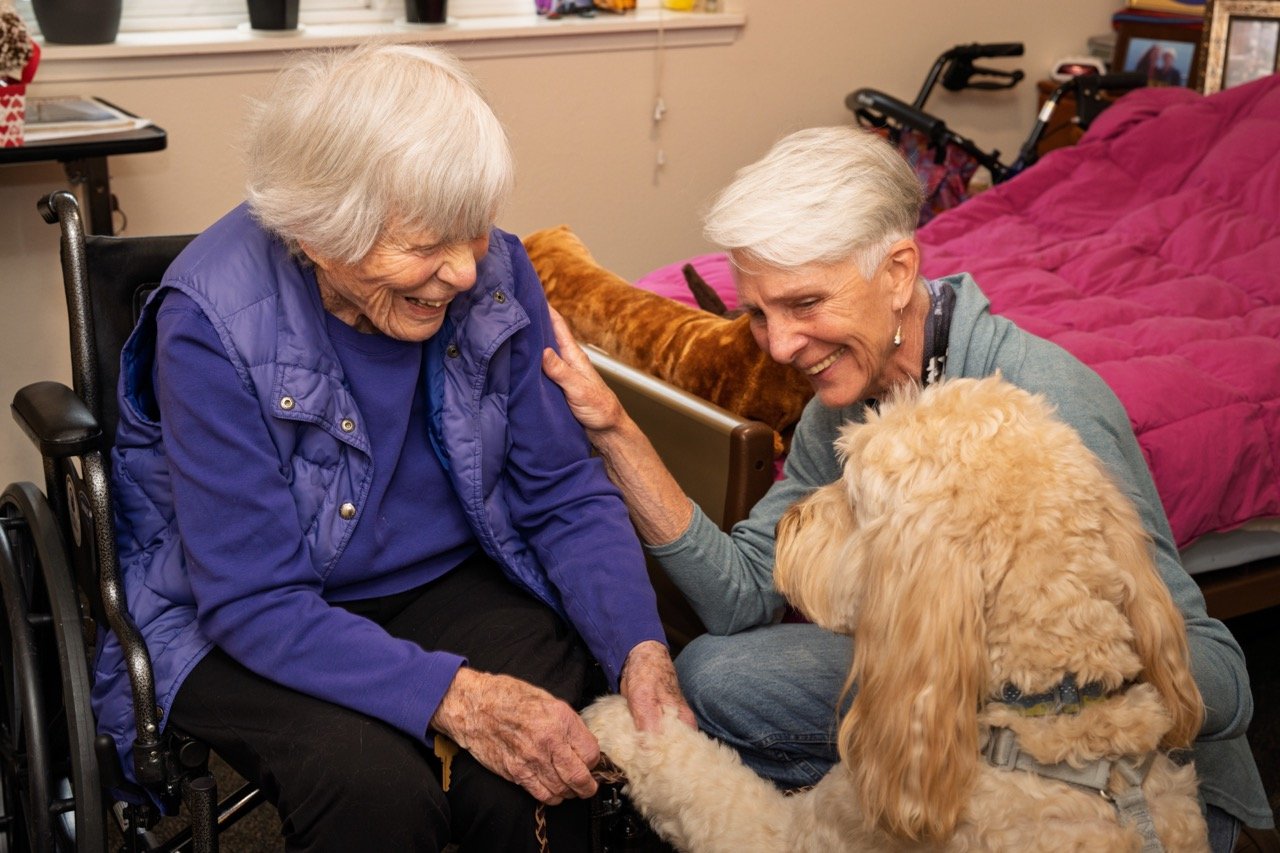
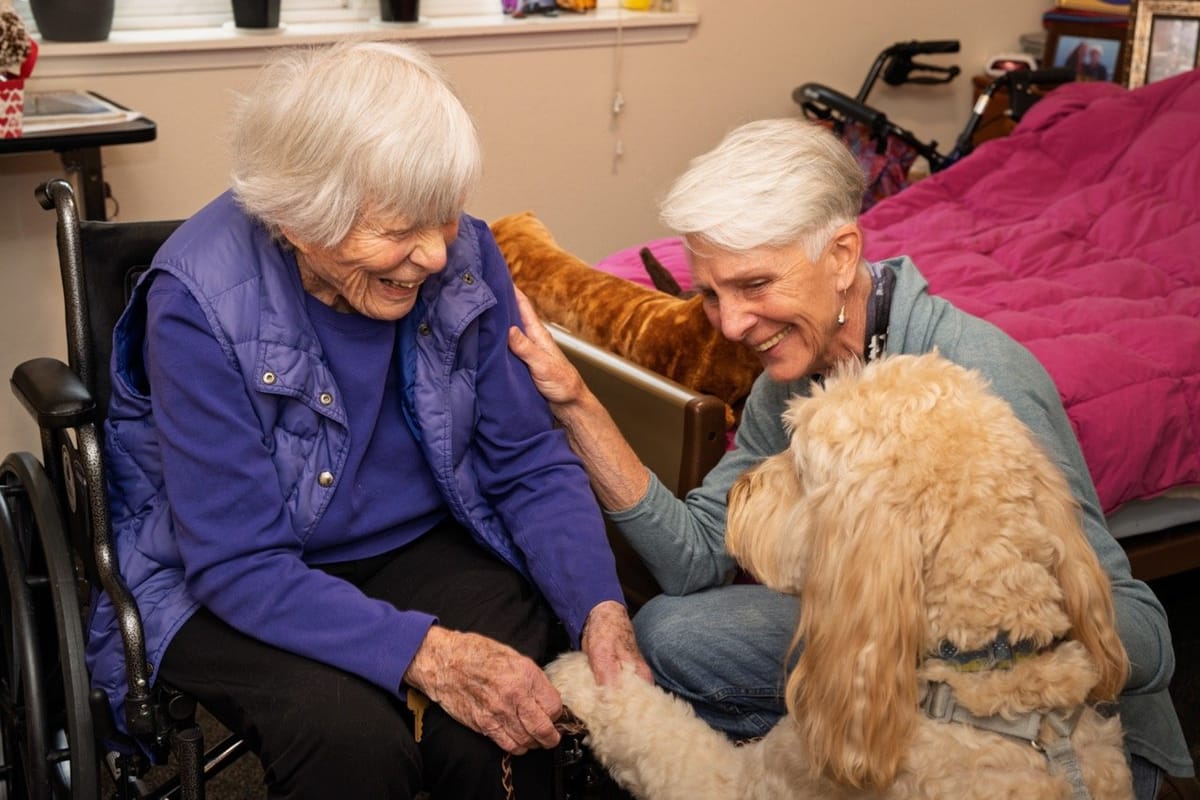
Goldendoodle Jake and owner Keri French enjoy spending time with patient Eva. Photo by Luc Schoonjans. [/caption]
News by Scott France
The word “amazing” is generally not used to describe most people’s experiences as they near the end of their lives. But that is precisely the expressed objective of Jefferson Healthcare Home Health & Hospice, says its manager, Jill Newsome.
Newsome’s career journey through nursing, women’s health and eventually hospice sparked an interest in the subject of death, and the experience of dying. “If I were on hospice, what would I need to be meaningful to me?” she says.
Since 1997, the Hospice program has provided services to hospice patients at their homes delivered by nurses, home health aides, certified nursing assistants, medical social workers, spiritual chaplains, and physical and occupational therapists. With these mostly medical conditions addressed, Newsome asked herself when she took over the program in 2022, “If I were in hospice, what would I need to be meaningful to me?” That set her on a path to pull together a stable of Volunteer Specialists to address patients’ emotional needs, as well as to assist with a wide variety of more mundane but important tasks and contributions for patients, their families and their caregivers.
These volunteer specialists bring their skills and experiences to hospice patients through a wide array of applications, including art play, sound healing, photographing patients and their families, guided meditation, Reiki, dog therapy, horse therapy, energy work, knitting, Swedish death cleaning, craniosacral therapy, guided imagery, and end of life planning. Patients may request any of these services. Some may use them one or two times, while others have used them for years.
Nancy Stevens has been contributing her skills to Jefferson Healthcare Hospice patients for two years as a meditation guide, Reiki master, guided imagery facilitator, and end-of-life Doula.
“My biggest contribution is deep, compassionate listening,” Stevens said.
“When they don’t have anyone, or can’t talk about their fears with family members, I can help them write to estranged family members, advocate for the dying person’s wishes, and be present during the final days. People are afraid of suffering and most people don’t have anyone nearby. They want someone there.”
Jake is a certified therapy dog, a 10-year-old Goldendoodle whose calm demeanor and affectionate behavior could melt the hardest heart. Almost every week for the past eight months, Jake’s owner, Keri French, has brought Jake to visit Eva, who we are referring to by her first name for privacy reasons.” Eva is a 92-year-old hospice patient in dementia care who has closely bonded with Jake. “Jake gives patients a break from people and brings another dimension to their life,” French said.
[caption id align="alignnone" width="1280"]
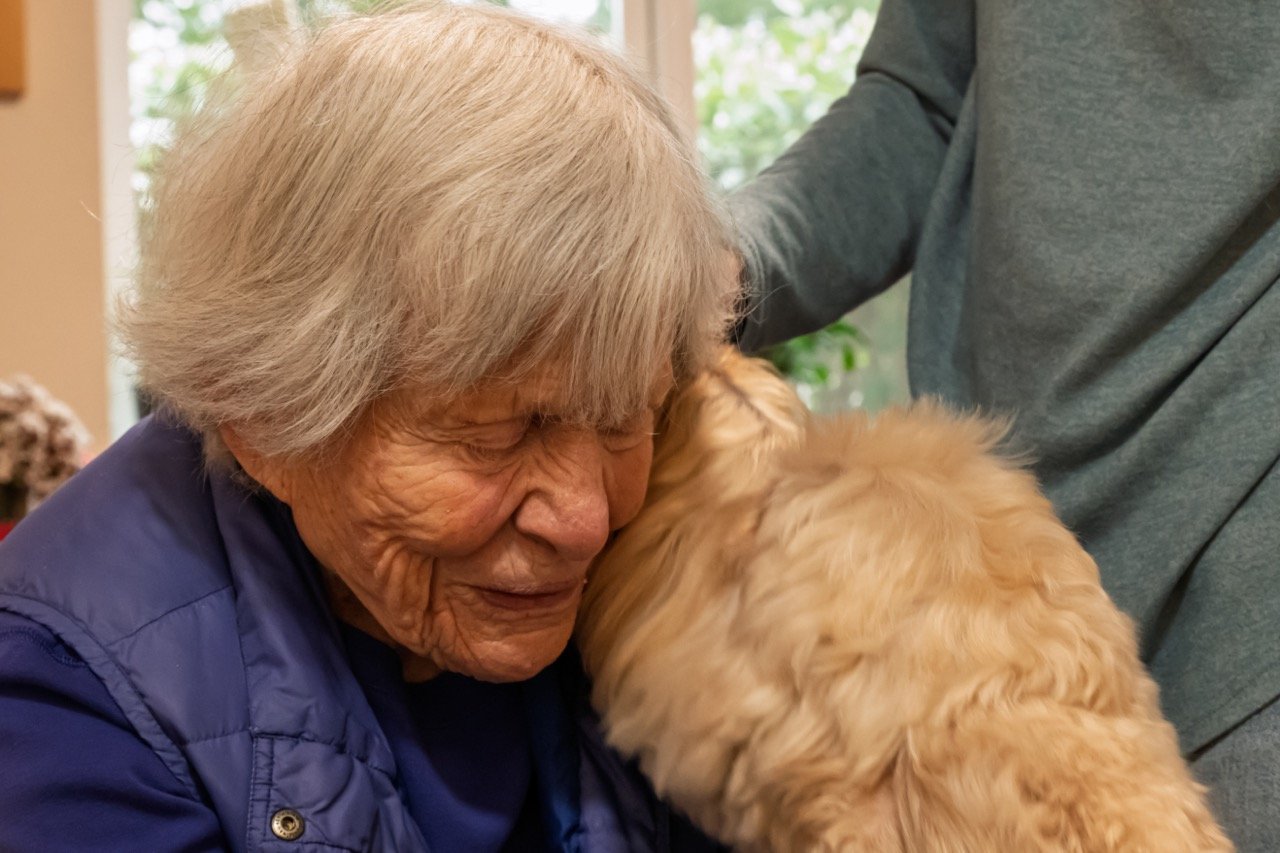
Eva and Jake on a typical visit. Photo by Luc Schoonjans. [/caption]
On a typically gloomy Olympic Peninsula February day, volunteer specialist photographer Luc Schoonjans captures smiles and laughter flowing between Eva, Jake and French, as Eva gently brushes Jake’s coat. Eva’s family has requested that Schoonjans photograph Eva with Jake. “Jake brings golden sunshine to Eva. The way she engages with him is heartwarming,” French said. Noticing the tactile pleasure that Eva enjoyed petting Jake on a recent visit, French said, “I’m reminded that often as we age, especially in a facility setting, there isn’t lots of affectionate, friendly touching, and his soft fluffy fur is an invitation to the senses.’ French and Jake are popular with other hospice patients, as well.
Schoonjans likes to “shoot photos that are memorable to the family. For me,” he said, “it’s about capturing the moment, the decisive moment” that makes for a memorable photo. Schoonjan’s photo shoot with Eva is his first session with Jefferson Hospice after doing similar volunteer work with a hospice at Seattle Children’s Hospital in Seattle, where he lived before moving to Port Townsend two years ago.
Newsome is excited to add photography to the hospice services. “The last thing that families think about is taking photographs of the house or belongings that are special to the patient’s children,” she says. Families often undertake clearing out their deceased family member’s belongings, and sometimes sell their house before they think about taking photographs that theylater wish they had taken.
Pattie Reynolds brings her skills to patients in their homes with Swedish death cleaning, a kind of decluttering and clearing out unnecessary belongings. “ You don’t want to put important stuff in the garbage”, Reynolds says. “I have to listen hard to evaluate possible destinations for belongings so that it’ll go someplace where it will be used optimally.”
Reynolds approaches her volunteer hospice work with more of a generalized approach than many of the other volunteer specialists. Having worked with hospice patients since 2006, Reynolds says that she will do whatever she can to help not only the patient but also to provide support for the nurses and caregivers who are often tired and need a break. This could include helping with laundry or reading to the patient.
Stevens said some of the patients’ most common needs are to find meaning and look at their life regrets. “You have to find peace with life, and you have to find peace with death”, she says. “Some patients may resent their spouse who is able to continue living and sometimes people hurt each other‘s feelings. I buffer and facilitate during those times. I consider it an honor. They are giving me a gift.” And when death does come for a patient whom Stevens has gotten to know, she says, “I can be happy and relieved that they’ve made the transition out of suffering.”
Program manager Newsome speaks with passion about the services that the hospice program is making available to patients as well as the connection to the community. Echoing her statement of making people’s end-of-life amazing, she says, “We come to hospice to live, not to die.”
Anyone interested in volunteering can reach out to the Hospice office at 360-385-0610