Comprehensive new homeless housing plan will require execution, funding

[caption id align="alignnone" width="2414"]
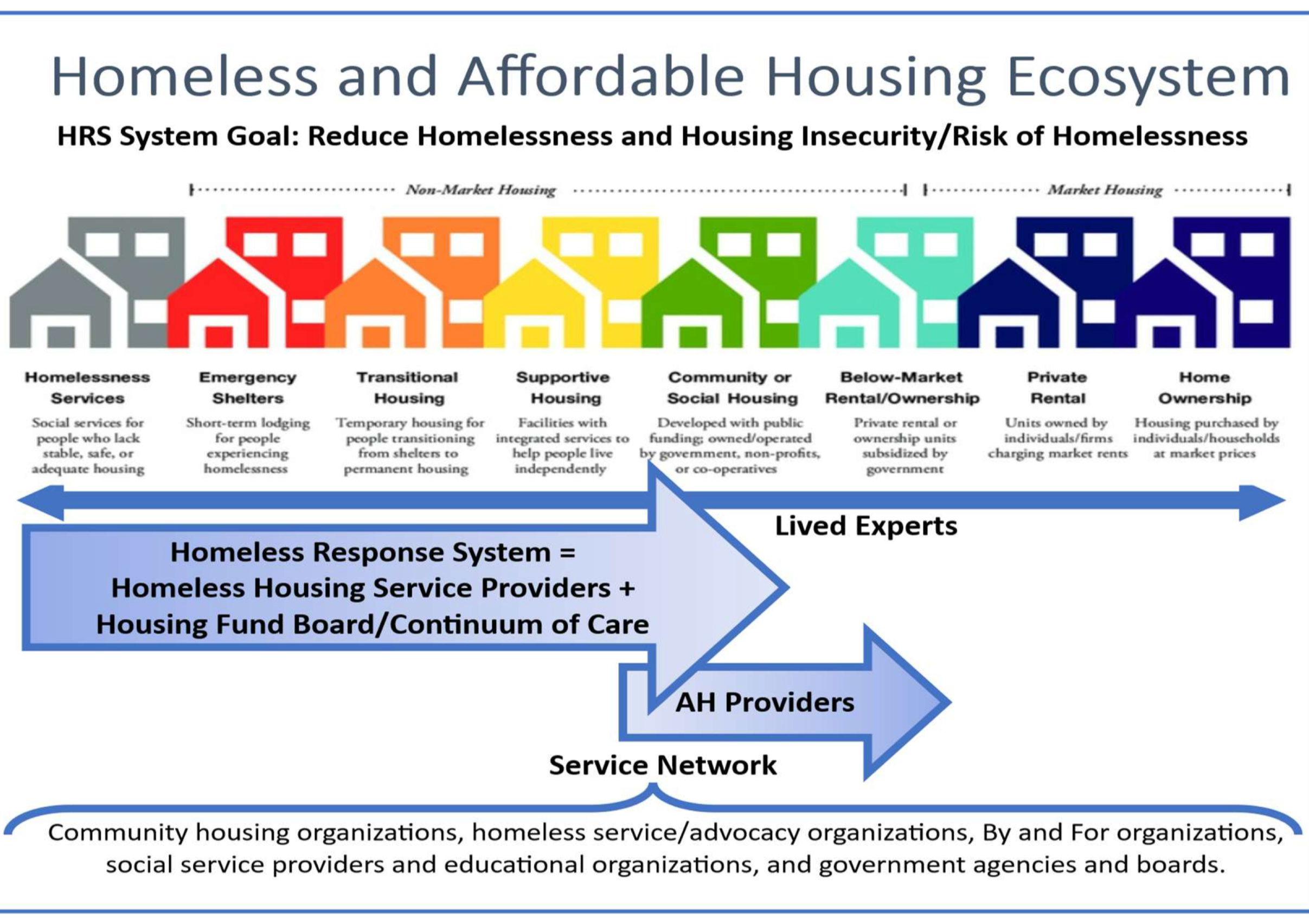
Infographic from the five-year plan meeting [/caption]
News by Scott France
The mounting challenges of meeting the housing needs of those at or near the edge of homelessness have spurred a coalition of housing and homeless services providers, City and County officials, housing experts, and people with lived experience of homelessness or housing insecurity to adopt a five-year plan.
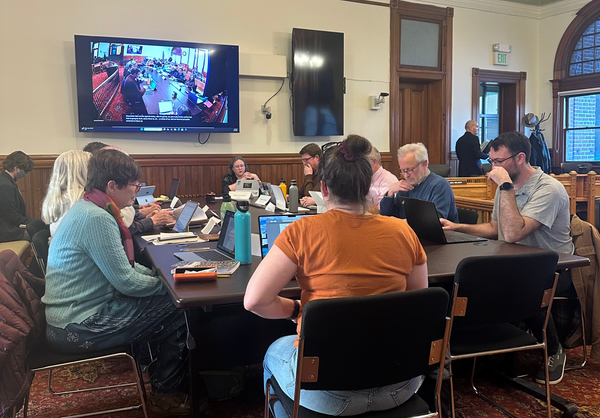
The City and County approved the 2025-2030 Jefferson County Homeless & Housing Services Affordability Plan on December 8, which will serve to “recognize the importance of each type of housing in this continuum as essential to addressing the issue of homelessness and housing instability,” said Audra Mumford, a member of the Housing Task Force (HTF).
The document states that:
“Homelessness and housing insecurity generate trauma with consequences for the entire community. The social and economic costs include:
- Increasing risk of interpersonal violence and traumatization
- Social isolation and loss of community connection
- Worsening mental and physical health and higher risk of untimely death
- Loss of essential workforce and lowered employment opportunities
- High rates of disconnected youth
- Increased rates and perpetuating cycles of incarceration”
The document goes on to say, “We can reduce these social and economic costs by building a strong support system for people experiencing homelessness or at risk of homelessness that includes preventing homelessness whenever possible and providing housing in a stable setting that meets people’s needs.”
In developing the plan, the HTF sought to identify needs-driven, resource-conscious, and actionable strategies for creating pathways to permanent housing by involving a wide cross-section of Housing Response System (HRS) stakeholders.
The plan is focused on five objectives:
Strengthening the homeless service provider workforce. Promoting an equitable, accountable and transparent homeless crisis response system. Prioritizing assistance based on the greatest barriers to housing stability and the greatest risk of harm. Preventing episodes of homelessness whenever possible. Seeking to house everyone in a stable setting that meets their needs.
Port Townsend resident Derek Firenze said during the public comment period at the plan hearing in the City Council chambers, “that supportive services like this more than pay for themselves, up to 30 to 50 percent reductions in public costs like policing, emergency room visits, and jail stays. Every dollar spent on a low-barrier intervention has been shown to save multiple dollars down the line. It isn’t just compassionate. This is fiscally responsible.
“The particular focus for this five-year period is to lay a solid foundation for strengthening and expanding the homeless response system to successfully meet the housing needs of those experiencing homelessness and housing insecurity,” said Viki Sonntag, an HTF member. “To do that, we need a strong homeless service provider workforce objective that acknowledges that housing service providers are frontline workers.
County commissioner Heather Dudley-Nollette said that the eventual effectiveness of the plan’s strategies will demand a greater standard of relationship and collaboration between the jurisdiction and service providers.
Mumford said that the number of homeless individuals in the county has stayed roughly constant at about 500 since 2018. “Housing instability is increasing and impacting those at higher and higher income levels in our community. Overall funding to operate homeless services has increased in the last couple of years.”
Sonntag said that Jefferson County will need 8,400 new affordable housing units in the next 20 years. But the plan is not an affordable housing plan because “developing affordable housing is not in the skill set of the HTF,” Sonntag said.
According to the plan, “the number of people at risk of displacement or homelessness are many times greater than the number of unhoused. Housing displacement refers to the involuntary relocation of residents from their homes or neighborhoods for economic, physical, or cultural reasons. It is distinct from voluntary moves and is often associated with increasing rents as is the case in Jefferson County.”
Each of the plan’s actions outlines a way to measure completion plan timelines, and identifies a lead party who will be responsible for completing the action.
The scope of the plan does not address encampment policy, which must be addressed separately by the city and county.
Several public comments were pleas to avoid any repeat resemblance of the recent removal of residents at the Evans Vista encampment. “A lot of people who were fortunate enough to get placements are already struggling in those places because they weren’t really appropriate because the service providers and advocates helping them get placed didn’t have time to do their jobs properly,” said County resident David Griffiths in his public comment.
Anya Callahan, who helps provide direct services to homeless people in her job at Jefferson County Public Health, suggested that the city build a low-barrier encampment. “A well-managed, supported encampment can provide safe shelter, allowing residents access to healthcare, case management, housing, navigation and other services,” Callahan said.
The Evans Vista closure experience has spurred many in the homeless services and advocacy community to champion a “No displacement without placement” policy.
The local housing situation is being squeezed, not only by the increasing demand, but by dwindling support at the supply level, mainly because of large reductions of federal funding for programs and services for affordable housing and the unhoused.
“Thoroughly disgusting,” is how Port Townsend mayor David Faber described the grant limitations.
“This is going to be a difficult time as we have this really aspirational, homeless and affordable housing services plan, and face more stark headwinds than I think we’ve felt in a long time,” he said.
Fellow City Councilor Ben Thomas chimed in with a positive message. “I really like how the different agencies are working together. That alone doesn't guarantee results, but it can minimize bad outcomes based on poor communication.”
Editor’s Note:
This is the last housing article we’ll have the pleasure of publishing from Scott France, who has been on our housing beat for nearly a year. France has accepted a position as co-chair of the Housing Solutions Network (HSN) Steering Committee, and we feel like it’s a conflict of interest to have him deeply involved with a housing organization while reporting on housing for the Beacon. France will still be covering County issues and the environment, and if you have a story idea for either topic, please reach out to France directly at scott@jeffcobeacon.com
Correction: An earlier version of this article said that the Housing Task Force was the apprroving body on the plan, not the City and County.