Black Lives Matter call for a Boycott of PT Food Co-op


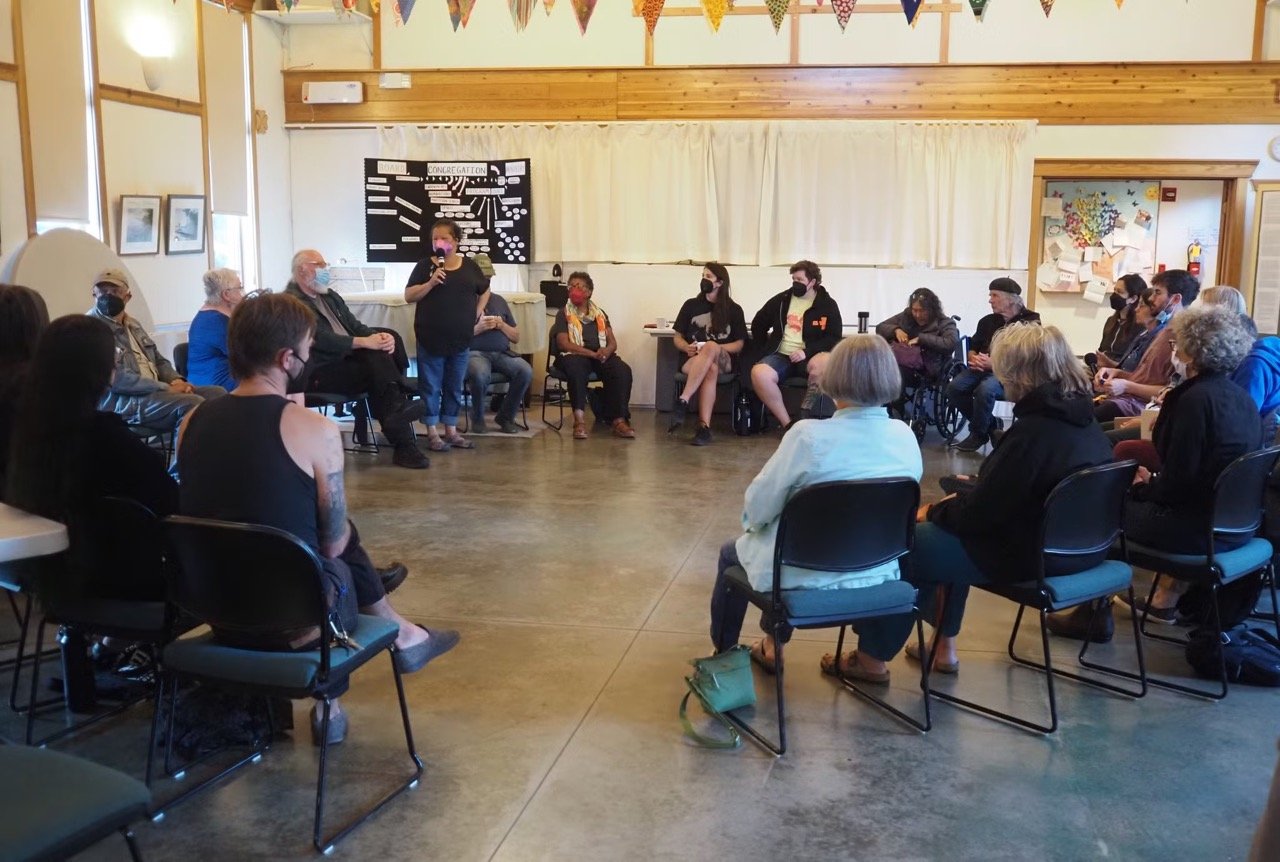
Black Lives Matter of Jefferson County has held four public information sessions to discuss concerns with the Port Townsend Food Co-op. The latest was held on September 3, one day before the Co-op’s board of directors was set to meet. Photo by Derek Firenze [/caption]
Activists from Black Lives Matter of Jefferson County (BLMJC) have put out a call to “Boycott the Co-op!”
This action is in response to a history of difficulty, including two incidents this year involving the departures of a trans employee and a Black board member from the Port Townsend Food Co-op.
According to a statement from BLMJC on social media, “There have been many anecdotal and documented instances where queer/trans and people of the global majority (PGM aka BIPOC) members have experienced harmful encounters with staff or members of the management team.”
On August 8, BLMJC sent the Port Townsend Food Co-op a letter asking for the redress of this string of racialized and transphobic actions they say have been committed in recent years. The activist organization gave the Food Co-op until August 15 to respond and notified them that they would act if they did not. The Co-op did not respond within that time period.
Starting August 16, BLMJC called for the boycott and began encouraging people to sign a petition requesting that the Port Townsend Food Co-op take immediate action to remediate the hostile environment they say it has created for employees, board members, and member-owners who identify as BIack, Indigenous, People of Color, People of the Global Majority, or LGBTQIA2S.
+++
The culminating conflict came when Cameron Jones, who is Black and part of BLMJC, was voted off the Food Co-op board. Jones was removed at a special meeting called at the last minute, which caused fellow board member Juri Jennings to resign in protest.
Port Townsend Food Co-op Board President Owen Rowe described the removal as an act of repair in a letter to The Port Townsend Leader, claiming Jones had “jeopardized the working Board/GM relationship through his words and actions.”
Neither Rowe nor Port Townsend Food Co-op General Manager Kenna Eaten have named exactly what those “words and actions” involved, but everyone agrees something went wrong during an April board meeting when discussing the departure of a trans employee.
“In this particular instance, we had a meeting, and it was pretty contentious,” Eaton said in an interview with The Beacon. “Members had come to the meeting on April 4 and had raised some concerns. We wanted to look at the members’ concerns and how we we’re going to respond.”
After the public portion of the meeting, Jones continued to take up the cause during a closed executive session.
“I and others had expressed concerns about what appeared to be a lack of transparency and a growing dissatisfaction with the Co-op's culture of neutrality, which, in my view and the view of others, negatively impacts BIPOC and LGBTQIA member-owners and staff,” Jones wrote in a post to social media after his removal.
It was during this closed session that Eaton claimed she was treated wrongly.
“It would be kind to say the conversation got heated, but in actual fact, I was not allowed to talk. I felt I was treated in such a manner that I really was made to feel unsafe,” Eaton said.
The concerns expressed at the April meeting centered around Scout Anderson. Anderson transitioned while working at the Co-op and quit after feeling unsafe due to the actions of his manager, as well as being unsupported by higher-ups.
James Robinson, the manager in the section of the store where Anderson worked, had written an article for The Leader concerning the lawsuit between Julie Jaman and the city of Port Townsend, an issue that many consider to be about trans rights.
“That article contains harmful language and speaks towards a ‘groomer’ rhetoric that has been used to demonize the Trans community for years,” Anderson wrote in a social media post. “This article, when read by the people who believe these false accusations, has the very real potential to cause extreme violence to the Trans community. I felt my safety was at risk, working with someone who was willing to spread this kind of misinformation, so I decided to reach out to HR to coordinate a mediated conversation.”
“I was accused of putting this employee on the spot to defend their article, of wasting The Co-op's time since ‘what this person does outside of working hours is none of my concern,’ and the employee themselves doubled down on this statement with no apology or acknowledgment of their actions or my feelings,” Anderson continued. “I decided to act on my one and only controllable and left the room.“
He quit the next day.
+++
One phrase Anderson used sums up much of what is at the root of the issue: “The ‘Co-op’ or should I say Corp-op, will continue to prioritize profits over people,” he wrote.
While speaking with numerous current and past employees of the Co-op, similar complaints about Eaton and the culture of the Co-op arose. These traced back to before Eaton came to Port Townsend when she was still the general manager of the Moscow Food Co-op in Idaho.
Fifteen years ago, Eaton was involved in a lawsuit with one of her Idaho employees. Cass Davis was an employee of the Moscow Food Co-op for 25 years. He brought the case against his employer over his alleged wrongful dismissal following a shoulder injury. It was settled for an undisclosed amount.
“I never disliked Kenna; I just think she isn’t equipped to do the job she has to do,” Davis said in an interview with The Beacon. “She doesn’t understand how to negotiate with people who are under her. She thinks that she should be the ultimate authority and that she shouldn’t have to explain herself.”
When asked about the lawsuit, Eaton said she could not comment.
Davis’s complaints, much like those of BLMJC, stemmed from a dissonance between the stated ethics inherent in a cooperative business and the reality experienced by employees.
“You’re telling people to voice their opinion when you know they’ll get fired if that’s not what is wanted to be heard,” Davis said.
He pointed to the policies of the National Co-op Grocers (NCG), a business services cooperative for retail food Co-ops, which represents 164 food Co-ops operating over 230 stores in 39 states, including the Port Townsend Food Co-op. Davis believes that the policy governance model of the NCG pushes boards under the thumbs of their general managers.
Davis regularly attended the board meetings of the Moscow Co-op, where he voiced his concerns and recorded the sessions. Over time, he recorded a number of conflicting statements from the board regarding health problems he was experiencing, which he said were used to get him fired.
“They tried to use the ADA to fire me when the ADA was actually meant to protect me,” Davis said. “It was all documented. I recorded the meetings,” Davis said.
During her interview with The Beacon, Eaton declined to be recorded.
Davis also said he was branded as an “angry man.” A similar sentiment was expressed by Jones, who said during his time on the Port Townsend Food Co-op board, he felt “reduced to the ‘angry black man’ stereotype.”
+++
One of BLMJC requests of the Port Townsend Food Co-op is to replace the general manager and board president as soon as possible.
There has yet to be a direct response to the request which also asks that the Co-op:
- Conduct a series of listening sessions with target group members among member-owners, employees, and the board of directors to identify relevant issues and actionable outcomes that will be reviewed quarterly until completed;
- Provide ongoing training for employees and board members on matters related to equity and inclusion.
- Overhaul of policies and procedures through an equity lens with guidance from an outside facilitator steeped in equity theory and praxis that reflects your published values and operating principles.
- Publicly apologize to all employees, member-owners, and board members who have been harmed.
BLMJC also claims the Port Townsend Food Co-op violated operating policies and procedures in the removal of Jones, including the last-minute board meeting, which was called to remove Jones. Eaton said that a lawyer had been consulted about the timeline but was not able to provide the date on which board members were notified.
At the Port Townsend Food Co-op’s most recent board meeting on September 4, the majority of comments from member-owners were in support of BLMJC, with one activist offering a last appeal.
“I would really like to see an effective, respectful, and restorative change,” said Frankie Rafferty who also helps to organize a monthly free community meal. “Otherwise, in a month you’re going to hear about me organizing all of my young community Co-op friends who are the future of this economy for this town.”
When asked about why the Co-op has yet to respond to the requests, Eaton said, “We want it to be authentic.”
“This is a volunteer board. Sometimes it’s hard for them to all get together to talk about this. That takes time. We’re not exactly nimble. We don’t want to say something that we can’t end up doing,” she added.
One thing Eaton did agree with is that outside help is needed.
“I think we need to have a consultant, someone who can really help us as an organization,” Eaton said.