County Passes 2026 Budget With Across the Board Cuts

[caption id align="alignnone" width="2838"]

Photo by Nhatt Nichols [/caption]
News by Scott France
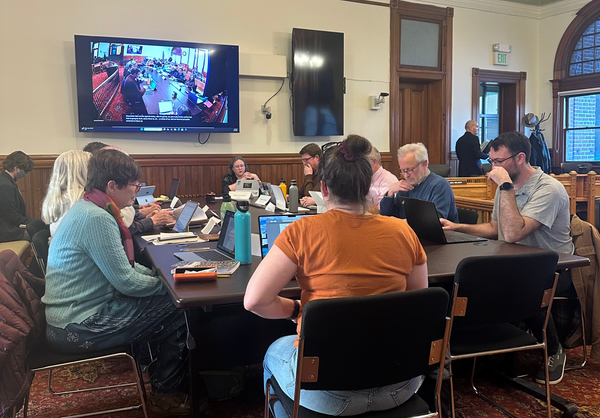
The Jefferson County Board of County Commissioners (BOCC) adopted its 2026 budget on December 22 after several months of difficult, deficit-driven deliberations by county leaders, and input from community stakeholders and county residents and businesses.
The all-hands-on-deck effort was necessitated by a projected budget shortfall for 2026 that stood at $5.2 million in the General Fund after county departments provided their respective budget requests to the Auditor’s Office in September.
All Departments Share the Pain
To balance the budget and end 2026 with a modest $1.5 million in the General Fund, Finance Director Judy Shepherd calculated and recommended a 12% total cut to each department’s allocation, plus even more substantial reductions of transfers to special revenue funds. A healthy reserve is 15% of expenditures, which in 2026 is budgeted at $4.43M.
“We got into a situation where we were way overspent for 2025 in our general fund and the end-of-year balance was in a deficit, which is what necessitated this whole exercise,” said Heidi Eisenhower, the chair of the BOCC.
“We did this as a team,” Eisenhower said, “There's a bunch of independently elected officials who are responsible for their own budgets as well as department directors. So we look to our leaders to propose cuts that they felt would keep their programs intact or have the least impact on the community. We didn't tell them how to cut.”
The county’s financial road remains challenging, according to Shepherd. “We still have work to do to restore our reserve, which will mean more changes are possible in 2026. We have basically reduced the budget by the ‘low hanging fruit’. In a sense, this is round one. The challenge will be to preserve services while making additional reductions.”
Hardest hit, according to Shepherd, was the Department of Community Development (DCD), which manages building permits and land use planning.
Maintaining Vital and Desired Services
“Community Development has been under financial pressure for about three years, and it isn’t getting any easier,” Shepherd said, “They will need to leverage the short-term rental and fire safety protection programs to boost revenues to support personnel costs. The improved turnaround time for permitting is beginning to have a positive impact. If the economy holds and the larger housing projects break ground in 2026, these will help to stabilize their revenues.”
Community Development Director Jeremy Williammee started his job one month ago as these budget challenges were reaching a fever pitch. His department will be shedding 3.5 full-time equivalency positions, mainly through retirements and voluntary departures that will not be filled.
“We want to maintain a focus on, of course, building permits, and we still have our permitting team intact for land use issues and site development reviews,” Williammee said, “We're working on a system to coordinate that.”
He added that “a lack of a dedicated code compliance coordinator will require distributing that work throughout the department and balancing it with other responsibilities.”
Depending on how the state decides its budget for the 2027 fiscal year (beginning on July 1, 2026), Public Health and other departments that rely heavily on state funding could be challenged.
The BOCC heard more concern about potential cuts to the recreation center than perhaps any other issue, though Eisenhower said that much of the concern revolved around incorrect assumptions that the senior center, and perhaps the entire recreation center, would be closed.
”We got a lot of comments from people about the recreation center, especially from young families, low-income families,” Eisenhower said, “What was going to be impacted was the drop-in area and the use of the gymnasium. I get it that the use of the drop-in recreation area and the gymnasium was going to impact segments of our community.”
Thinking Outside of the Box
The looming imminence of this cherished community resource prompted Eisenhower to approach Siobhan Canty, the executive director of the Jefferson Community Foundation, to discuss a potential stopgap solution. Their discussions led to inclusion of a $150,000 donation line in the 2026 budget.
“An account will be opened at the Community Foundation for people to donate to, and we’re in talks with the city about collaboration,” Eisenhower said.
While the county has flexibility over some General Fund allocations, its state-mandated services must be funded. These include elections administration, law enforcement jails and juvenile detention, public health oversight, roads and transportation, and courts, prosecution and public defense.
“Public Defense costs have been over a million for several years now, and with this year’s Washington State Supreme Court decision, it’ll only get more expensive each year for the next decade as we build public defense capacity to address new caseload standards,” said Shepherd, “In addition, all the law and justice departments of the General Fund are mandated services serving our community.”
The Department of Emergency Management (DEM), as one of the smaller departments in the county, will experience arguably less disruption from its share of budget cuts, but faces an additional potential hit from likely partial or complete federal funding cuts for various initiatives.
”On a day-to-day basis, what people will most see would be a reduction in our ability to do outreach and education in getting folks prepared,” said DEM Director Willie Bence, “So we are talking with neighborhood preparedness groups on ways for volunteers to step up and fill that gap. But we have less printing materials, less giveaways, and less equipment. The thing that would worry me most is a mid-level disaster that exceeds the county's resources, but the federal government isn’t going to step in and help.”
Financial challenges of the past few months appear to have been a learning process for the BOCC, the county administrator, as well as the department directors from which the group is intent on creating a more resilient financial house.
“The commissioners who have their budget authority for the county don't have a say in these additional budget appropriations,” Eisenhower said, “A big part of why we're in this situation is because we've gotten used to these appropriations processes and haven't really had good checks and balances.”
County Administrator Josh Peters will be a lead in this reshaping process. “The Core Financial Team will be collaborating—with input from throughout the organization—to bring revenue-generating options and cost-cutting ideas to the board with the intention to improve our standing and make future budget processes less strenuous for all,” Peters said in a press release.