Feral Feelings: Anxiety Road


[caption id align="alignnone" width="1491"]

Image Collage by Amber Autumn Leaves Huntsman [/caption]
Dear Feral Feelings,
Anxiety is a huge roadblock in my life. I worry about most things that are happening, or that are going to happen, on a daily basis. There’s so much cool stuff I want to do and I do none of it. It’s all way too far out of my comfort zone. I know I’m supposed to push outside of my comfort zone, but I just panic when I do that. If I find ordinary life so stressful already, I’m not sure how I’m supposed to live an extraordinary life. Please help!
-Generally Anxious Gal
Dear GAG,
The road you are traveling, and the block you find in your path, is well trodden. Anxiety is a very basic human state; anxiety is an expression of fear hard-wired in each of us. Fear is a fundamental feature of our mammalian bodies. Without the ability to respond to fear, human beings would not have survived this long and with such success. We know how to protect ourselves from danger.
When I read your question, GAG, it seems that your anxiety is sensing danger constantly. It seems to be protecting you from everything, even things you want.
Your pen name here is serendipitous- Generalized Anxiety Disorder is a very common mental health diagnosis that seems to be had by…everyone. Or so it seems.
I am not diagnosing you with generalized anxiety disorder, to be clear. Whether you are diagnosable as having GAD or not, you are living with a clinically significant level of anxiety as you describe it.
I was recently reacquainting myself with the diagnostic criteria for generalized anxiety disorder. More than any other mental health condition, GAD is present in most of the people I work with professionally and many of the people I know personally. As a refresher, here are some symptoms:
- Persistent worrying about things that are out of proportion to the impact of the events
- Overthinking plans and solutions to all possible worst-case outcomes
- Perceiving situations and events as threatening when they aren't
- Difficulty handling uncertainty
- Indecisiveness or fear of making the wrong decision
- An overall Inability to set aside or let go of a worry.
GAD can also be accompanied by fatigue, insomnia, nausea, irritability, and muscle tension. For something considered to be fairly common, it can be greatly impactful. And, its main trigger is change and uncertainty. You’re right, GAG- this quality of anxiety keeps life small.
Anxiety is absolutely supposed to arise when anxiety provoking situations occur, but an anxiety disorder, on the other hand, creates distortion, discord, and confusion. Reaching for clinical diagnostics isn’t usually the portal I take to answer questions here, but I think it’s important to notice the difference between an anxiety disorder and anxiety that arises from a proportionate situation.
In terms of treatment, anxiety is usually addressed through a combination of medication and cognitive-based therapies meant to reduce the distorting quality of anxiety’s risk-based, fatalistic perspective. These therapies aim to reframe thoughts and reorient you to a more logical, rational perspective. Most of the time, anxiety is convinced a bad outcome is coming, when it likely is not, and we live in distress over what feels like a very real possibility. Rationality can help, certainly, and I do not discount the smoothing, medicinal quality of sound logic.
And here, my more clinical reflections end.
“The roads we travel are fraught with many harrowing experiences, and our anxiety is shaped by those experiences. ”
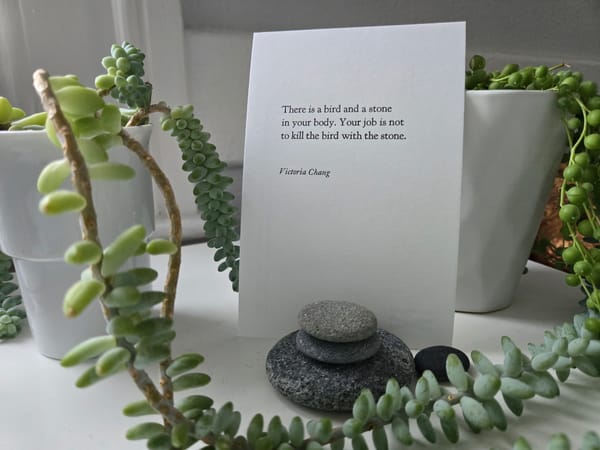
Anxiety can be thought of as a disorder, and that can be helpful to a certain degree. But it’s not only a disorder. It can also be thought of as a companion that has followed you on the road of your life, making notes. Trying to protect you. Telling stories. Holding the existential dread of being alive. Like a bird on your shoulder, alarming you at every turn on your path.
Anxiety may not be logical in the here and now, but it has its own logic. Most of the time, that logic is based on prior, often painful experiences that left us feeling scared, helpless, or out of control. Generalized anxiety disorder, specifically, is associated with early childhood trauma or with difficult experiences of the past that have yet to come to resolution within us. The roads we travel are fraught with many harrowing experiences, and our anxiety is shaped by those experiences.
My advice to you, GAG, is to sit with your anxiety. Listen to what it has to say as if you were a loving, knowing friend. Cry with it, if needed. Feel what it’s telling you, until the feeling fades. Feelings aren’t always reality, but they have a reality of their own.
If you are curious about your anxiety, I bet you learn it is holding a ledger of every scary thing that ever happened, every bad outcome, every experience that disproves your more rational assurances that “everything will be okay.”
Medication helps, and so does therapy, but neither are a substitute for self-awareness. Whatever measures you take, know your anxiety is a potent teacher. It can illuminate your darkest corners and tell your most painful stories. When we listen to someone, we build trust. You don’t need to believe everything your anxiety says, but you can learn where it originated if you listen. And, if the two of you can reach a place of trust, your anxiety may let you move out of your comfort zone and reach for a more extraordinary life.