Homelessness Here and Now: County plans to take over management of Legion shelter while SCOTUS deliberates



Maggie G. traveled five days via Amtrak to reach the United States Supreme Court where she made sure her voice was heard and got this shirt. Beacon photo by Derek Firenze [/caption]
The Jefferson County Emergency Shelter located at the American Legion Hall in Port Townsend may keep doors open under new management. With the Olympic Community Action Program’s contract coming to a close June 31, County Commissioner Greg Brotherton is now spearheading a coalition which includes the County, local faith groups, and housing nonprofits.
So far, the group has met informally to discuss the future of the shelter, but Brotherton says he hopes to ratify their coalition and sign a contract with the American Legion in the next week.
“It’s a loose coalition so far,” Brotherton said. “No one has said I’m in or out, but people keep coming back and having good ideas to contribute.”
The Community Outreach Association Shelter Team, or COAST, originally signed a contract for the shelter with the American Legion in 2006 with the intention that it be a temporary agreement during winter seasons only. Soon after, OlyCAP took over managing the shelter and began offering it as a year-round service in 2017.
For the last few years, There has been a growing question as to whether or not the Legion would continue the contract with OlyCAP. Brotherton hopes the County can help stabilize the situation for the time being.
“At this point, they’re ready to move on,” Brotherton said in regards to OlyCAP, whose board he also sits on as treasurer. “We recognize it’s not the most ideal place, it’s just the only place.”
Local reflections of a national trend
This shift comes at a more critical time than ever with the Supreme Court taking on the issue of homelessness. In the case of the City of Grants Pass, Oregon v. Johnson, currently before the highest court in the land, the justices will decide whether the enforcement of generally applicable laws regulating camping on public property constitutes “cruel and unusual punishment” prohibited by the Eighth Amendment. The case revolves around the heavy fines Grants Pass has been imposing on people for camping in public parks, and for the weekly sweeps through encampments which seize and destroy an unhoused person's property.
“We’re watching the Supreme Court and how they handle the Grants Pass case,” Brotherton said. “But no matter how they handle it and what legal capacity is regarding encampments on public land, that’s not the issue. This is the basic level of service that we need to offer, and we’re not willing to go back to the winter-only model.”
One local advocate has been speaking out for the unhoused to the Board of County Commissioners for months and recently traveled to Washington, D.C., to protest the Grants Pass case. As she is experiencing homelessness and has asked that we protect her privacy, we’ll be referring to her only as Maggie.
[caption id align="alignnone" width="2000"]

In a still from a video by Invisible People , Maggie G. stands before the United States Supreme Court alongside hundreds of other protestors. Photo courtesy of Invisible People [/caption]
“Of course I should go there,” Maggie said of her five-day trip to attend the oral arguments. “Of course I should be on the side of people who should not be arrested and jailed. There are so many disabled, so many elderly, and so many other populations out there for various reasons: immigrants, you name it. Of course they need to eat, sleep, and go to the bathroom. And breathe according to one justice. One justice even said, ‘What is the limit of punishment? Is execution ok?’”
“I’m glad they went there because it points out how absurd it is,” Maggie continued. “People need a safe place to store their belongings. They need a place to rest. They need a place to be warm. If they can’t have a tent, how are they supposed to stay warm?”
Maggie arrived in Port Townsend a year ago from Portland, Oregon, where the effects of the housing crisis are unavoidable. With no housing affordable to her there and a reasonable fear of the alternatives, she chose staying at a shelter as a temporary measure.
“I went into the shelter and thought I’ll sign up for public housing and they can get a third of my check,” Maggie said. Of course, the wait for public housing is long, years long, and she came to Port Townsend in hopes of greater availability.
When she saw that the Washington Association of Sheriffs & Police Chiefs (WASPC) had signed on in support of Grants Pass, Maggie decided to show up to represent her new community on the other side of the issue. Jefferson County Undersheriff Andy Pernsteiner is a member of the WASPC, tying Jefferson County’s own law enforcement to this national issue.
Maggie’s story also ties the case into conditions at the local shelter. She listed a number of complaints about the shelter at the Legion during our conversation, from rodent infestations to mold, at one point comparing it to trying to sleep in a coffin with people dancing on the lid when events are hosted in the space above.
“What this changes is people having a choice not to go into a shelter that is discriminating, unsafe, and unsanitary due to exemptions in laws,” Maggie said of Grants Pass decision.
Because emergency shelters are not meant to be permanent housing, there are separate and somewhat looser codes and code enforcement regarding their habitability.
Balancing budgets and bodies
[caption id align="alignnone" width="2000"]

Shelter Manger Terry Strickland and County Commissioner Greg Brotherton discuss logs tracking offenses at the emergency shelter. Beacon photo by Derek Firenze [/caption]
Port Townsend’s city council recently took a fresh look at this issue. Over the course of two sessions in April, they discussed Ordinance 3335, which includes the codes regarding emergency shelters, when it seemed the Legion shelter could close. The council's changes included giving shelter residents a space for grievances with a process for adjudicating disagreement. Zero-tolerance policies were also discouraged to allow more people access to shelters. Additionally, religious organizations and nonprofits can now apply to allow the use of their parking lots as safe spaces for RVs and people sleeping in cars overnight.
Brotherton has not given up on the shelter at the Legion though. He is, however, hoping they’ll be able to operate it with less funding than in the past.
“We don’t have a balanced budget yet, but we think we can run it for less than $300,000 per year,” Brotherton said in reference to OlyCAP’s previous staffing budget for the shelter. Currently, the taxes the County collects to fund the shelter leave a $7,000 deficit per month.
The plan is to hire one shelter manager, two full-time monitors, and up to two part-time positions to function as overflow monitors.
Currently, OlyCAP operates the shelter with one manager in addition to one full-time and two part-time monitors. Shelter manager Terry Strickland noted that means only one staff member is on duty at all times. While Strickland said he will not stay on when the County takes over, he did encourage Brotherton to up the staffing. If the monitor on duty needs to step out for a moment, say to use the bathroom, Strickland said, “anything can happen.”
To make do with a small staff, volunteers will be required. Leading by example, all the county commissioners have agreed to volunteer one night per month at the shelter, though they’ll still need more community support.
“We’re trying to supplement it with volunteers which OlyCAP stopped having access to,” Brotherton said. “It’s not an easy gig. I’ve done it once, and it was not a fun night,” he added.
[caption id align="alignnone" width="2000"]
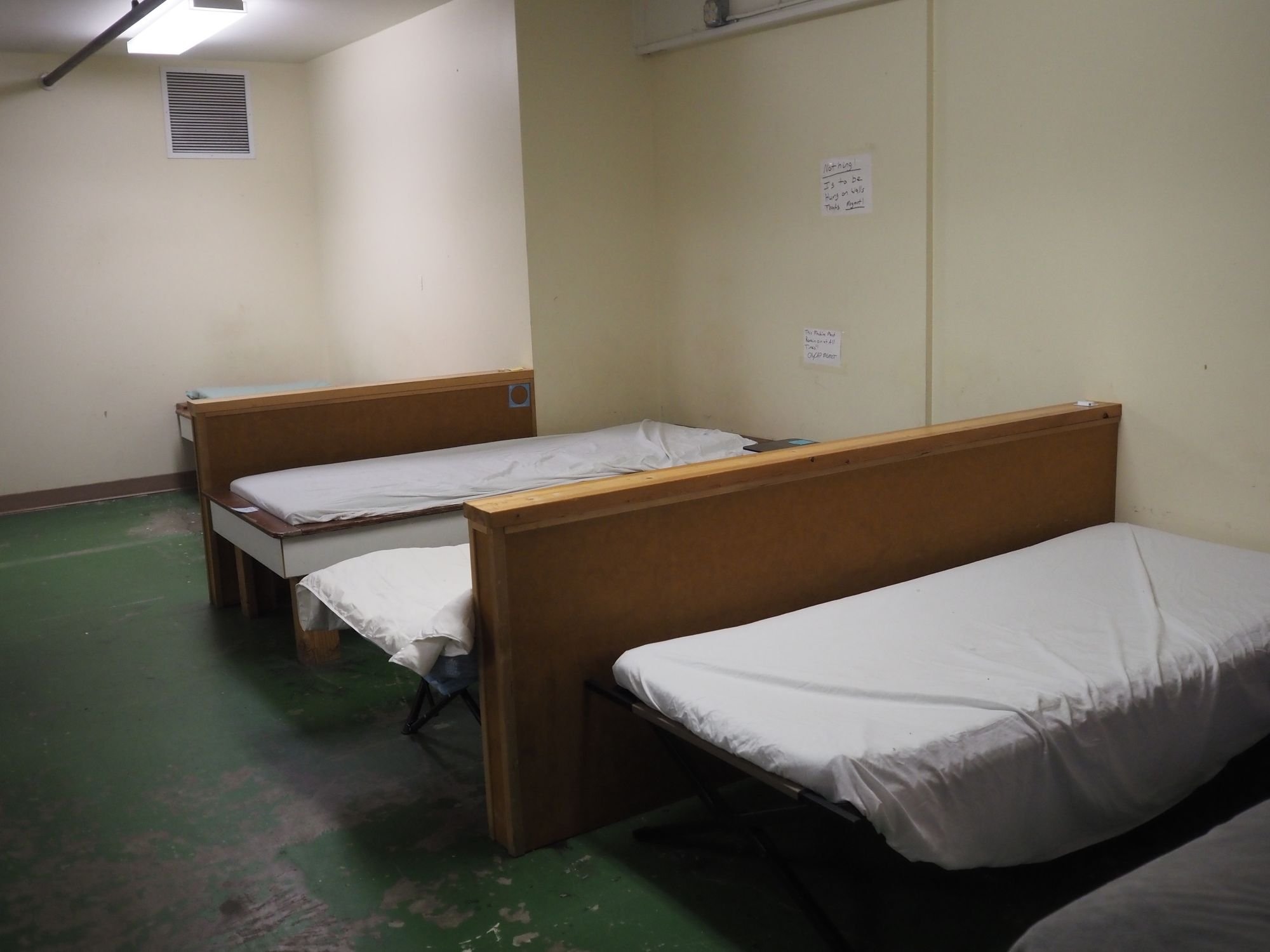
Plenty of cots remain unoccupied at the emergency shelter. There are more than enough people sleeping in tents around Port Townsend to fill the shelter, but many prefer the outdoors to the unventilated space under the American Legion Hall. Beacon photo by Derek Firenze [/caption]
With plenty of problems still plaguing the current shelter, there is still hope for something better in the not-too-distant future.
“We all know that what is an emergency shelter has functioned as permanent supportive housing for quite a number of people that there’s just no other place they fit. Some of them have been placed in permanent housing and it didn’t work,” Brotherton said.
The solution to this issue has already been designed, it just needs to be built. Construction, however, remains on hold on the emergency shelter and permanent supportive housing facility OlyCAP plans to build next to the Caswell-Brown Village on Mill Road. But a way forward is on the horizon.
“I think we have support for our congressionally directed spending request to fill the funding gap to build the new shelter,” Brotherton said.
OlyCAP announced it would break ground on the project last summer, but a funding shortfall the nonprofit blames on inflation left a $2.5 million gap. U.S. Congressman Derek Kilmer may be able to help find those funds, but nothing is certain.
“It’s still predicated on a federal budget in October, so it’s not there yet,” Brotherton said. “OlyCAP is really hesitant to break ground on a promise that you can’t cash.”