How to Move From “You’re on Your Own” (YO-YO) to ‘We’re on Our Own Together” (WOOOT)


Opinion by Scott France
Upon moving to Port Townsend in 2023, I experienced numerous feelings: gratitude for landing in a place with a strong sense of community and a beautiful environment; curiosity about small town life of which I had very little experience; and vulnerability about living on a small out-of-the-way peninsula within a peninsula in an earthquake and tsunami zone.
Armed with some emergency preparedness training and planning experience from my public health days in Oregon, I began connecting with neighbors in my Port Townsend neighborhood in an effort to create a neighborhood emergency preparedness group.
The experience has been productive, so the Beacon suggested that I share a bit of our group’s experience with readers.
I'll start by saying that the engagement of our little neighborhood, combined with the amazing resources and support from our county Department of Emergency Management (DEM), has given me and my neighbors much higher confidence in our individual and collective preparedness during a disaster. So my message is that if we can do it, you can too.
Or maybe you already have. Scores of neighborhoods and thousands of County residents have formed their own preparedness groups. Willie Bence, the DEM director, says that 160 neighborhoods have organized, and that at least 70 of those are active based on responses from a recent DEM survey.
The Quimper Peninsula on which most of East Jefferson County is situated, is vulnerable to wildfires, landslides, severe storms and wind events causing power outages, flooding, and the big one, a double whammy of a severe earthquake followed by a tsunami with waves that could inundate our area with waves up to 50 feet, according to Dave Codier of DEM.
And it gets worse, at least in the case of an earthquake and tsunami. An earthquake-induced tsunami will cause a disaster with “a very strong likelihood in terms of cost and impacts to people that would be the worst in US history,” Bence said.
And because both roads on which supplies and people flow into and out of our area, we will truly be on our own for an indeterminate period of time. Strong motivation, my neighbors and I thought, to get our act together.
After cobbling together a group of five people, we set a neighborhood boundary comprised of approximately 50 homes, and created a map for our area, which included residents’ names, addresses and contact information. Most residents agreed to provide their contact information for our neighborhood database. We pledged to contact residents only in the event of disaster-related events or to announce meetings or other vital developments.
In the past five months, we have hosted three meetings at the Quimper Grange at which Codier from DEM presented on topics such as sanitation, supplies, including building a go-kit, food and water storage, communications, shelter in place, and neighborhood hubs, which are places for people together after a catastrophic emergency to share resources and information. Codier will return to do first aid training. He is available to present to neighborhood groups on these topics at no charge.
We are currently in the process of building a group of block captains, who know who lives in each home on their street, who is disabled, and who has specific assets like plumbing knowledge or specific equipment that would be useful in an emergency.
I would like to shift here from our neighborhood to that of a group whose experience is far more extensive than that of my neighborhood. Kala Point is a community of 600 homes just south of Port Townsend that has a homeowners association and an emergency preparedness standing committee within that association.
The committee has created six teams as part of its emergency preparedness effort: a communications team; a first aid team; a team of block captains that comprised of captains and assistance for each of the 19 geographic zones within the community; an emergency pet management team; a search and rescue team; and a neighborhood emergency operations center team, which will stand up a control center and coordinate other teams in the event of an emergency.
Kala Point, of course, is not typical of the majority of neighborhoods in the county, but it serves a useful reminder of what is possible, as well as what will likely be useful for all of us in the event of a major disaster.
Washington state advises that residents be prepared to sustain themselves and their families for varying durations: at least three days for winter storms or power outages, two weeks for significant storms or minor earthquakes, and up to 30 days for a catastrophic event like a major earthquake. Bence says that “more is obviously better,” especially considering that an earthquake and tsunami will I most certainly cut off our supply roads for months.
Keep in mind that an earthquake will almost certainly disrupt cell phone operations, and even if cell phones work, the networks are likely to be quite overloaded. Bence advises texting rather than phone calls as they use less data. He also suggests having an out-of-state contact which could provide information that might not be attainable locally.
“I want to emphasize that a big earthquake or major disruption is intimidating, but you have all the power in this situation to prepare yourself, and it doesn't have to be an overwhelming process,” Bence said. “We like to think of it as you're camping at home. Have food available and ways to cook it, have entertainment, and you're going to set yourself up for an experience that ultimately is what you're going to make it.”
Bence said that his department will have response mechanisms for people who can't take care of themselves.
In a final nudge in support of community preparedness efforts, Bence said, “After every major disaster, people speak semi-fondly of the community that was built, and the ways that people reached out, and bonded together to help one another.”
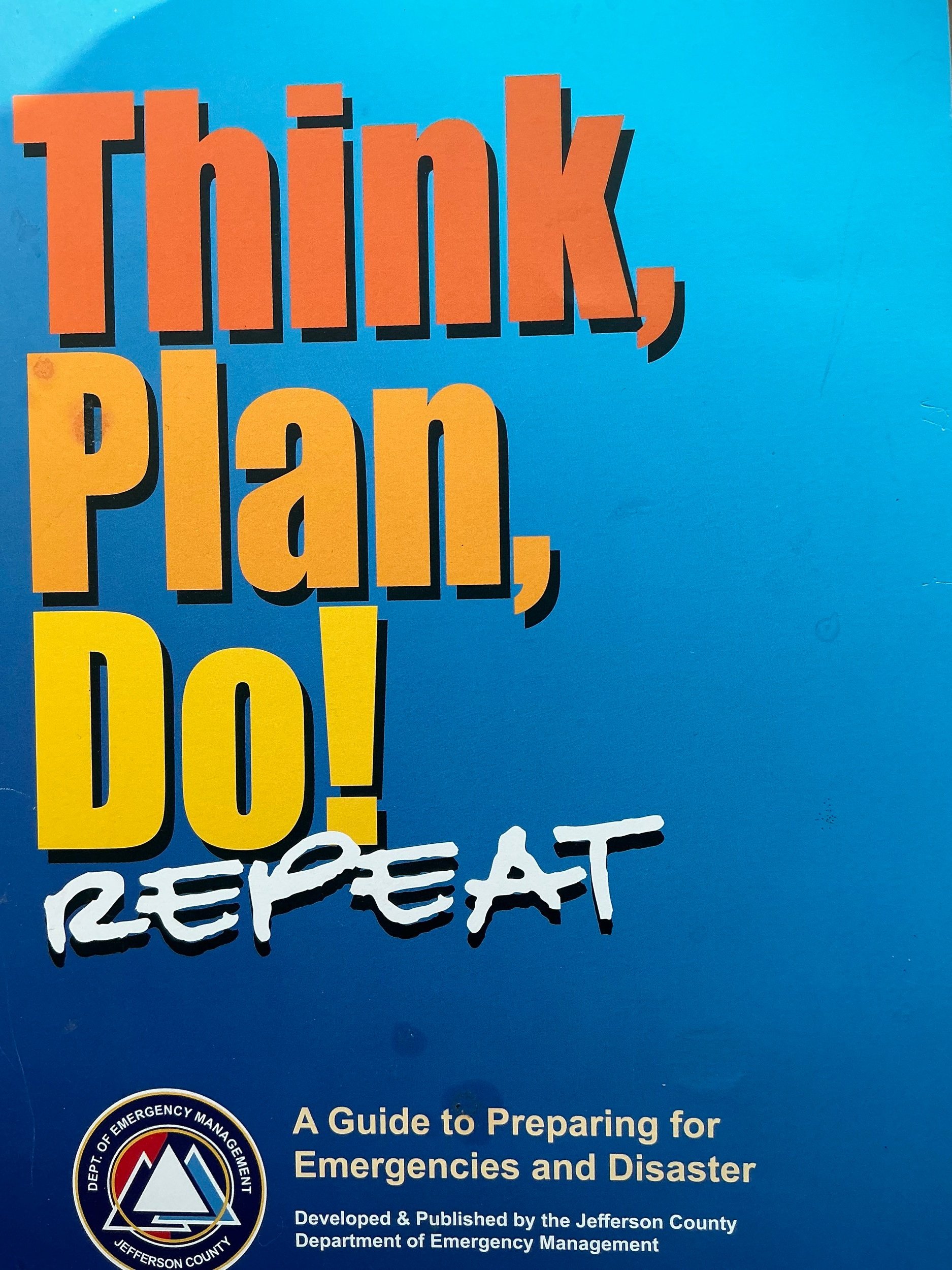
Jefferson County Department of Emergency Management and Local 20/20 have many useful, free resources, and information available on their webpages that you may access at the links below.
For more information:
Jefferson County’s Preparedness and Planning page: https://www.co.jefferson.wa.us/1067/Preparedness-Planning
Local 20/20 Neighborhood Preparedness page: https://www.co.jefferson.wa.us/1067/Preparedness-Planning