Humans and Birds “Collaborate” to Improve Forest Health on the Olympic Peninsula
New program uses bird song recording to manage Land Trust properties.

News by Scott France
JEFFERSON COUNTY, WA – Jefferson Land Trust (JLT) Preserve Manager Carrie Clendaniel pauses along a faint trail in the Quimper Wildlife Corridor at the west end of Port Townsend, concern etching into her face as she gazes left to right, then up towards the treetops.
“This is not a complex, diverse, healthy forest,” Clendaniel says, ”We need more diverse conditions for more diverse wildlife, so a mix of large diameter trees, a diverse forest understory, standing snags, and nurse logs.”
Snags are standing dead or dying trees that are vital for biodiversity, and serve as a crucial habitat element in forest ecosystems. A nurse log is a fallen, decaying tree that provides essential nutrients, water, and shade, creating a fertile “nursery” for new seedlings, moss, fungi and other plants to sprout and thrive in a forest ecosystem.
Birds Aid in Their Own Cause
The monumental task of transitioning the lands that JLT owns, manages and protects to healthier, more resilient conditions spurred Clendaniel and JLT to partner with land trusts, tribes, and county parks to use recording devices that capture bird calls to gather data about forest health.
These seven organizations, which now call their project the Listen Up Collaborative, procured a $50,000 grant from the Cornell Lab of Ornithology to fund audio devices that JLT and other partners strap to trees on their managed lands to monitor bird calls.
The Listen Up Collaborative organizations are: Jefferson Land Trust, Greater Peninsula Institute, Northwest Natural Resource Group, Bainbridge Island Land Trust, the Point No Point Treaty Council, Jamestown S’Klallam Tribe, and Kitsap County Parks.
Acoustic recording devices capture the bird calls, and software is used to analyze them. The acoustic devices can capture bird data over a much greater area than cameras, which only capture what’s right in front of them.
Each of these organizations monitors bird calls on lands that they manage, and “share experiences about the effectiveness of certain treatments, and do knowledge sharing for similar practices,” said Clendaniel.
The group aims to improve forest habitat by monitoring bird calls across 4,533 acres of protected land in Kitsap and Clallam counties, on islands, in monoculture forests, along restored floodplains, and on land that has endured intense agricultural and timber use.
JLT monitors and treats lands they own in the Quimper Wildlife Corridor that stretches from Fort Warden to Middlepoint Road, as well as properties across Jefferson County as far south as along the Duckabush River.
What the Bird Calls are Saying
”We monitor our forests and our actions to try to determine if we are indeed making progress towards those long-term goals of a more complex condition that provides select wildlife habitat, and that’s where bird monitoring comes into play,” Clendaniel said.
“Birds became the vehicle to check for health and help us improve habitat and fire and climate resilience, along with wildlife cameras and forest health inventory,” she said. Clendaniel last set out audio recorders in spring 2025 and collected 15,800 recordings from nine conservation areas.
Clendaniel sees forests across her work territory struggling to recover the health and resilience they had before settlers began altering forest conditions two centuries ago.
“A big theme we’re seeing across all of those forests is that they were heavily logged,” Clendaniel said.
“The audio data point to a lack of complex forest conditions, and supports the need for important habitat features such as large diameter/large branched trees, a diverse forest understory, standing snags, and nurse logs,” Clendaniel said.
The Data Guides the Treatment Approaches
“The audio analysis, along with forest health inventories, have led us to implement practices including forest thinning to stimulate more robust tree growth, and creation of standing snags, constructed nurse logs, and habitat piles to mimic features that would otherwise exist in old, complex forests.”
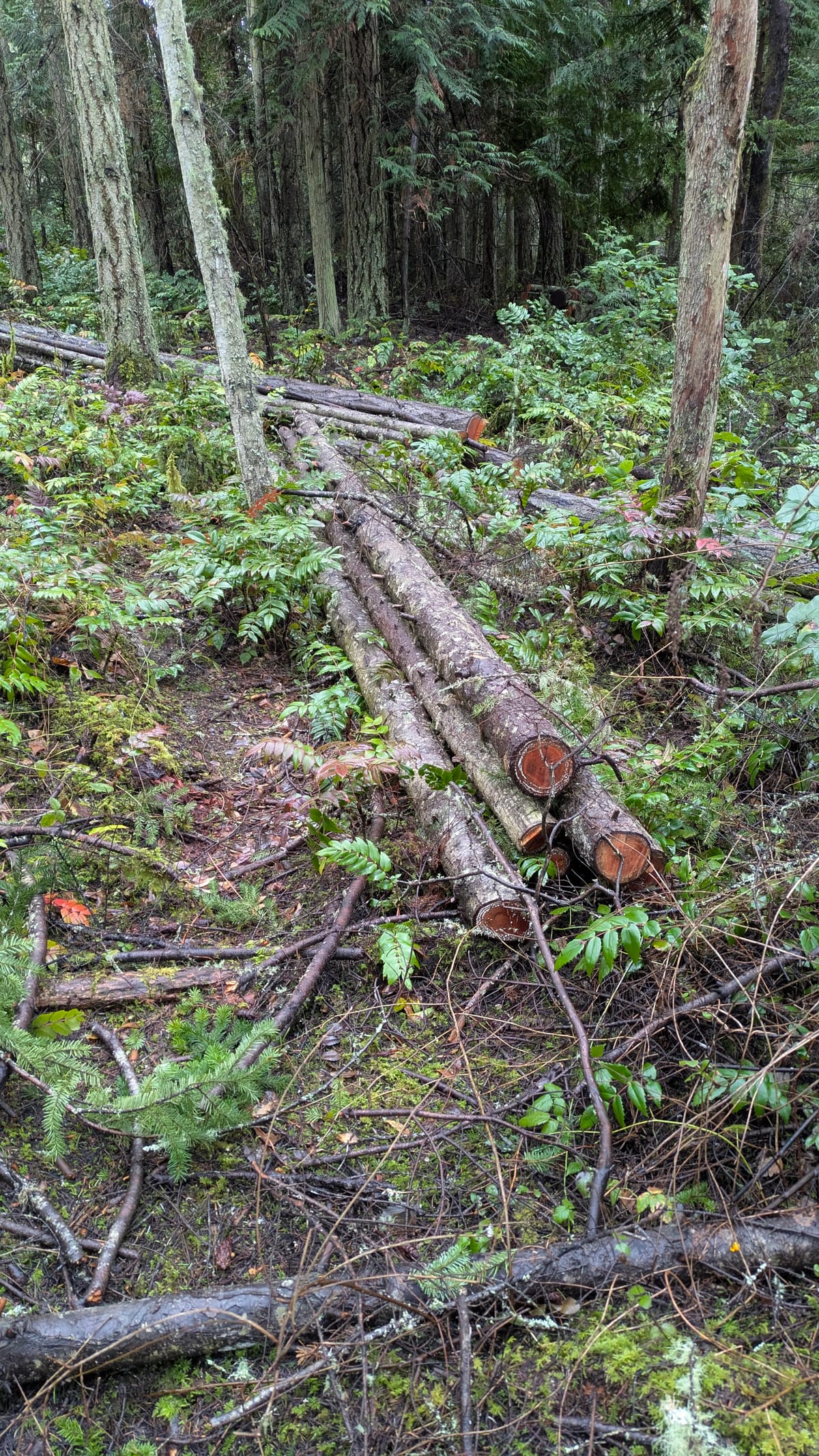
Shortly before Clendaniel’s forest tour with The Beacon, she was felling small-diameter trees with a chainsaw to provide more sunlight in dense patches of the woods. Open patches are necessary for new understory growth and for adjacent trees to increase in diameter and develop larger treetop crowns. These small, freshly cut trees are arranged in small piles to become nurse logs, which are excellent habitat for newts and salamanders.
“Our forests need to be more diverse, both in terms of species and age and structure to face coming climate change impacts. So that when some sort of impact happens, it doesn’t take out the whole forest in one go. The more diversity there is, the more ability for the forest as a whole to resist change and also to recover from change,” Clendaniel said.
Clendaniel said that historically, a walk through these forests would find one stepping into a nurse log every five steps. Now, she said, not even five percent of the forest floor has nurse logs.
“Within the Collaborative, we’re trying to accelerate the development of these complex forests that are going to be critical for the wildlife that specialize, that don’t have those places left in our landscape,” Clendaniel said, “We’d like to see over time that we are getting more birds who depend upon more complex forest conditions.”
“Together, monitoring and active land management are helping us make progress towards that desired future condition of a structurally and species diverse forest that is resilient to climate change—whatever that may bring,” Clendaniel said.
For more information about the Jefferson Land Trust, visit: https://saveland.org