Jefferson County Plans New Solid Waste Transfer Station as Recycling System Changes Take Effect
Existing waste transfer station proves to be inadequate for current—let alone future—needs.

News by Scott France
Jefferson County Public Works is moving forward with plans for a new solid waste transfer station, a long-anticipated project intended to replace the aging facility.
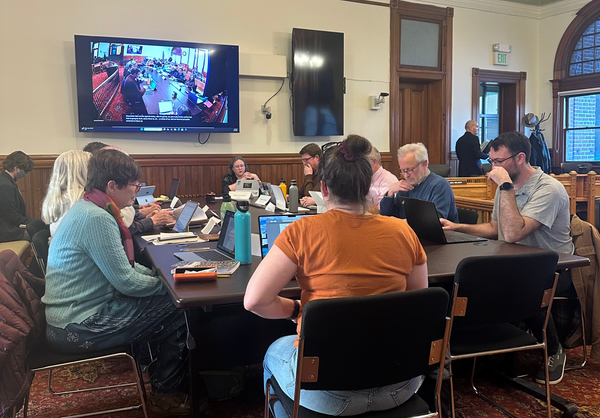
A 20-acre property at SR 19 and Highway 104 has been identified as the best available property, announced Solid Waste Program Manager Al Cairns at a meeting of the Board of County Commissioners (BOCC) and Solid Waste Facilities Task Force at the Tri-Area Community Center in Chimacum on January 26.
Built in 1993, the current transfer station has served the county for more than three decades, but officials say it is no longer capable of meeting present—let alone future—needs.
Since 2022, Public Works staff have worked with consultants and the county’s Solid Waste Facilities Task Force to design a replacement that can serve Jefferson County residents for the next 40 years. According to Cairns, the urgency is clear.
“We have increased staffing over the years to match the increase in material volume and improved operational efficiencies in every area we could,” Cairns said, “However, the transfer station has operated at more than 40 percent over its designed capacity for over a decade. We simply need to build a new and more efficient facility for the next 40 years.”
Cairns said that the Task Force explored many options for adapting the current site to accommodate the changes it deems necessary for the next 40 years. It found that the existing site is too small to handle current traffic volumes, requires major capital repairs, and relies on aging infrastructure nearing the end of its useful life. The planned facility is intended to improve traffic flow, worker safety, and operational efficiency while accommodating population growth and increasing waste volumes.
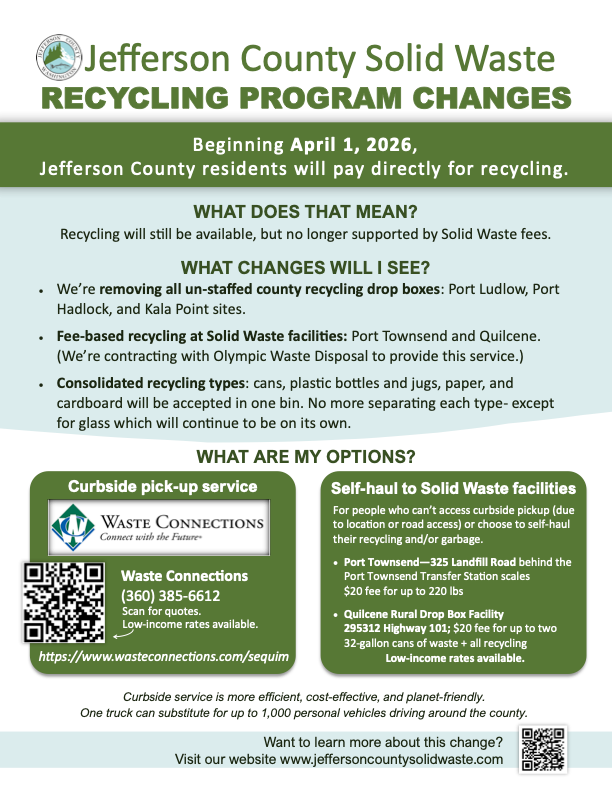
While planning for the new transfer station continues, county officials are also preparing residents for significant changes to the recycling program, set to take effect April 1, 2026.
Recycling fees coming in 2026
Beginning next spring, Jefferson County residents will pay directly for recycling services. County officials say this change reflects a long-standing imbalance in how recycling has been funded.
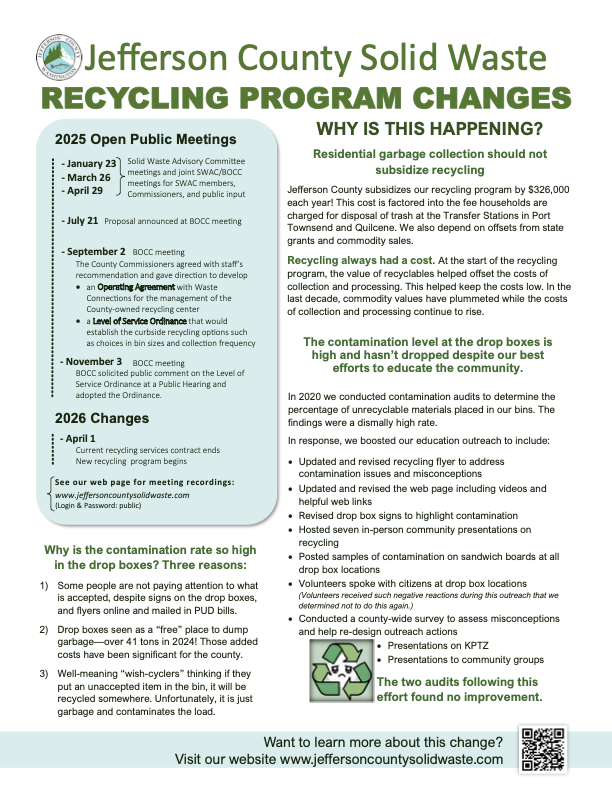
Currently, the county subsidizes recycling by approximately $326,000 per year. That cost is built into the disposal fees residents pay for garbage at the Port Townsend and Quilcene transfer stations, meaning trash disposal has effectively subsidized recycling. Additional support has come from state grants and the sale of recyclable commodities.
“Recycling always had a cost,” explains a county pamphlet on waste. When the program began, higher commodity prices for recyclable materials helped offset collection and processing costs. Over the past decade, however, those markets have collapsed, while labor, transportation, and processing costs have continued to rise.
County commissioners addressed these realities during a series of public meetings in 2025. At a September 2 BOCC meeting, commissioners agreed with staff recommendations to develop an operating agreement with Waste Connections for managing a county-owned recycling center and to draft a Level of Service Ordinance outlining curbside recycling options, including bin sizes and collection frequency.
On November 3, after a public hearing, the BOCC adopted the ordinance, setting the stage for the new recycling system when the current contract expires on April 1, 2026.
Why drop boxes are going away
One of the most visible changes will be the removal of all unstaffed county recycling drop boxes at Port Ludlow, Port Hadlock, and Kala Point. County officials cite persistently high contamination rates as the primary reason.
Despite years of education efforts—including signage on bins, mailed flyers, and online information—contamination levels have remained stubbornly high. Audits conducted in 2020 found a “dismally high” percentage of unrecyclable material in the bins, a trend that has not improved.
Public Works identifies three main causes. First, some users simply ignore what is accepted. Second, the drop boxes are often treated as a free dumping ground for garbage; in 2024 alone, more than 41 tons of trash were improperly deposited, adding significant disposal costs. Third, so-called “wish-cycling” remains common, with well-intentioned residents placing non-accepted items in bins in hopes they can be recycled somewhere. Instead, these items contaminate entire loads, sending more material to the landfill.
What recycling will look like
Recycling will still be available countywide, but it will no longer be supported by solid waste disposal fees. Instead, residents will have fee-based options.
Recycling services will be offered at the staffed solid waste facilities in Port Townsend and Quilcene, under a contract with Olympic Waste Disposal. To simplify the process and reduce contamination, recyclable materials will be consolidated. Cans, plastic bottles and jugs, paper, and cardboard will all go into a single bin. Glass will continue to be collected separately.
Curbside recycling options, including different service levels and collection frequencies, will be governed by the new Level of Service Ordinance.
County officials emphasize that these changes are intended to make the system more financially sustainable while improving recycling quality and reducing contamination-related costs.
Looking ahead
The planned transfer station and recycling overhaul reflect broader challenges facing rural and small counties nationwide: aging infrastructure, rising operational costs, and volatile recycling markets. For Jefferson County, the goal is to build a solid waste system that is safer, more efficient, and financially transparent.
Cairns said that the new facility would likely not be up and running until 2032, at the earliest. The cost estimate has not yet been finalized by the program consultant, but Cairns put the range at between $8 million and $20 million.
Public Works encourages residents to review meeting recordings and program details at www.jeffersoncountysolidwaste.com (login and password: public) and to stay engaged as plans for the new transfer station and recycling program move forward.
As Cairns put it, the choices being made now are about preparing Jefferson County for the decades ahead—even if they require some near-term adjustments for residents.