Jefferson County Youth Challenged by Limited Activities, School Funding Gaps, and Mental Health Concerns

News Commentary by Ross Pruden
Port Townsend is famous for its annual Wooden Boat Festival, but some kids have complained that it can be hard to find anything to do if you don't do maritime activities.
High schoolers in Port Townsend spend their leisure time at The Nest—a youth-oriented space and coffee house in uptown Port Townsend within walking distance of PT High School—but even in that youth-centered space, it can be challenging.
“I can rarely find a private alcove like I used to,” one student from Port Townsend High School said, “because it’s always occupied by an adult.”
Aldrich’s and Elevated Ice Cream are also welcome hangouts, and the Uptown Public Library is a good, quiet place off the PTHS campus, but all of these places only provide space for kids to hang out, not things for them to do.
As for activities, there are actually many non-maritime programs, volunteer opportunities, and career training pathways for high schoolers, including opportunities with The North Olympic Salmon Coalition, Jefferson County Land Trust, Sunfield Biodynamic Farm Internship Program, Jefferson Teen Center, and Jefferson Healthcare Job Shadowing. All of these organizations have programs specifically geared toward youth. What they don’t have, however, is a way for youth without reliable transportation to take advantage of these opportunities. Even teens who live within city limits may struggle to make a commitment that requires transit.
School Funding Gaps
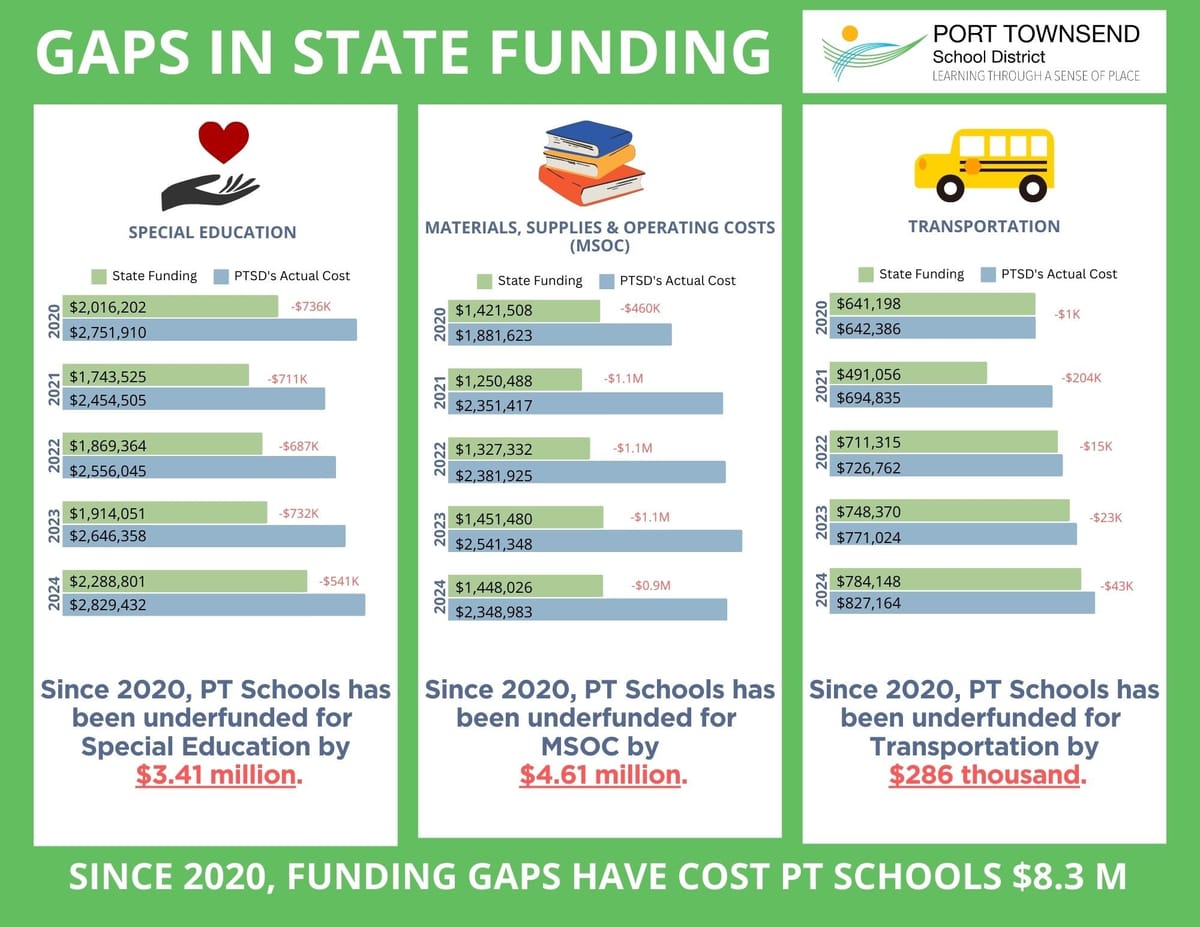
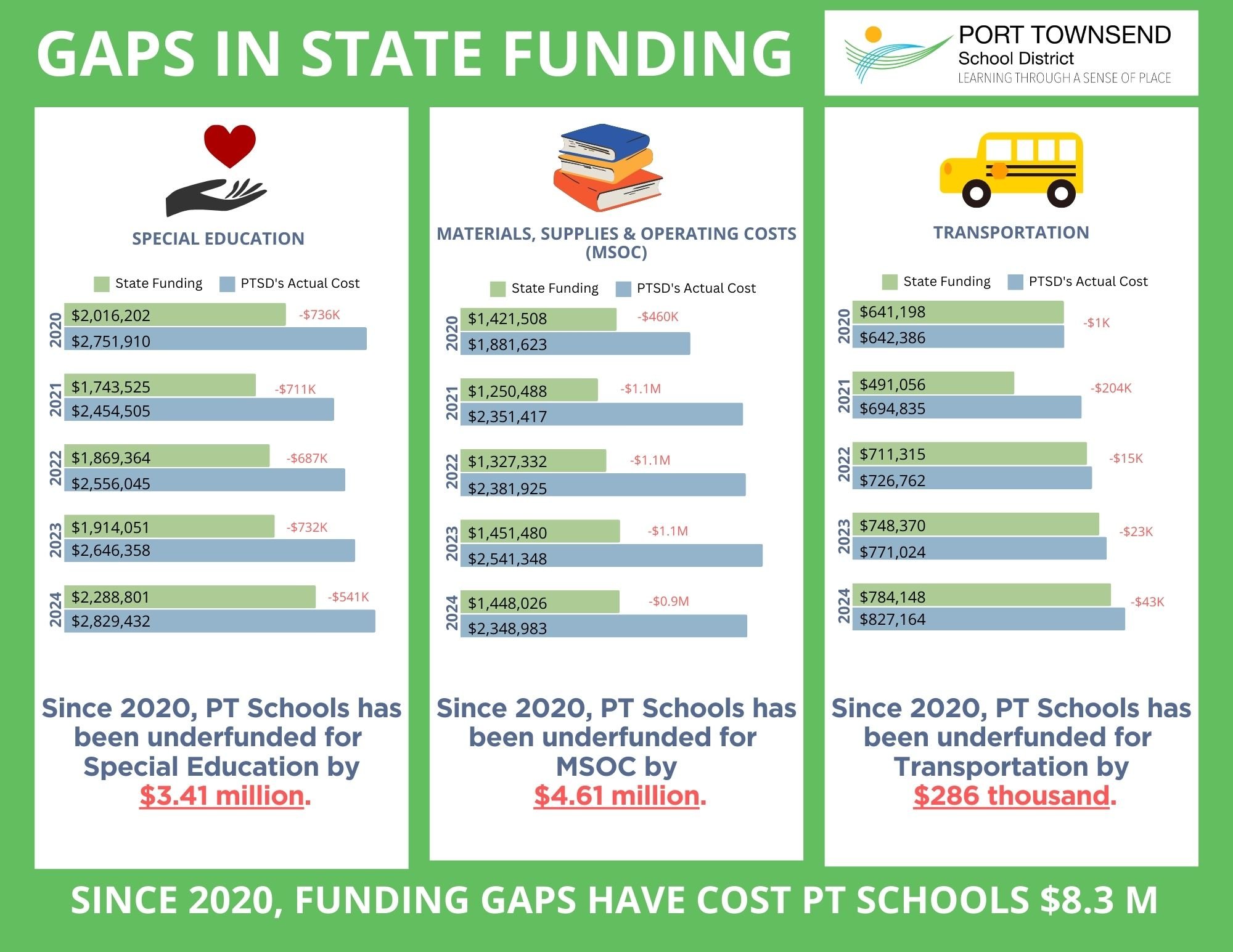
The Washington Constitution unequivocally requires public schools be “adequately funded,” but since 2020, Jefferson County schools have been underfunded by over $9 million: $5.72 million for Materials, Supplies, and Operating Costs, $3.41 million for Special Education, and Transportation was underfunded $286,000.
It is challenging to cut school funding because much of the school budget’s operating expenses are spent on staff salaries and benefits. School districts are left with no other option but to hope voters approve tax levies to cover the funding that the State has not been able to give them.
Assuming the levies aren’t passed in this week’s special election, many Port Townsend school programs might get restructured or nixed altogether. Even if the county’s levies pass tomorrow in Chimacum, Port Townsend, and Quillayute Valley, there are no guarantees that those programs will be funded.
It’s about equity
Dr. Linda Rosenbury, superintendent of the Port Townsend School District, shares a key insight: “If students aren’t attending school programs, it’s not because they aren’t being offered—it’s because there’s a lack of transportation or similar factors related to low-income families. For example, if you can’t get picked up by a family member from an after-school soccer practice, why would you even try out for soccer? When we talk about providing more ‘equity’ in education, it’s not usually based around race or gender, but about dealing with the challenges faced by low-income students… like transportation.”
Hannah Nordstrom, a recent high school graduate from Port Townsend High School, said: “When I was in high school, I lived in Port Townsend but not near town. I didn’t have access to a car; if I had, I would definitely have done more after-school programs. I just couldn’t get to them.”
It’s clear there is a real gap between low-income students and those who have more access to resources, both during and after school.
In 2024, only 73.5% of low-income 9th graders at PTHS passed all their classes, compared to 93.9% of non-low income 9th graders, a 20% gap. At Chimacum High School in 2023, only 29.4% of low-income students passed all their classes compared to 76% of non-low income 9th graders. (Source: Washington Office of Superintendent of Public Instruction)
Kids Mental Health—here and elsewhere
How are kids in Port Townsend doing overall compared to the rest of Washington State? Let’s look at two well-documented data sets: Mental Health and Alcohol Use for 10th and 12 graders. Seniors in Jefferson County did better in 2023 than in previous years, but 10th graders (who endured COVID at ages 12-14) are worse than the State average in every category (No adults to turn to when depressed; Feeling nervous, anxious, or on edge; Unable to stop or control worrying; Generalized anxiety disorder; Depressive feelings, etc.).
[caption id align="alignnone" width="2174"]
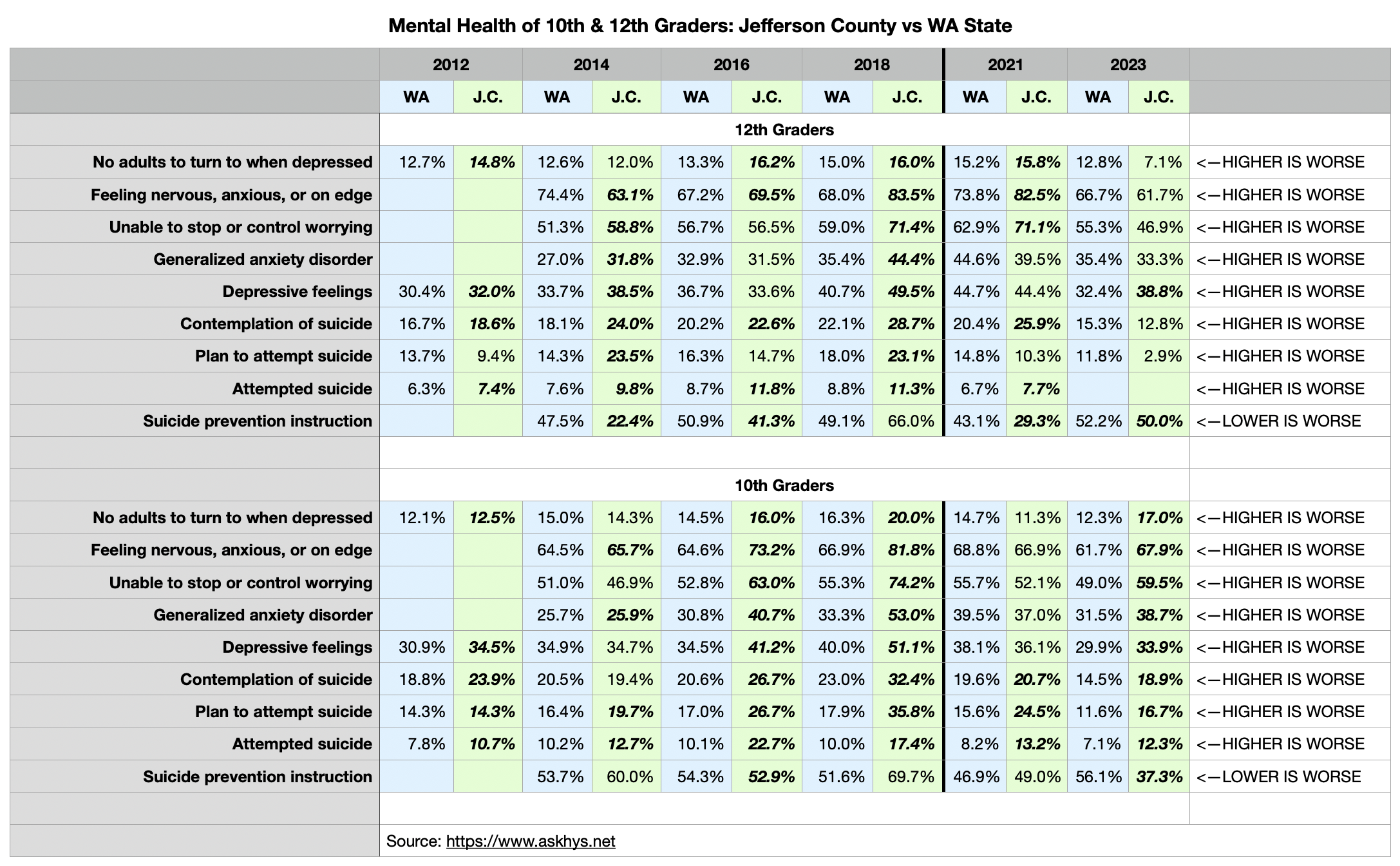
Mental Health Comparison Between Jefferson County and Washington State [/caption]
The state’s self-reporting health surveys are bi-annual, so we have no data for 2024. However, in 2023, 12th graders did much better than the state average in terms of mental health overall. Still, underage alcohol use is concerning for both 12th and 10th graders in that year. All alcohol categories for 10th graders and nearly all categories for 12th graders are worse than the state average, while 25.9% of 12th graders self-reported as drinking alcohol (7% more than the state average), 10th graders in Jefferson County have a stunning 64.4% access to alcohol, an increase of nearly 25% over the state average… and their lifetime alcohol use is 58.8%, nearly 20% higher than the state average. (Source: Washington Health Youth Survey)
These statistics show what Jefferson County youth are facing: chronic underfunding of public schools, voters likely unwilling to vote for new tax levies, and COVID-traumatized youth isolated by rural geography who have turned to alcohol.
Young people in Port Townsend and the rest of Jefferson County need help getting to and from activities; there simply aren’t enough safe and reliable transportation alternatives for them. They can’t do after-school soccer if they can’t get home from practice. They can’t join Mock Trial practices on Saturdays. They can’t do night classes. Kids from low-income families are being robbed of the most important part of their childhood—volunteering, job training, and overall world experience that prepares them to be a better worker, a better citizen, and a better person.
Old Meets New
Jefferson County needs a budget-friendly solution to the low-income problem, and Judge Brandon Mack has a good one.
“We need a volunteer program with those willing to shuttle students from low-income families. Many people in our community—for example, retirees—are still looking for some way to help, and this would be a great way to do it,” Mack said.
If we want to ensure all the youth of Port Townsend and Jefferson County attend after-school programs and create the kind of community involvement that prepares them for life after high school, we have to do more than just get adequate public school funding or approve tax levies that bridge the shortfalls. We have to make sure the least able in our community have equal opportunity to get out of their front door and then get back home again.