Jefferson County’s $5.2 Million Deficit Explained
General fund prioritizes mandated spending.

JEFFERSON COUNTY, WA — For residents, the news of deep budget cuts, staff layoffs, and the near-closure of the Port Townsend Rec Center may have felt sudden. However, the fiscal crisis that led to a projected $5.2 million general fund deficit was years in the making due to structural revenue problems, skyrocketing mandated costs, and a lack of long-term planning.
The 2026 deficit is not merely a spending problem. It is, in the words of District 2 Commissioner Heidi Eisenhour, a “structural revenue issue” baked into the way Washington State funds local government.
At a March 28 budget workshop held at the Connectivity Summit, County Administrator Josh Peters and county commissioners walked a room of concerned citizens through the fundamentals of the crisis. Three structural problems emerged as the core drivers.
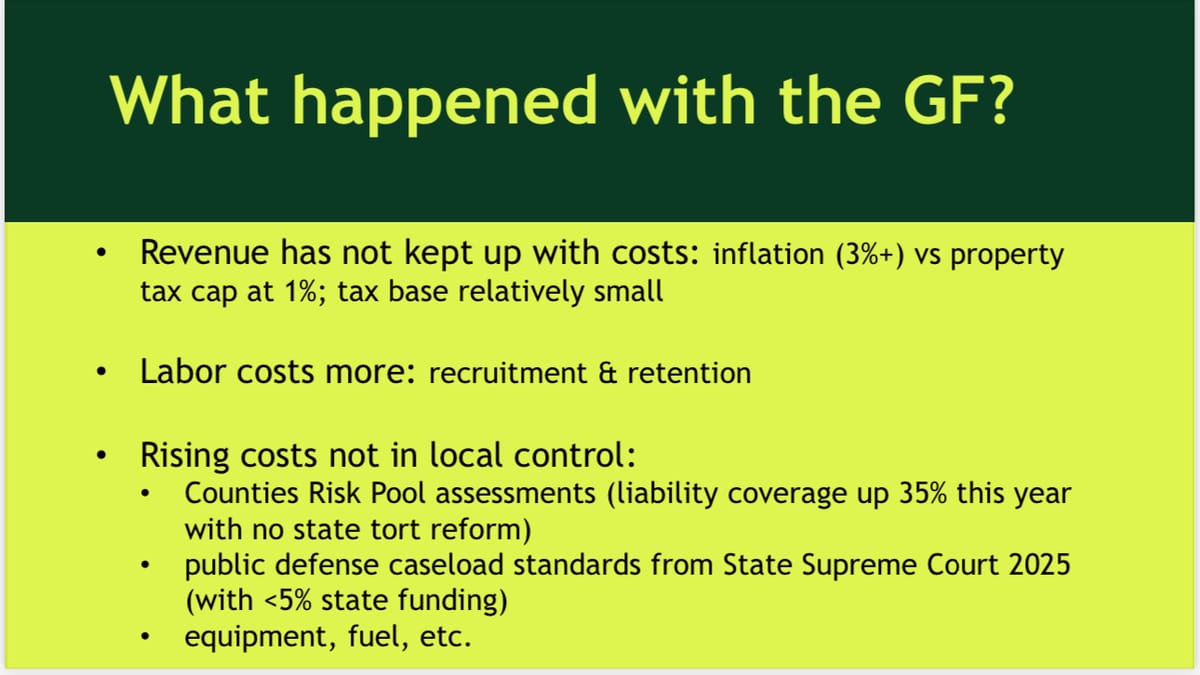
The 1% cap on property tax increases
Property taxes are the county’s largest single source of General Fund revenue. But under state law (RCW 84.55.005), counties cannot increase their regular property tax levy by more than 1% per year without a vote of the people.
As Peters explained, this cap has created a widening gap between revenue and costs. “Think about how things cost more, but we’ve only been able to bring in revenue to try to meet those costs at a cap of 1% per year,” he said. “It creates a system that makes it pretty hard to keep up. And we’ve been doing sort of more with less for many years, and it’s really caught up with us.”
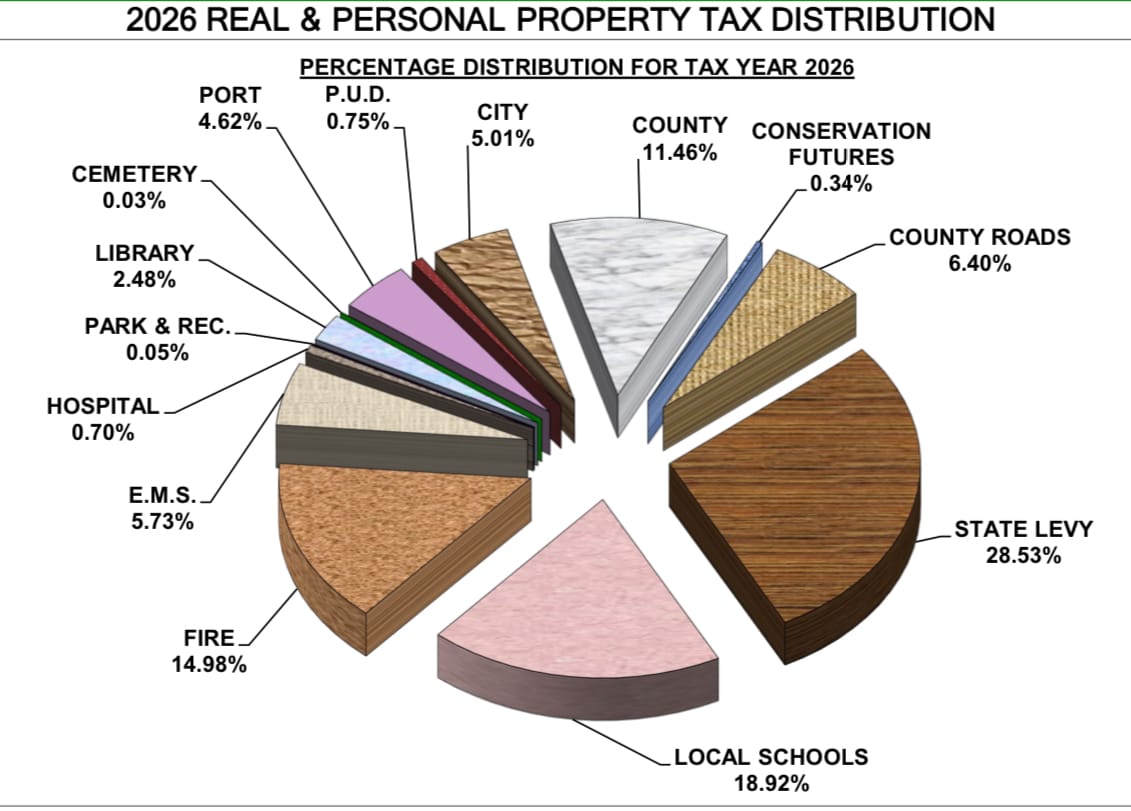
A question from the audience revealed a common point of confusion: If property values are rising rapidly, why doesn’t tax revenue rise with them? Treasurer Stacie Prada clarified that the 1% cap applies to the total levy amount, not to individual property assessments. When values go up, the tax rate is adjusted downward to ensure the total collected doesn’t exceed the 1% increase (plus new construction). The result is that the General Fund’s share of a typical property tax bill has shrunk over time, from roughly 17% of the total years ago to just 11% today. Property taxes are distributed as shown below.
The public defense mandate
Public defense is a constitutionally mandated service that counties must provide. The judicial system is also one of the fastest-growing costs in Jefferson County.
Peters noted that the state provides less than 5% of the funding for this mandated service, leaving counties to shoulder the rest. In 2025, the Washington State Supreme Court issued new caseload standards for public defenders, requiring counties to hire more attorneys to handle the same number of cases. The result, Peters said, is that public defense costs—already at $1.3 million in 2026—will “just keep going up and up” over the next decade.
The Washington State Association of Counties is currently suing the state over this funding imbalance.
The insurance spike
In 2026, the county’s insurance premium increased by 35%. Total insurance costs now stand at roughly $2.2 million, with $1.2 million of that coming directly from the General Fund.
Peters explained that the county participates in a risk pool with about 20 other counties to guard against liability from lawsuits. In Washington, jury awards in lawsuits have skyrocketed, driving up premiums across the board. “We’ve got to go all the way to London or elsewhere to get people to want to insure us,” Peters said. A bill in the state legislature to address tort reform, which could have limited litigation faced by counties, died this session.
Taken together, these three forces form the structural foundation of the deficit.
The 2026 deficit amount
The 2026 General Fund revenue budget is $28,474,383, down approximately $500,000 from 2025. But the deeper problem, Peters revealed, is that the county has been deficit spending for years.
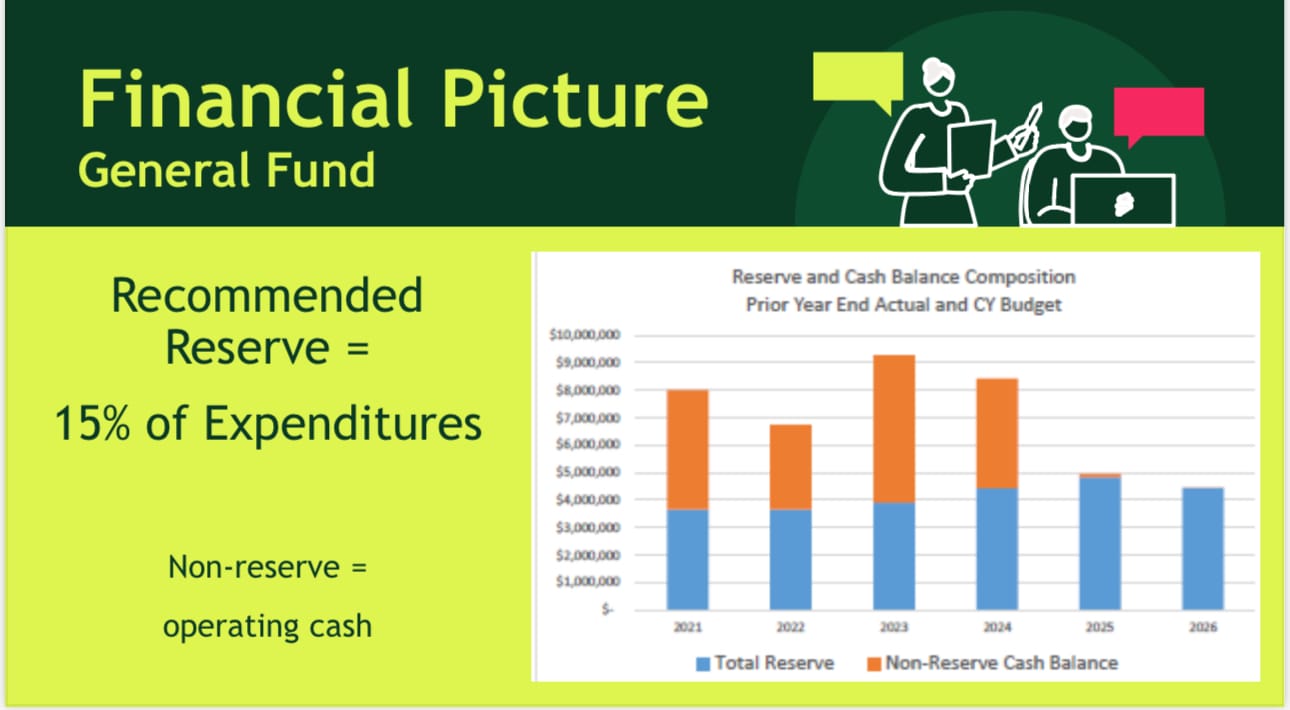
In 2025, the county spent $3 million more than it brought in, drawing down reserves to cover the gap. The adopted 2026 budget still carries a deficit of roughly $1.1 million, meaning the county is “borrowing time” from the reserves to address fundamental issues.
“We can’t continue to keep deficit spending, clearly, just like you couldn’t in your own household,” Peters said. “But temporarily, though, we’re borrowing time to be able to address some fundamental issues in our budgeting process.”
The county’s reserve policy, set by the Board of Commissioners, targets a balance equal to 15% of annual expenditures—roughly $4.3 million left in reserve. But the projected year-end balance for 2026 is just $3.85 million, well below that target. Even more concerning, the county has been operating with virtually no “operating cash” (reserves above the 15% reserves) this year, creating cash-flow problems that forced the county to scramble to pay a $2.2 million insurance bill in January while waiting for property tax revenues to arrive in March.
“We’d like to build that orange back up,” Peters said, referring to the operating cash portion of the fund balance.
The mandated vs. discretionary distinction
One of the most significant revelations from the March 28 workshop was the county’s effort to categorize every service as either mandated by state law or discretionary. Commissioner Heather Dudley-Nollette walked the audience through a newly created flip book that lists mandated services—criminal justice, prosecution, public defense, superior and district courts, jail services, law enforcement, property tax administration, elections, public health (in part), roads, and land use under the Growth Management Act.
“These are all the non-fun stuff,” Dudley-Nollette said.
The discretionary services—the things the county does because the community values them, not because the state requires them—include:
· Parks and recreation programs and facilities (23 parks countywide)
· Community centers (Port Townsend, Quilcene, Brinnon, Tri-Area, Gardiner)
· The Jefferson County Fairgrounds
· WSU Extension programs (4-H, Master Gardeners, noxious weed control)
· Non-mandated public health services (school-based health centers, sexual and reproductive health, foot care programs, freshwater monitoring)
In the 2026 budget, these discretionary services took the deepest cuts. Parks and Rec was mandated to reduce expenditures by 25%, WSU Extension by roughly 30%, and the Department of Community Development lost its code compliance coordinator and fire marshal position.
The Parks & Rec cuts
The most visible impact of the budget crisis has been on the county’s Parks and Recreation program. The $250,000 cut (25% of its budget) put the future of the Port Townsend Rec Center in question.
A special public meeting has been scheduled for April 10, 2026, at 5:00 p.m. at the Port Townsend Rec Center to discuss the future of the facility and other park services. However, the location has raised accessibility concerns, as the gym is not wheelchair accessible. County officials are exploring alternative spaces within the community center.
Parks and Recreation staff have said that $85,000 in community donations would allow current services at the Rec Center to continue through the end of 2026. $250,000 would completely replace the lost General Fund revenue and restore 2025 service levels. The community successfully fundraised the amount needed for the Port Townsend Rec Center as of Monday, March 30.
But the long-term challenges are even more daunting. The Port Townsend Community Center, which houses the Rec Center, needs $2.5 million in capital improvements, including a new roof. The county owns the building and is responsible for its upkeep.
The community responds: Priorities, ideas, and frustrations
The March 28 workshop was not just a briefing; it was an attempt to engage the community in the difficult trade-offs ahead. Attendees were asked to consider: if discretionary services had to be cut to the bone, which one would you bring back, and why?
The conversation revealed deep community values and deep frustration with the constraints the county faces.
Public health emerged as a top priority, with some attendees arguing that recreation programs for youth should be considered a public health service. Others noted that the 2019 Community Health Assessment identified stress as a top health concern, and that nothing has been done to alleviate stressors for teens since then.
One attendee challenged the framing of the exercise, saying, “I can’t answer this question . . . this is awful.” Commissioner Dudley-Nollette acknowledged the pain: “That’s how we feel when we’re up on the dais and somebody is saying, ‘Well, here’s the dollars. Cut something. Cut one of these things, the things that make our lives whole.’”
Dudley-Nollette introduced the concept of moving beyond the current model where “county government has been doing these things in X way for all of these years.” She suggested deeper partnerships with the city, school districts, nonprofits, and the private sector to sustain services without relying solely on the county General Fund.
One attendee asked why the county isn’t pushing to raise the 1% property tax cap. Peters noted that this would require action by the state legislature, making it a long-term solution, not an immediate fix.
District 3 Planning Commissioner Andrew Schwartz reminded the audience that the county’s Comprehensive Plan is being updated right now, a 20-year vision that should reflect what the community wants. He urged everyone to get involved.
The City-County partnership: A work in progress
One attendee asked whether the county and the City of Port Townsend are discussing the Rec Center. Dudley-Nollette confirmed that conversations are ongoing and deepening.
She revealed that she meets monthly with City Manager John Mauro, and that Peters meets weekly with Mauro and other public-sector administrators in a “public sector cabinet.” These meetings are open to the public, though they have not been widely aware of them.
Dudley-Nollette also recounted that after a recent Board of County Commissioners meeting where 120 people spoke in support of the Rec Center, she immediately contacted Mauro to discuss how the city and county could collaborate more closely.
Peters brought attention to the roof repairs needed for the Rec Center, totaling approximately $2.5 million. When referencing previous conversations with the city, Peters jokingly said, “Hey, do you want this Rec center, it’s in Port Townsend? [They said] does it come with a fixed roof?”
One model under discussion is a regional parks district that would combine the city’s parks department with the county’s, creating economies of scale and its own taxing authority. A similar conversation took place 12-15 years ago during the last recession, but they never resulted in a ballot measure. The county is now revisiting that idea.
What comes next
The April 10 meeting at the Rec Center is the next major milestone. But the county faces longer-term decisions with significant consequences.
Peters outlined the budget timeline:
· Now through June: Long-term fiscal planning, including the mandated services exercise
· Summer: Budget goals adopted, budget call issued to departments
· Fall: Department presentations, board workshops, public hearings
· December: Final budget adoption
He also noted that the county will begin negotiating new collective bargaining agreements this year, as the current contracts expire in December. With the county already in a deficit position, those negotiations will be challenging.
As for potential ballot measures, Peters confirmed that the county is considering a levy lid lift dedicated to parks and recreation or community services more broadly. The August primary election is the first opportunity, but the county is not required to meet that deadline. “If you wanted to do something like that, we could do that,” Peters said. “But there are deadlines. And so we are at least going to consider that question.”
For residents, the question is no longer whether county services will change, but which services will survive and what the community is willing to do to save them.
As Commissioner Dudley-Nollette said at the close of the March 28 workshop, “We don’t have to stop at ‘money is tight.’ We need to be truthful about that. We need to be transparent about that. We need to be willing to make adjustments . . . but part of the paradigm shift is how do we partner more deeply in the community to actually create new ways of getting what this community wants?”
The answer, she suggested, will not come from the county alone. It will require all of us at the table.
If you go
The Board of County Commissioners will hold a special public meeting on the future of the Port Townsend Rec Center and county parks services on:
· Date: April 10, 2026
· Time: 5:00 p.m.
· Location: Port Townsend Rec Center Gym, 620 Tyler Street, Port Townsend (note: location may change due to accessibility concerns; check county website for updates)
To stay informed
Sign up for county emails at co.jefferson.wa.us (look for Communications section).