Josh Peters Prepares for County Leadership Job


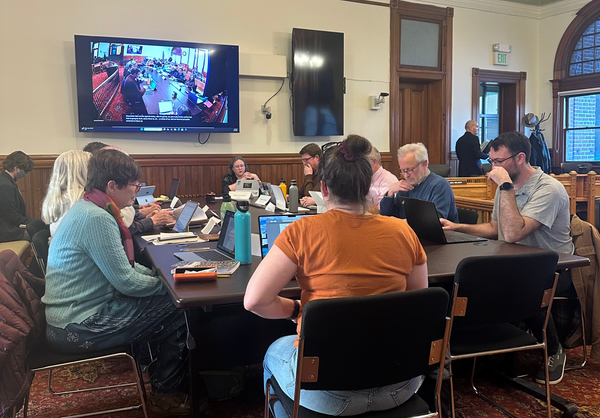
[caption id align="alignnone" width="1800"]

Photo courtesy of Josh Peters [/caption]
News by Scott France
Josh Peters, appointed on April 30 as administrator for Jefferson County, sat down with the Beacon to discuss the role and responsibilities of the Jefferson County administrator, and to outline key issues and priorities he will address.
Peters is currently the director of the Department of Community Development (DCD) for the county. He will replace outgoing administrator Mark McCauley in June, though the exact date has not yet been determined.
The County Administrator serves as the Chief Executive Officer for the County and is responsible for carrying out all decisions, directives, policies, ordinances, and resolutions made by the Board of County Commissioners (BCC). County department heads, such as those for Community Development, Public Health, and Public Works, report to the administrator, while elected officers, such as the auditor and treasurer, do not. However, the entire budget process and overall administration for the county go through the administrator’s office.
Peters was appointed by the BCC after a nationwide search, with Commissioner Greg Brotherton abstaining as he was a candidate for the position. Peters’ offer letter is for three years, which could be extended.
Peters said that he had not given serious thought to pursuing the administrator position until Spring of 2024. “ Mark put the idea in my head almost a year ago,” Peters said, referring to McCauley. “I gave it a lot of thought over 2024, before deciding to throw my hat into the ring.”
Having worked for the County for more than 14 years, Peters said that he is familiar with his colleagues, he knows what the departments and offices do, but that he will have to learn what those departments’ needs and visions are as well as what each commissioner is interested in, “and as a team what kind of puzzles are they solving. For me, it’s not what I want, but it’s what the community wants as expressed through the people they elected, and the policies they’ve set,” he said.
Peters cited housing affordability at the top of the key issues the County faces, as well as “employment, economic development, policy choices around continuing to fund the roads program, justice concerns around funding and sustainability, emergency preparedness and continuity of operations.” Peters also mentioned climate resiliency planning, food systems planning, and emergency preparedness, as rising in importance as “the message from federal government seems to be to not expect to be there to help when needed,” he said.
"If an earthquake happens and the bridges go down, we need to rely on ourselves,” Peters said. Fortunately, he continued, “collaboration with local partners is at a scale that is at the deepest level it has been in 25 years. That is vital, and I anticipate that we will continue putting a lot of energy into collaboration with our partners.” Peters is also “very interested in state process,” as it affects the county. “I and the commissioners are interested in government relations at the federal level, as well.”
Regarding the local economy, Peters said, “We’re trying to pull the right levers and push the right buttons to foster economic development, but there are complications everywhere you turn in terms of what tools are available to the county to do things. There are severe restrictions on what we can do. For example, the county is restricted from rezoning property that is vacant to commercial or industrial use.”
One of the few areas that the County can expand is its light industrial land base; it has been working on expanding the light industrial park around the airport with the Port of Port Townsend. Peters said that the sewer system being built in the Irondale/Port Hadlock area “will be a game changer, and we’re putting a lot of eggs in that basket.”
”Now we’re talking about what the plan is for Glen Cove. Is it possible to extend the sewer to Glen Cove? Would that be something that people are interested in investing in?” Peters said.
“Housing is a key consideration of our economic development,” Peters said, “because you can’t attract businesses and employees if we don’t have an adequate housing supply that’s affordable. Do the city and county have something to do with it? Sure, but there’s a lot of bigger factors at play that we don’t have control over.”
Peter said that the county’s financial solvency will be the major operational objective, in his opinion. “We’re doing OK at the moment,” he said, but he cited the challenges of “doing at least as much stuff with fewer resources” in a financial environment where inflation exceeds the one percent cap on property taxes increases that the county is allowed to impose, “unless you come up with creative ways to fund individual things.”
Peters prefaced his thoughts around the County’s top priorities in the next year or so, with a caveat that the BCC may have other ideas. Regarding a decision on a regional pool facility, Peters said, “We need to resolve the remaining questions regarding the proposed regional pool facility.”
Peters next highlighted the importance of having a plan to maintain the county's road fund, especially in light of the increased uncertainty of federal funding for roads. Finally, he cited the implementation of the comprehensive plan that was adopted recently.
He said that there are many other priorities, among which he mentioned developing a community wildfire protection plan
The County is now updating the housing element of the County’s Comprehensive Plan for the next 20 years, which will entail “a new twist” Peters said, in the form of a new requirement of counties in Washington state that they must plan to accommodate housing by income band, and to create and implement that plan using a model provided by the Washington state Department of Commerce.
Peters says that planning for middle and low income housing is important, and that the county’s development of a sewer system in the Irondale Port Hadlock area will help, but that laws incentivize maintaining farmland, forest lands and low density rural residential lands greatly restrict the power that the county has to put land into development for housing.
Finally, Peters said that the county is developing an artificial intelligence (AI) policy to create more efficient, county operations and customer interactions. “The County has a committee looking into how to implement AI,” Peters said. “Even if we’re not taking full advantage of the tools, we can’t just ignore it because it’s happening anyway. But we have to be careful and thoughtful.”