Light and Space Comes to Port Townsend

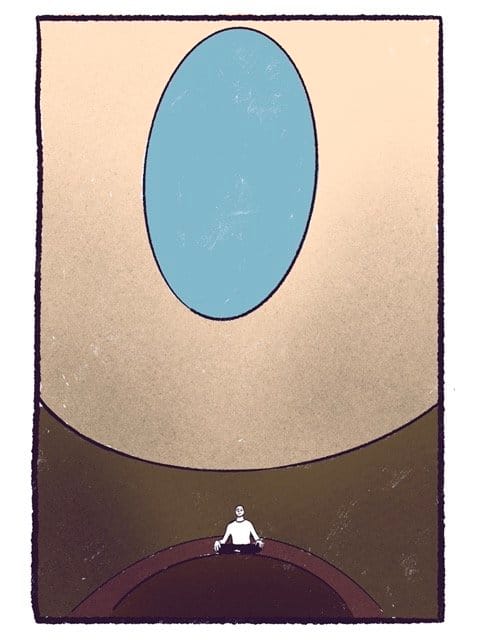
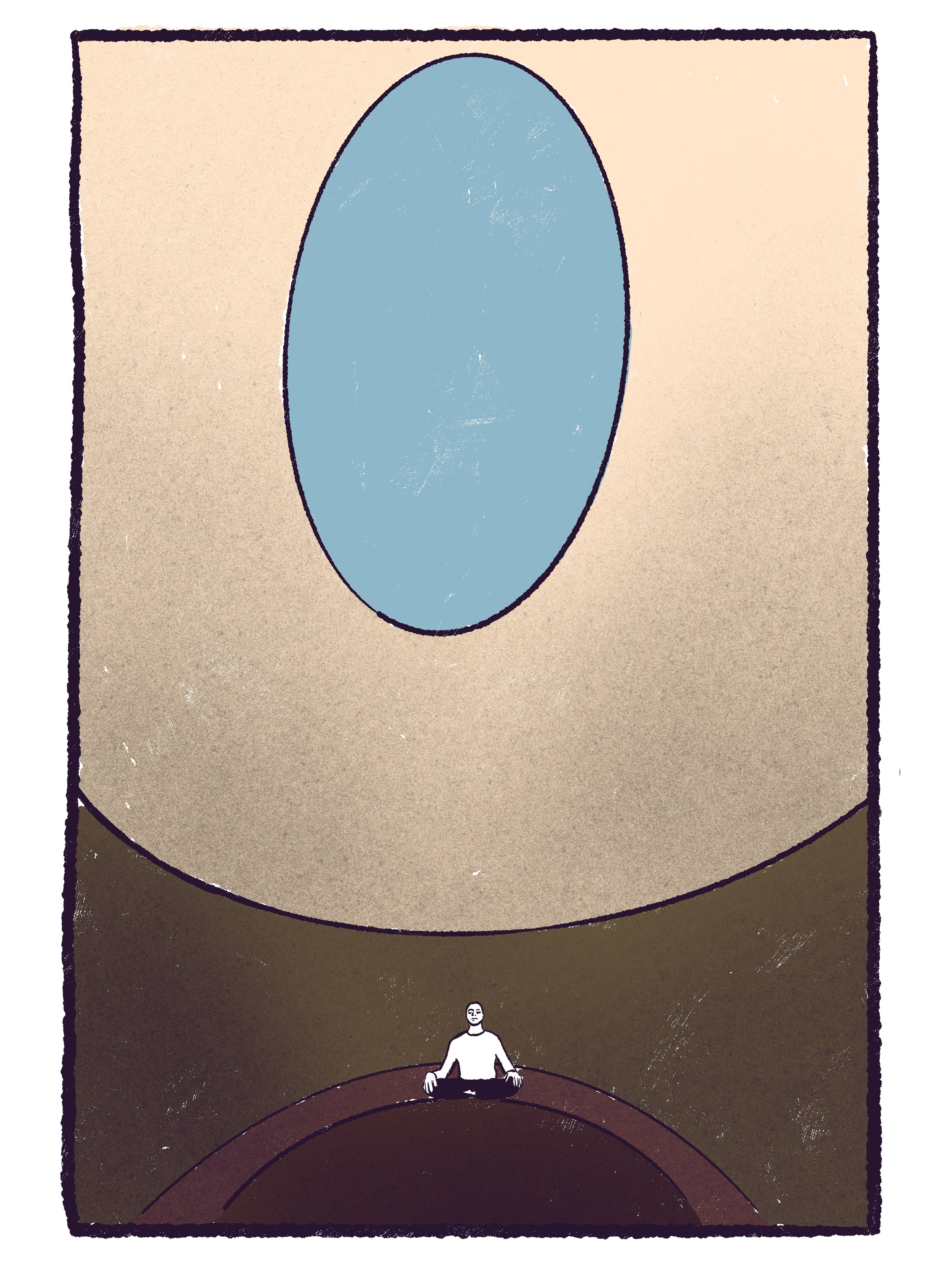
Illustration by Nhatt Nichols [/caption]
by Kathie Meyer
It first came up at a New Year’s Day party, from someone in the local Quaker community.
“We’re getting a Turrell.”
“A Turrell?” The name James Turrell was not in my mental artist Rolodex.
My friend explained that Turrell is a major mover and shaker of the Light and Space movement that began in Southern California in the 1960s. When they break ground to build the Camas Meditation Hall in Port Townsend, plans include a James Turrell skyspace, a piece that will be part of the lifelong series that has made his career. Dozens of his skyspaces have taken up permanent residency all over the world on almost every continent; over 75 of them are publicly accessible. There is, naturally, one in the James Turrell Museum in Argentina, but the closest one to us at this moment, “Light Reign,” is at Seattle’s Henry Art Gallery at the University of Washington, installed in 2003.
“It’s major,” my friend nodded.
A later cursory research glance reveals she is right. Turrell, along with Robert Irwin and others, began experimenting with light and dark, sun and shadow, time and space, sound and silence, fire, smoke, scrim, and string to create something that was more phenomenon than objet d’art.
My brother, Vincent Ramos, a respected Los Angeles artist, grew up in Venice, CA, so I start by asking him if he’s ever run into Turrell on his own artistic journey. He says no, Turrell had left LA for Arizona long ago, but the gym where our dad trained as a boxer was near the studio where Turrell began his life’s work. Dad pointed out both the studio and the gym to my brother one day a few years back before the dementia set in.
The studio is now a high-rise, and Turrell is now in every book on American art history that is comprehensive in any way.
Architects of nothingness
He wasn’t the only one. Working independently of each other for the most part, Turrell, Irwin, Larry Bell, Maria Nordman, and a few others experimented with simplistic elements in a complicated manner to create their work. Melinda Wortz, a University of Southern California art professor, called them “architects of nothingness.”
Wortz was nearly the only art historian tracking these artists early in their careers. The East Coast crowd was unaware until the end of the 1970s when, finally, the movement became too big to be ignored. By the time that happened, though, the artists had plenty of time to really dig into it before the critics started offering input. The time it took to thoughtfully create work without outside pressure was a fruitful and positive factor for their pieces. Not that too many of these particular artists cared then or now what anyone else thinks anyway.
[caption id align="alignnone" width="1570"]
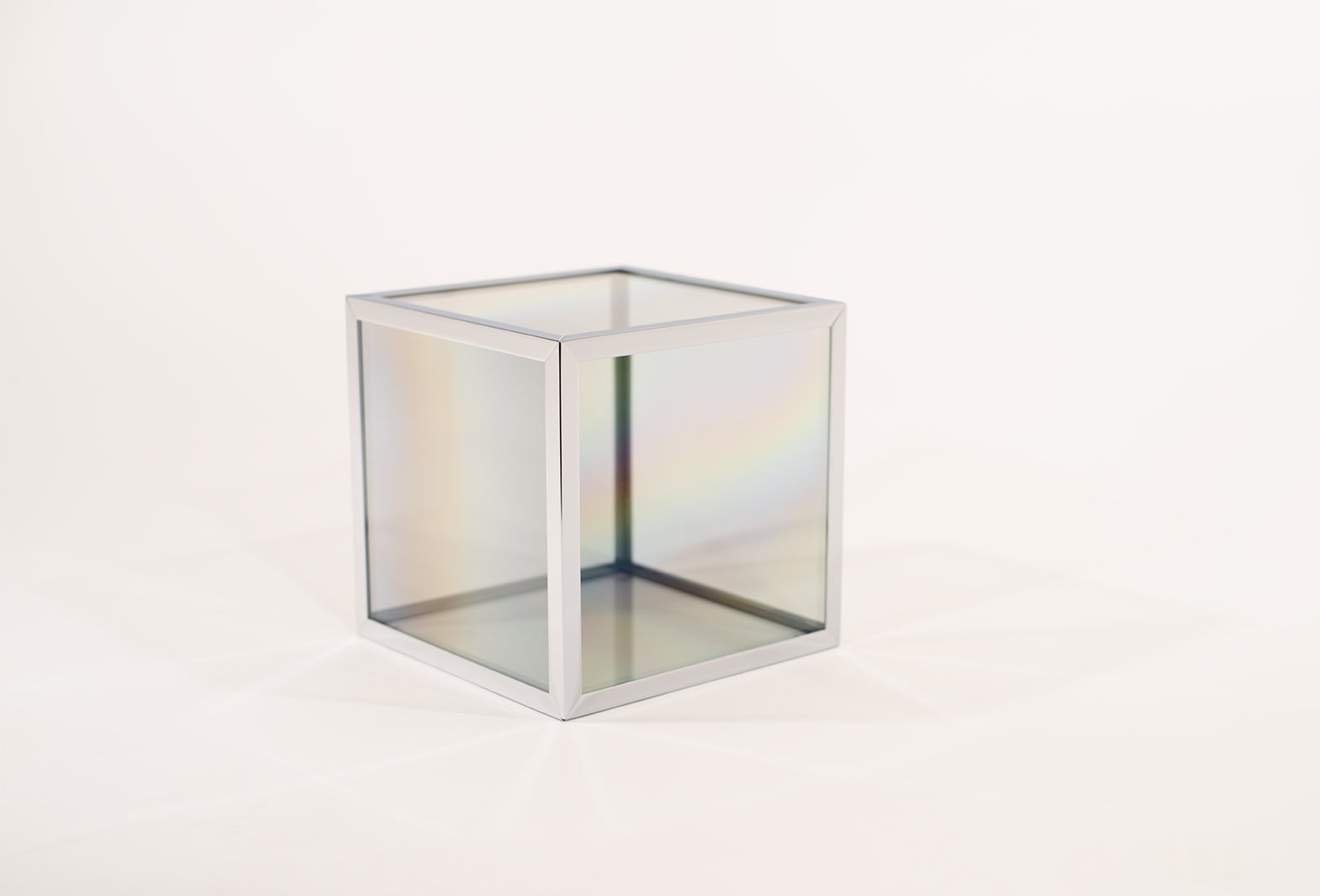
Cube 3 (8" Rainbow); Larry Bell; 1969/2022; 8 1/4 x 8 1/4 x 8 1/4"; 70's glass coated with copper and copper oxide and quartz with chrome plated brass edging. While this is not the Cube exhibited at Washington State University Museum of Art in 2006, Larry Bell's gallery manager offered this Cube as a fair representation of the artist's Cube work at that time. Photo courtesy of the artist. [/caption]
At least not Larry Bell. Early in my arts journalism career, I was flummoxed over an untitled piece of his in an exhibit at Washington State University’s Museum of Art. According to the column I wrote, I called him on the telephone. I must’ve mentioned I didn’t understand what was going on with his cube thing. Clearly, I didn’t know jack about any art movement out of Southern Cal.
Bell cheerfully explained to me how I had missed the subtleties of his work, which required moving around it to see the gray tones become lighter. He explained his process, which sounds complex. He did not mention his cubes have been in every museum featuring modern art that one might think of.
I am still chagrined to be reminded of asking one of the major living Light and Space artists for this clarification. My younger self was a cheeky dumbass sometimes. Clearly. However, I found Bell’s response reassuring.
“My work is about feeling. If my work is bewildering to someone, then I’ve succeeded,” he said.
This is the whole point of the Light and Space movement. You do not merely look at it.
You feel it.
Rush of blood
Describing it is awfully difficult, too. A mere photograph of Bell’s cube doesn’t do it justice. The best description of Turrell’s pieces is that they are illusions shaped by light in both soothing and jarring ways.
For some, it can be pretty intense, and surrender is necessary. Making use of the Ganzfeld Effect, the same thing that can make pilots become disoriented in the clouds, some of Turrell’s pieces can literally bring a person to their knees. Sometimes, people have been hurt. Sometimes, Turrell has been sued.
To get the full effect of one of Turrell’s “Dark Spaces,” one needs to stay for 30 minutes before it even begins, but the “Perceptual Cells” are his most extreme. It sounds like they shut you up in a morgue drawer, or “pod” as it were, and then bombard you with so much light that your eyeballs turn inward, and then you hallucinate. Some of Turrell’s biggest fans have taken a hard pass on this one. Before you get into one, you must sign a waiver affirming you are 18 years old, sober in all ways, sane, and not epileptic. You can choose the “hard” version, or the “soft” version.
In 2013, Turrell opened three major shows inside a month. He started at the Los Angeles County Museum of Art. Then to the Museum of Fine Art in Houston, and the Guggenheim Museum in New York City. It was a three-museum retrospective, 92,000 square feet in total. All for one, single artist. It had not been done before.
As he covered the event in Los Angeles for The New York Times Magazine, Wil S. Hylton wrote, “I rounded the final corner and saw the piece materialize before me. It was a looming plane of green light that shimmered like an apparition. The rush of blood to my head nearly brought me to my knees.”
Beacon editor Nhatt Nichols attended the 2013 Guggenheim show in which Turrell constructed “Aten Reign” – a site-specific skyspace using hidden LED lights and the ubiquitous natural light of Frank Lloyd Wright’s famous swirl. The lights changed color. The atmosphere invited you to stay a while.
“The Turrell show had a thing I long for with installation art; the demand that the viewer interacts with the space in a new way. The Guggenheim was set up so that visitors could lean back and view the light show above, creating this unhurried, comfortable environment that feels like it’s missing from a lot of galleries. People took the time to experience the space and the light, to experience the collaboration between Wright and Turrell. Perhaps that’s the thing I’m most excited about with the piece coming to Port Townsend, that it will give people the opportunity to slow down and observe the light in our environment.”
Bathed in light
The Port Townsend Turrell piece promises to be what Nichols would hope for – a source of peace and comfort, not sensory deprivation.
Northwind Art’s Executive Director Martha Worthley has been to Seattle to visit “Light Reign.” Her late husband, John Hansen, was a big fan of minimalist art, she said. Her description of the skyspace at the Henry Art Gallery sounds like a spa visit.
“It is the experience of being bathed in light that you get when you’re in that installation.”
I was jealous when some of the other Puget Sound communities came up with the money for a giant, hand-built troll by Danish environmental artist Thomas Dambo last year. Now? Not so much.
Now I’m seriously intrigued. Since I do most of my networking in a grocery store at my day job, I waited until I saw Bill Porter, aka Red Pine, and quizzed him about the skyspace and the meditation hall.
“We’re breaking ground this summer!” he says, and then he gives me his card as he whizzes by to get his groceries.
“Tom Jay was his roommate in college!”
Next week: an interview with the Camus Meditation Hall’s architect Richard Berg and more, of course, about Turrell and his mindbending art.