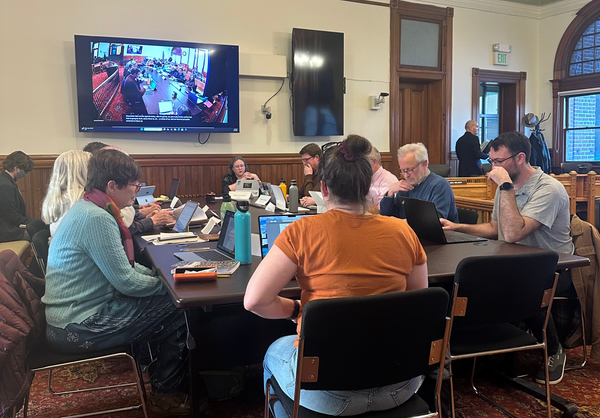
Local Agencies, Government Deliberate Solutions for Displaced Unhoused People

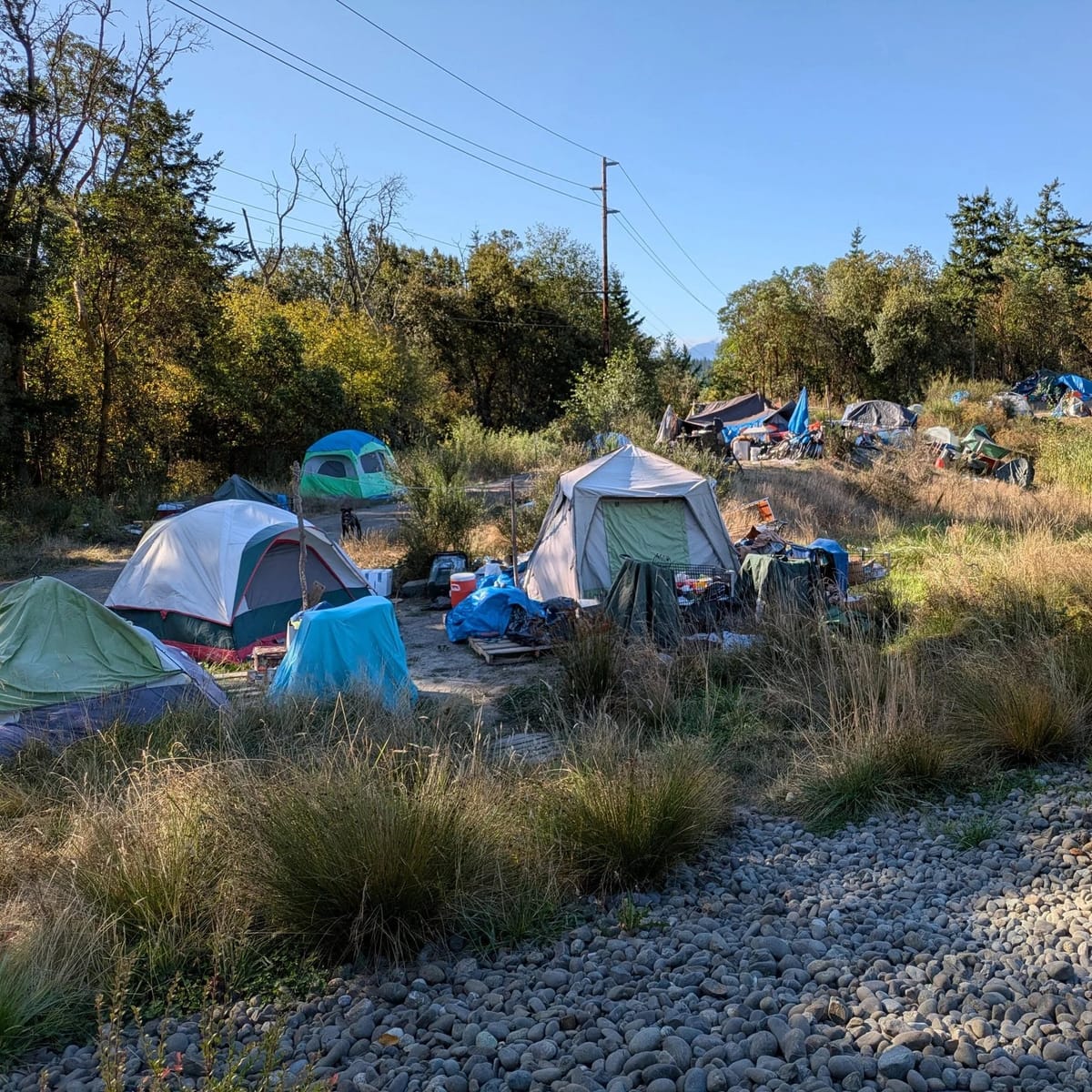
[caption id align="alignnone" width="4624"]
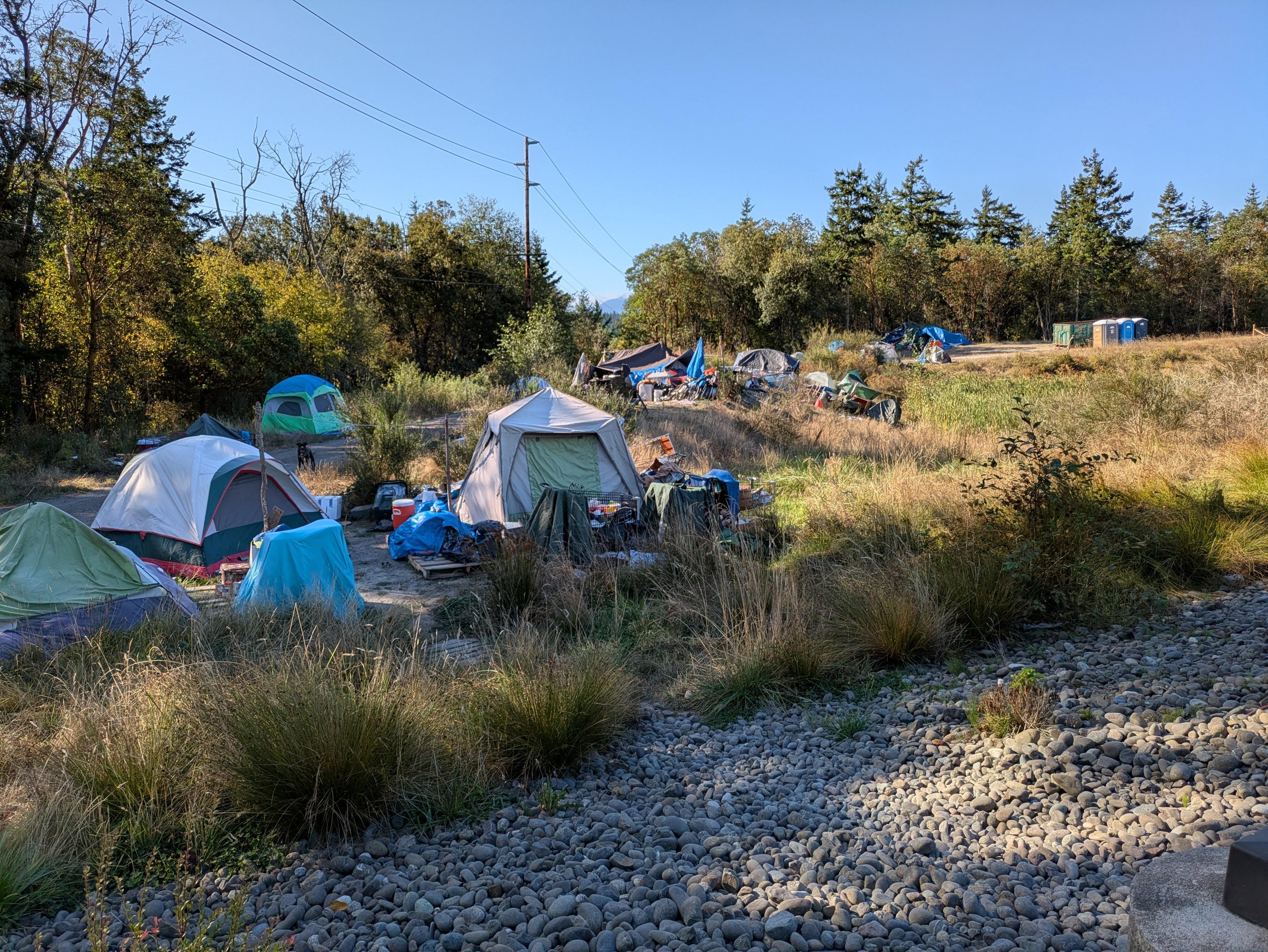
This encampment, which houses between 40-50 people, may be removed in early November. Photo by Scott France [/caption]
News by Scott France
The fate of approximately 40 to 50 people living at the tent encampment next to the DSHS facility on Sims Way hangs in the balance as options are being considered for the removal of all tents in early November. The City of Port Townsend, Jefferson County, homeless advocates and local support agencies are discussing possible options for those who will be displaced.
“The situation at the encampment is going to take a team effort from all of the organizations,” said James Holthaus, director of housing and supportive services for Bayside Housing and Services. “ We’re waiting to see what the County can come up with in terms of funding.”
The City has determined that the location of the encampment is not suitable for camping, and that the site will have to “undergo abatement due to sensitive infrastructure,” said Emma Bolin, director of planning and community development for Port Townsend. “There are several sensitive utilities, a waterline, power poles, and stormwater ponds in that area that require unimpeded access for ongoing maintenance and emergency repairs. There is also a wetland in the area that is an environmentally sensitive area, and is signed for no trespass, yet is repeatedly being disturbed with human occupation and waste. The site must be abated because it is not compliant with city zone code, public health codes, and this nuisance code.”
The city-owned land is slated to be developed into a 321-home neighborhood. City staff aim to select a developer by the end of 2026, with agreements negotiated during 2027 and construction starting in 2028.
Meeting the Needs of the Campers
Assessing the needs of houseless people through case management services is a vital early step in the process of arriving at solutions for individuals and the unhoused community as a whole, according to Holthaus.
“We’re trying to get individuals from each of the major organizations to come together and do beginning steps of case management,” Holthaus said. These organizations include Bayside OlyCAP, Dove House, The REAL Team (Recovery Empowerment, Advocacy and Linkage), the LEAD Team, and the Fires Care Team, Holthaus said.
However, case management may not be accepted by some homeless individuals, or might not result in an individual's progress, according to Viola Ware, Director of Housing and Community Development with OlyCAP. “We cannot force people into programs,” Ware said. “Sometimes, doing outreach to people in their tents is the best choice when there is no housing available.”
Citing an extremely limited supply of housing in Jefferson County, Ware said, “if we are going to do the group justice, we need to give them a variety of options. Change cannot be forced on people if you want it to be fair and just.”
Where Can They Go?
Options are limited in the short term. The American Legion in downtown Port Townsend provides shelter beds and has five male beds and two female beds open as of September 19, according to Trevor Breland, the Shelter Manager.
The County has committed funding for this shelter through March 2026, “with the hope and intent that they will be ready to reassume management at that point,” said Heather Dudley-Nollette, Jefferson County Commissioner.
The Caswell Brown Village on Mill Road is in the process of building a 31-bed congregate shelter that should be ready for habitation by July or August 2026, according to Peggy Webster, Housing Project Manager at OlyCAP, who is the lead project manager. Additionally, there are eight tiny shelters with kitchens and bathrooms on site that should be ready by summer, if not a little sooner, depending on the progress of completing the septic and water construction, followed by electrical hookups.
The encampment sprouted when people were forced out of the encampment that closed in 2021 at the Jefferson County Fairgrounds.
Estimates of the population of the encampment range from 35 to 60. Travis Slagle says he has lived there off and on over the past six months. He has an option that most of the campers don’t, which is to move into actual housing in the form of his parents’ home in Port Ludlow. “But it’s gonna suck because my friends are here,” Slagle said. “I don’t know where they’re going to go.”
Dudley-Nolette and fellow commissioner Greg Brotherton both expressed a desire for a permanent location for such tent encampments during a bi-monthly Shelter Coalition meeting at the Recovery Cafe on September 16. Ideally, a local organization would take over long-term management and possibly ownership of such a site.
As local organizations deliberate on the question of a case management strategy, Holthaus said that houseless people may take advantage of the Care-A-Van Health and Vaccine Education event on October 3, from 11 AM until 3 PM at 175 Chimacum Rd. in Port Hadlock. The Washington State Department of Health sponsors the event.
Services available will include blood pressure, vision and blood glucose screenings; A1C testing for those over 35 years old; BMI, telehealth and mental health screenings.
Naxalone (Narcan) kits will be available for distribution.
The event will be held outside and may be subject to cancellation or rescheduling due to inclement weather.
The various local aid and advocacy organizations and local government are working hard to develop solutions in a time of increasing houselessness and decreasing resources. Holthaus also cited the commitment and contributions of local law enforcement, including the County Fire Cares team.
Ware of OlyCAP said that she would like to see more people who have lived houseless experience represented in the decision-making processes, including the Shelter Coalition meetings.
Indeed, it is that lived experience that separates those who experience houselessness from the rest of us, both day and night — in myriad ways. “Last night, I dreamed that I was lying in my tent and it was sliding down a hill,” Slagle said.