Local farmer proudly preserves poultry

By Derek Firenze
There is no evidence that turkey was served at the first Thanksgiving, but, even if there had been, that bird wouldn’t have looked like the ones most Americans celebrate with these days.
Today, nearly all of the turkeys on U.S. tables are a breed developed in the 1960s known as Broad-Breasted Whites. This white-feathered, large-chested bird was bred because its clean-looking carcass appealed to consumers, on top of the decades of breeding starting in the 1920s to push turkeys to grow at ever increasing speeds with ever increasingly large breasts. A Broad-Breasted White can grow up to 50 pounds if allowed to reach full maturity with 70% of that weight in its chest, and they can grow so fast that their legs break under the weight.
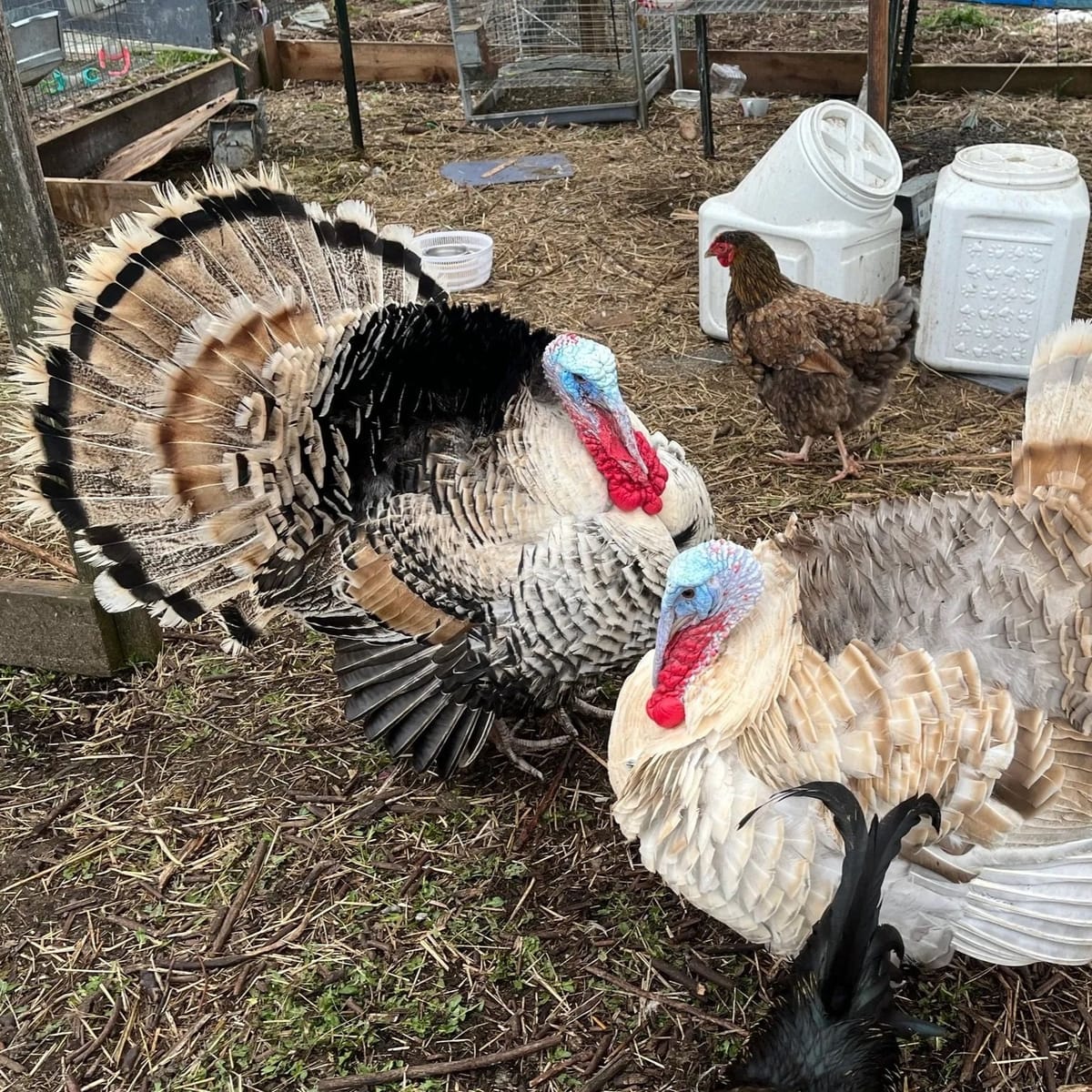
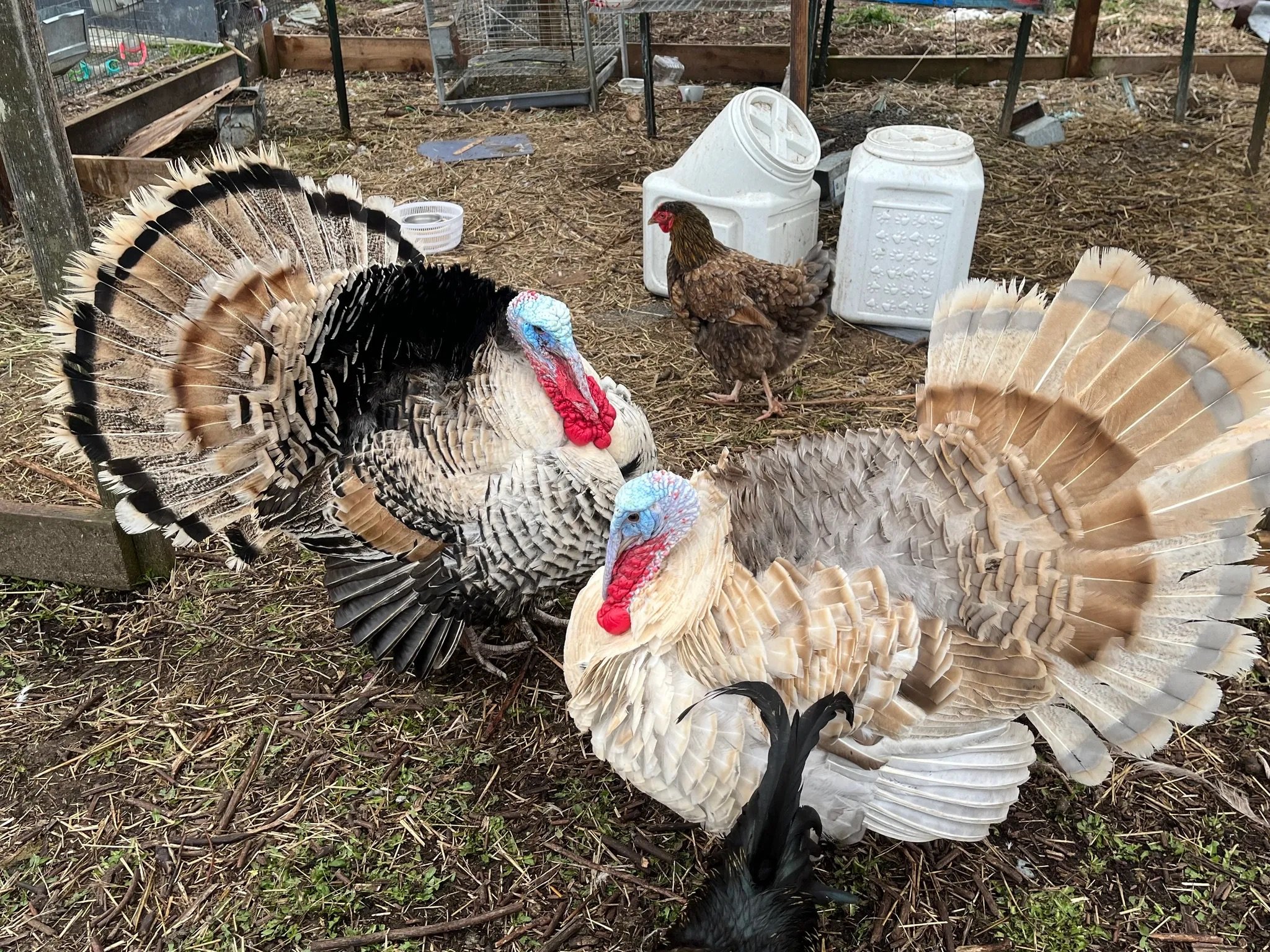
Heritage turkeys are what most likely comes to mind when imagining a turkey that’s feathered rather than coated in gravy. The beautiful array of colors children imitate when filling in the outlines of their hands are found in heritage breeds like Chocolate Turkeys, Blue Slates, Spanish Blacks, and Bourbon Reds.
Despite the large number of these drawings hanging on refrigerators, heritage breeds compose less than even one percent of the overall turkey population, with only 25,000 produced annually compared to 200 million industrial broad-breasted birds.
Against those odds, 25-year-old local farmer Ren Winchester began raising heritage turkeys four years ago on a plot of land he rents off Beaver Valley Road. Winchester first decided to size up from chickens when he saw a turkey sell for over a hundred dollars at auction. But he didn’t want to get too attached to his first turkey, so he and his partner decided not to name it. Nonetheless, they eventually started calling the bird “Yurkey the Turkey” for fun.
“I hand raised him, and we hung out. He would come up to me and sit on my lap, and sit on my shoulder,” Winchester fondly recalled. “I was like oh man, I’m gone, I need more of these.”
“they’re so personable and they’re so funny. The heritage turkeys are really hardy and resilient animals. They’re very clever. If they see an eagle, they alert each other and they all go under cover together”
— Ren Winchester
Four years later, Yurkey is still hanging out with Winchester, in addition to another 30 or so birds that he added to his flock.
Broad-breasted birds are usually processed at 18 weeks when weighing only 20 or so pounds, though their breasts have already grown so large that they are unable to reproduce naturally and must be artificially inseminated. Yurkey, at the grand old age of four, weighs maybe 10 pounds. “If that,” Winchester said.
Winchester kept his flock of heritage turkeys growing in number, if not pounds, because he’s hoping to preserve history.
“In 1997, the Livestock Conservancy declared heritage turkeys the most endangered domestic animal in the United States,” Winchester said. “As broad-breasted were developed and ramped up, farms everywhere stopped raising heritage turkeys because they’re not as cost-effective for meat production.”
When the Livestock Conservancy announced those findings in 1997, fewer than 1,500 heritage turkeys were left in the U.S.
“As I got more into them, I was like, I don’t actually want to sell them, I want to get into the conservation,” Winchester said. “I think especially in our area people are starting to learn about heirloom crops, and heritage breeds are a very similar concept but for livestock where it’s old breeds of animals. They’re generally more robust and they’re built for more disease resistance, general health, and long life, versus production breeds like a broad-breasted turkey.”
“You’ve got your broiler chickens and your broad-breasted turkeys,” Winchester continued. “These breeds are bred just for maximizing food production. Since those things are selected very specifically for what has the most meat the fastest, you tend to lose things like disease resistance, and how long-lived they are, and you’re losing a lot of genetic diversity in general because you’re not preserving those old lines.”
To show the value of old breeds, the Livestock Conservancy collaborated with Virginia Tech to hold field trials on eight farms across America. Bourbon Red Turkeys—like Yurkey—competed against the industrial broad-breasted whites. The researchers made behavioral observations and collected data on weather, health, feed consumption, morbidity, mortality, weekly weight gain, harvest weight, dressed weight, and sales.
As expected, the commercial broad-breasted turkeys had faster weight gain and better feed conversion than the Bourbon Reds, but greater mortalities among the commercial turkeys on pasture offset the significant gain and feed efficiency rates. When mortality and sex were factored into the final results, the yield of pounds harvested per farm was only slightly lower for heritage than commercial turkeys.
Winchester also noted the research of Temple Grandin who has documented mass die-off events in commercial livestock production. But again, for Winchester, it’s not about competing commercially.
“I’m not really making money off my turkeys,” he said. “I’ll sell chicks and poults and things like that, but the main goal is to bring in the rare genes, breed them so that they’re proliferating more, and then move them out to other farms so that they can preserve those genes as well and continue passing them on to next generations.”
“I’ll sell adult breeding birds, and I can get a decent amount of money per individual bird,” he noted. “But for a lot of heritage preservation it’s got to be a passion project because at the end of the day if someone just wants meat, they’re going to get the bird that’s going to get them the most meat the cheapest as opposed to a slower growing bird that’s going to be more expensive in the long run.”
While he isn’t doing it for the money, that doesn’t mean Winchester isn’t interested in finding ways to expand.
“If there was a market for it, my focus is still going to be on the preservation aspect,” Winchester said. “But part of the preservation aspect is, if you have a product to put out and get the money to put back into that preservation breeding, it would be really cool to see that and get people connected to eating heritage turkeys as opposed to your grocery store broad-breasted.”
He’s explored bringing them to a facility for processing, but he said there’s only one nearby and at the scale he’s working the facility prioritizes people with a hundred cows over the five or so turkeys he could bring in at a time.
A mobile slaughter unit closer to home, however, is being explored by the Port of Port Townsend at the Short’s Family Farm.
[caption id align="alignnone" width="646"]
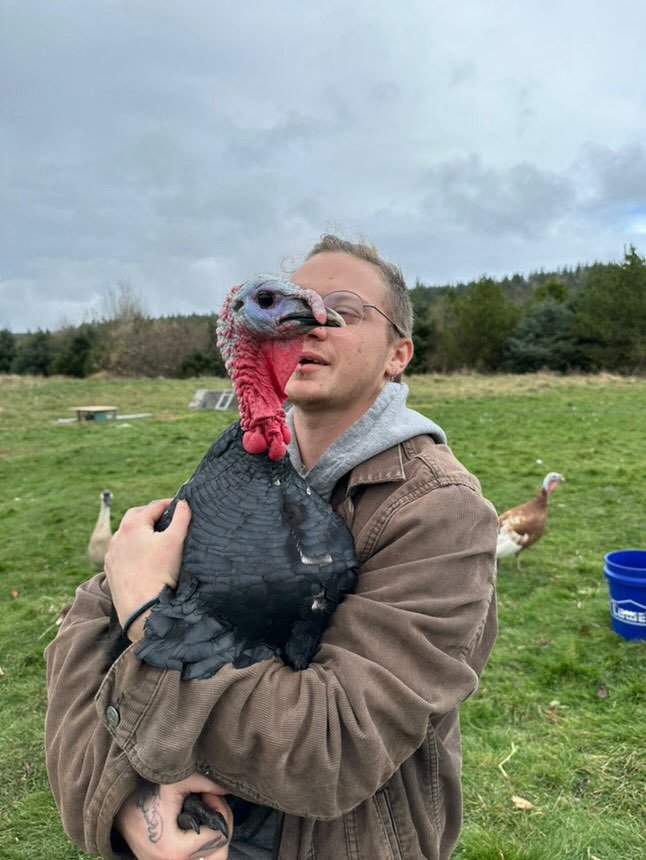
Winchester and one of his feathered friends. [/caption]
In the summer of 2023, the Port acquired the 253-acre Short’s Family Farm in Chimacum, one of the largest contiguous agricultural land holdings in the County, with the objective of developing and maintaining infrastructure and establishing uses of the property that will help sustain and expand agriculture in Jefferson County.
The Port’s Executive Director, Eron Berg, said that though a USDA facility seems out of reach on the farm, the possibility of a mobile slaughter unit is still being discussed, “but there are lots of challenges.”
“The big challenges are the cost, the scale of business to support the cost, regulations around the ‘feed lot’ for creatures awaiting the abattoir, availability of water and space/process for the waste,” Berg said. “In my opinion, the biggest issue is scale: not enough animals awaiting process to support a processing operation in Jefferson County.”
Winchester was unaware of the Port’s processing possibilities, and perhaps if word continues to spread enough small-scale livestock farmers could be found to make such a venture feasible.
Either way, Winchester plans to continue his poultry preservation because he sees a value in these birds that others might miss.
“All creatures, and all livestock, they all have something that makes them unique as individuals and as a species,” Winchester said. “When you actually look at it, they’re so personable and they’re so funny. The heritage turkeys are really hardy and resilient animals. They’re very clever. If they see an eagle, they alert each other, and they all go under cover together.”
“They’re just these weird birds with lumpy heads, and no one really thinks about them at all,” he added. “There are so many beautiful varieties that people don’t even know exist and so much diversity in them. We came so close to losing them, and it just shows you that there’s something to appreciate about anything out there, no matter how weird or insignificant you might think it is.”
To see more of Winchester’s turkeys and other farming adventures, check out his Instagram @buttonbuck.farm
Photos courtesy of Button Buck Farm.