My Heart Is Good: Treaty Rights and Food Sovereignty for the S’Klallam Fishing Community

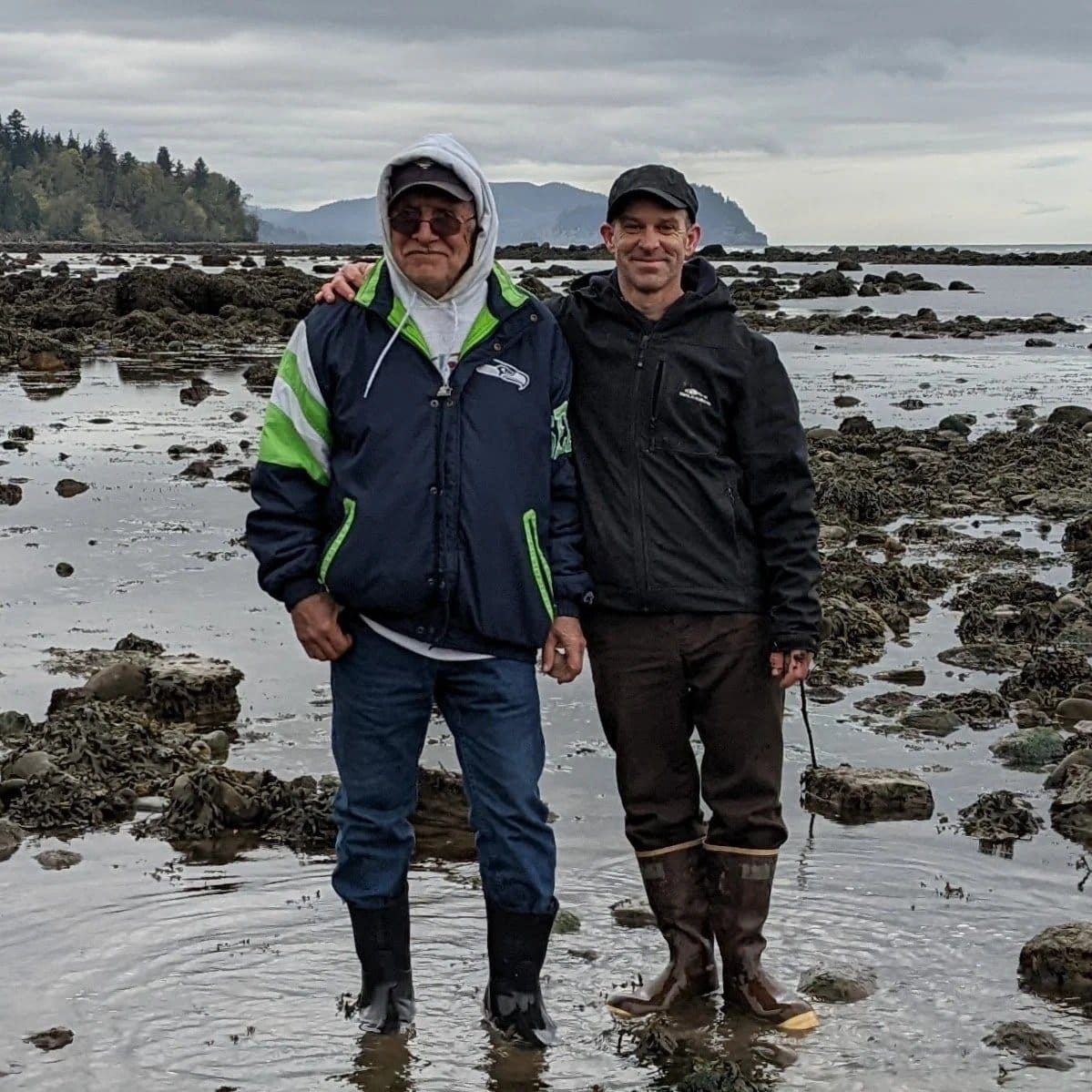
[caption id align="alignnone" width="1599"]
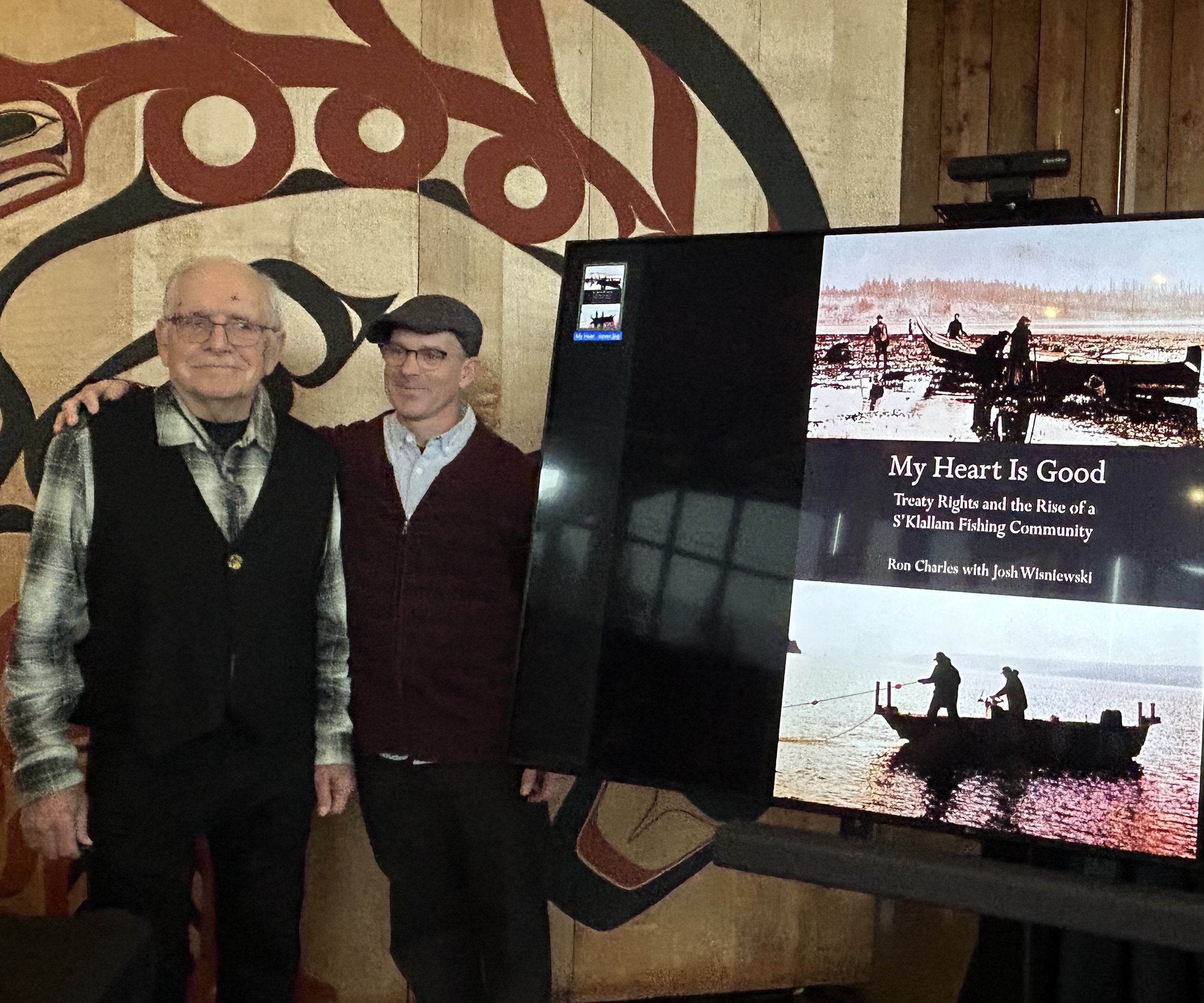
Port Gamble S’Klallam elder and former tribal chair Ron Charles (Left) and anthropologist Josh Wisniewski. Photo courtesy of Empty Bowl Press [/caption]
News by Angela Downs
On Friday, November 14, at the Meeting House in Port Townsend, Empty Bowl Press held a reading and discussion as part of their tour for the newly published book, My Heart Is Good, by Ron Charles and Josh Wisniewski.
My Heart Is Good is a history of treaty rights, told through the life story of Charles, Port Gamble S’Klallam elder and former tribal chair. Wisniewski, an anthropologist, brought context and background to the story.
The book traces the historical unfolding of the Port Gamble S’Klallams from treaty signing through the 1974 Boldt Decision that affirmed tribal fishing rights in Washington State, the sequential 1994 court decision affirming the tribes’ shellfish-harvesting treaty rights, and the growth of today’s S’Klallam commercial fishing fleet.
“I wanted to see this recorded,” Charles said, sharing his recent losses of two friends from neighboring tribes who were involved in the battles to assert their fishing rights, who didn’t record their stories. He wrote the book for those friends and for the younger generation of tribal members. “Some of them were born well after the decision, and now are out harvesting and they don't know what happened and how we got to where we are today, and we wanted to tell that story for our tribal younger folks. If we can educate some of the greater community, that's fine, too.”
The title of the book is a quote from tribal elder Chitsamahan, during Point No Point Treaty negotiations on January 25, 1855,
“My heart is good, (I am happy) since I have heard of the paper read, and since I have understood Gov. Stevens, particularly, since I have been told I could look for food where I have pleased and not in one place only.”
It is commonly misunderstood that the treaty rights granted rights to Indigenous peoples, when truly, they were granting rights to non-indigenous people, settlers, to use the land for hunting and fishing.
Article 4 of the 1855 Point No Point Treaty holds that the signatory S'Klallam tribes are able to fish at usual and accustomed grounds and to hunt and gather roots and berries on open and unclaimed lands. This was an exchange for ceding millions of acres of ancestral lands to the U.S. government. The treaty also specified that they could reside on any land not claimed by a citizen, or with a citizen's permission.
After treaties were signed, instead of moving to the reservation, the people of Little Boston in Port Gamble stayed where their ancestors were buried.
[caption id align="alignnone" width="2590"]
The book launch in the longhouse at Little Boston. Photo courtesy of Empty Bowl Press [/caption]
“From 1853 on, a major part of the workforce was at the mill. When I was a kid, that was the only place to work, and maybe a little bit of long-shoring,” Charles shared at the November, 14 event. “The wages were poor. We did a lot of subsistence, we had a lot of fish, all kinds of fish, ducks, deer and we got to be really good harvesters of different kinds of shellfish, clams and oysters during the period of time after the treaties.”
In the 1930s, the S’Klallam became a recognized tribe. Now, only three of the original 30 tribes of the area are formally recognized by the government.
Charles was part of the first class to graduate from high school in their area, and later served three tours in the Navy as a radarman on aircraft carriers. He served dual roles in his community as a fisherman since the 1970s and as tribal chair, making him an essential figure in the management efforts that followed the Boldt Decision: United States vs Washington State. Just as it took him years to learn to be a fisherman, he had to learn the ways of ordinances and government.
The Boldt Decision was a twentieth century cultural peak, affirming tribal sovereignty through treaty fishing rights. The state's position was that Native Americans were not entitled to special rights to fish off-reservation, and that the treaties gave the Natives an equal right to fish, not an equal right to 50 percent of the catch. The tribes argued that the state could not regulate their right to take fish at treaty locations, no matter the reason, it also did not matter who caught the fish.
Judge Boldt found that the tribes had the original rights to the fish, which they granted to the settlers with limitations. The treaty provided for an equal sharing of the resource between the tribes and the settlers. Boldt ruled that tribes that were parties to treaties could take up to 50 percent of the fish harvest that passed through their recognized fishing grounds.
In his ruling, Boldt made tribes co-managers of the state's fisheries. Suddenly, 19 tribes were working with the state to manage Washington's fisheries. There was no fish management plan in place in 1974, nor a reliable method of counting fish. Accurate counting was the first issue the new team collaborated on, creating pathways for agreement on other management guidelines.
“My experiences on the water were valuable in the forums that I had to be involved in as a chairman,” Charles answered a book-reading attendee. “[B]ecause if I didn't know the ins and outs and understand the fisheries that were involved, how could I advocate for them in my work with the states and the other tribes?”
The ‘70s were a time of major over-permitting for commercial fishing, and pacific decadal oscillation, long-term ocean-atmospheric patterns that shift every 20-30 years, were drastically affecting climate in the Pacific basin and North America.
These were two major contributors to the decline in fish populations and ocean health. But because of the political spotlight on tribal rights at the time, it was easy for many to blame the tribe's unexpected win and reconnection with the resources for these devastating changes.
Because their fisheries were taken so early, the Little Boston tribe was not involved in the Fish Wars of the 1970’s, but these violent clashes between law enforcement and the tribes in part led to the Boldt Decision. Charles’s contributed management efforts after the landmark decision, are featured in Fish War, a 2024 documentary exposing the illegal actions of the state and the will of the Washington tribes.
Charles spoke of the golden quality of change the era upheld, and questioned if, with our current administration, the result would be the same now.
The book, My Heart Is Good, beautifully illuminates the details of what came after, when a new tribal government was erected, and relationships were built. Working together, the S’Kllalam tribes and Washington State preserved salmon and paved a new pathway forward.
Yet, there are still unresolved terrestrial treaties. With differing interpretations of unclaimed land, tribal members are not permitted to hunt or gather on private land. Reconciling these treaties would require a coming together of all the regional tribes.
“I have quite the ties to my land. I still think I couldn't live any other place,” Charles said. “I have ties back to my grandparents and other relatives that were born back in the 1880s and lived next door to my great-grand uncle, who was born way back then, and he taught me that we could never move from Port Gamble Bay. The government, every once in a while would tell us, you can move up to Quinault, we'll give you land out there. But those old folks said, No, we can't leave here. Our dead are buried here. This is our land. We'll never move. I still feel that way.”