Navigating Activism on the High Seas for Palestinian Aid with Logan Hollarsmith

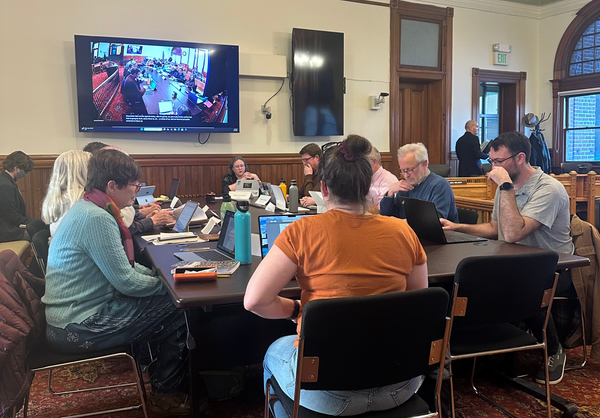
[caption id align="alignnone" width="4045"]
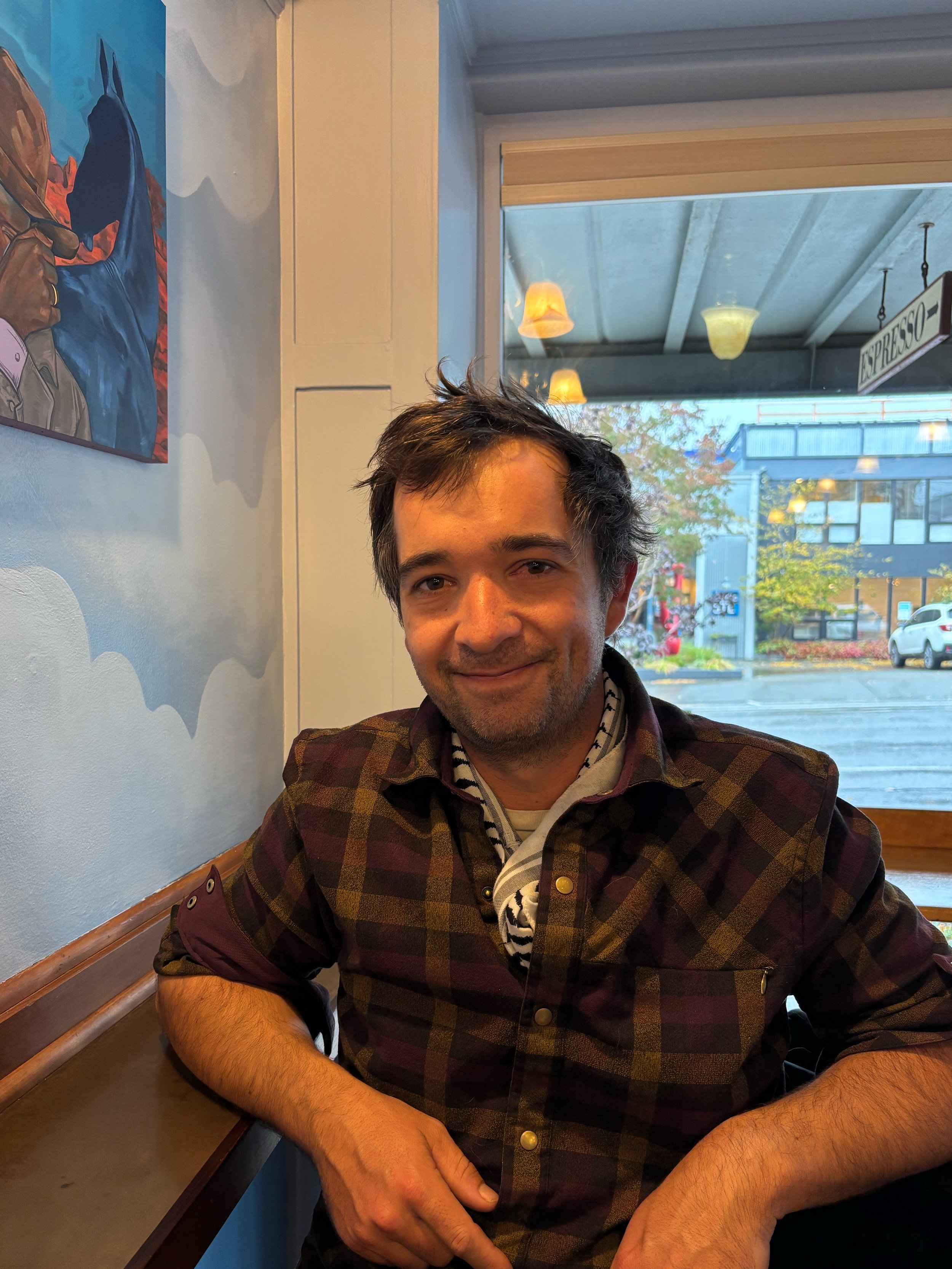
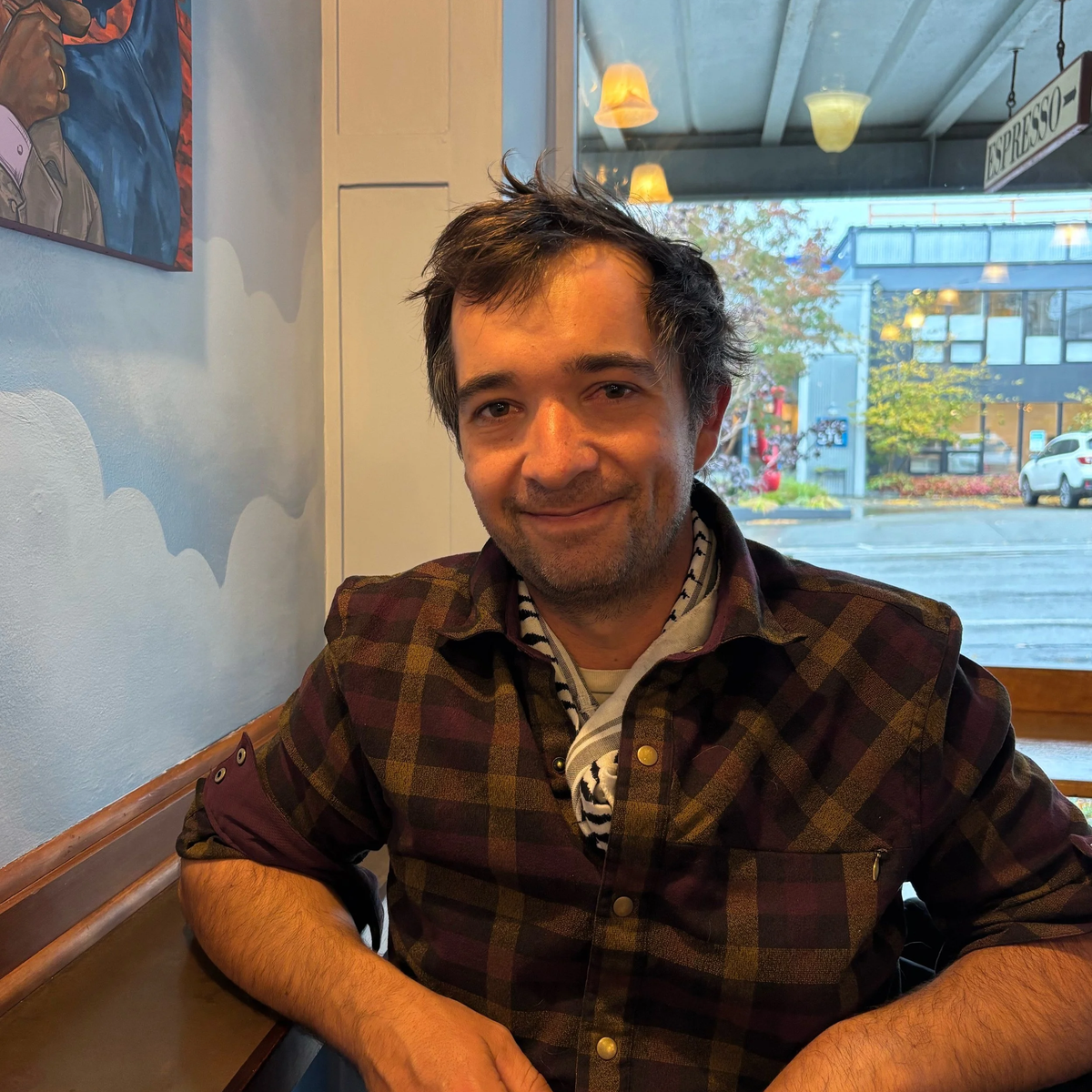
Logan Hollarsmith after his return. Photo by Nhatt Nichols [/caption]
News by Nhatt Nichols
On a rainy Uptown afternoon, Logan Hollarsmith arrived at Conduit Coffee directly from an acupuncture and sauna session, apologizing for his messy hair and full of descriptions of his first acupuncture session. Hollarsmith certainly earned the extra care after being held in a detention center in Israel for his role in the flotilla bound for Palestine.
At its best, activism is simply about helping people who need it, whether that’s timber framing a community project or captaining a boat full of veterans bringing aid to starving Palestinians. Hollarsmith is deeply committed to helping people and sharing his immense skill set.
The following interview between Hollarsmith and editor Nhatt Nichols covers his time on the Flotilla and the importance of fighting for the basic needs of others. It has been edited for length, but it’s still longer than most Beacon pieces because so much of what Hollarsmith had to say was too important not to share.
Nhatt Nichols
While you were working on Long House for the People, you heard about the flotilla? You were already a captain?
Logan Hollarsmith
I had organized these flotillas to Cuba and Puerto Rico, maybe 10 years ago, after Hurricane Maria. There was a call out for carpenters and sailors to come. We tried to take five boats from New Orleans with a bunch of sound recording equipment. Two boats made it, and we ended up, making music videos for bands down in Cuba.
I had captained a few sort of flotilla things, nothing at all at this scale. I guess there are very few things in history that have compared to the scale of this maritime attempt.
NN
How many boats were there?
LH
Over 40. We started with maybe 70, but we left a lot of boats in a lot of harbors out there.
NN
If Port Townsend people understand anything, it’s boats needing to head for repairs.
LH
[caption id align="alignnone" width="768"]
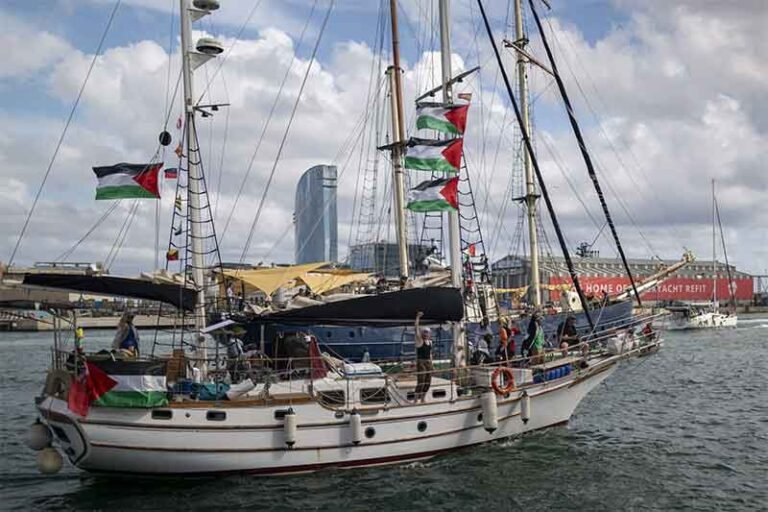
The Ohwayla. Photo courtesy of Counter Currants [/caption]
Sailing is misery. Every type of sailing is misery.
NN
Ha! You come from more of an activist than a sailor background, and you have acquired the skills to be able to captain a boat through your activism?
LH
I wouldn't say that, but I feel like even the Long House, that was acquiring skills that were more relevant to capturing the Ohwayla than any sort of nautical experience.
Knowing how to host morning meetings —something I’ve learned from living collectively for the past 15 years —everything like that is what it takes. Otherwise, you just raise the sails, turn the motor on, take the sails down.
I guess it's a lot more complicated than that, but I was glad for all the community-building projects I've been a part of.
NN
Did you know anybody that you were on the boat with before you got there?
LH
I didn't know anybody in the entire Flotilla. It was making broken boats go 1500 miles with a bunch of strangers.
I was in a unique position where we'd finished the Long House. I woke up in the middle of the day and was like, I wonder what the next thing is, and someone texted me about this. I wrote an email, and then I was on a plane two days later.
NN
So you're traveling with a bunch of people from different backgrounds?
LH
Not the Ohwayla [the Vets for Peace boat]. That was, for the most part, people from the states and predominantly US veterans.
NN
It must have taken this specific set of like communication skills to host meetings and make sure everybody's on the same page in that kind of a group.
LH
It was. A lot of people weren't used to cooking for themselves or cooking for groups. Sharing space was a little hard at the beginning, but I was very lucky to be on a boat with these veterans because they were very good at facilitating drills like coming under live fire, how to take cover, and what happens if gas comes in the hatches.
NN
How long were you on the boat
LH
I think 31 days. There are only a few people who really got that sailing is misery. There was this Finnish woman that said, “If this is sailing, I want nothing to do with it.”
It's like you're the perfect sailor. You're the only one that truly understands.
NN
What was the plan with the Flotilla?
LH
As advertised, it was really to establish a permanent humanitarian corridor, and there have been groups that were affiliated with the flotilla that have been trying to open up land corridors. Then the flotilla was to break the illegal blockade by any means possible.
I think it wasn't expected that we were to reach the shore. We didn't set off thinking that was going to be the case, but as the international pressure to let us through grew, there was a little chance, I thought maybe 7% or something.
NN
You were one of the last boats to be stopped?
LH
I think if we were going after that rubric, we would have done some really erratic, wild stuff, but the goal really was to stay together, it wasn't like we were turning off all our navigation lights and throwing it to 6000 RPMs.
Ohwayla was designated as the lead boat at the end, simply because of its size. There was no radio communication anywhere. Sometimes the Wi Fi would come in and out, depending on how close you were to certain Israeli crafts. So it was motoring up next to boats and just yelling, like, keep at 108 degrees. They're pushing us into Egyptian waters. We can't leave international waters.
NN
What did that look like when you guys were finally stopped?
LH
It looked like a lot of rifle lasers on people. See the red dots dancing around. It was kind of fine to see that on myself, but to see them on other people, something no one should have to look at.
We knew they weren't going to hurt us, judging by the deals they made with the Italian government.
It felt like we were getting royal treatment from the Israeli Navy, which I think should be reminded to people, and that privilege was the leverage in this situation.
NN
And then you were checked into a detention facility.
LH
Yeah, it probably took eight hours to work through customs. Essentially, each person had a police escort going through the customs process.
It was very rough. People got very hurt in there, lots of dogs. People getting pulled out of cells, brought down into the dungeons, where cells are just one meter by two meters, and people kept in the dark for over 24 hours.
When I would open my eyes, there would be a soldier with the rifle laser on me. Knowing that I was in one of the killing rooms of this genocide, but knowing that I had an end date, even though I didn't know it at the time.
And knowing that, part of our responsibility of being there was to bring the eyes onto what these prisons are for; to rape and murder Palestinian people. I think while we were there, Israel was debating whether it should be lawful or not to rape prisoners.
From the inside, our experience had so much singing. I think with that protection that the flotilla offered Palestinians, Arabic members of the flotilla would sing the calls to prayer in the morning, which is illegal in Israel, and certainly frowned upon in the prison. That was beautiful. So much singing, Irish singing, in response. The Irish captains really pulled through in the flotilla.
NN
I'm not surprised by that.
LH
No, because during the famine, the only boats to break the British blockade were Palestinian ships, which is a story that I had not heard about until I was in the cell.
NN
What are you hoping that your work achieved?
LH
The flotilla is just one strategy of this global movement for a free Palestine. It's certainly an expensive strategy. As far as like actions go, I can't fathom anything more pricey. But there was so much hope that it created. And like, that's what the world that was what the world wanted to see at that point, I'll be ready to sail for the flotilla again in the spring for the next one, and this is how I'll be able to contribute to the movement. The veterans need a sailor. They always said, There's a reason we never joined the Navy.
NN
What's the main thing that you would like to ask people to do?
LH
It would be to grapple with the violence that our country is enabling. And once you grapple with that, there will be no action will be too big or small against it.
Even Italy responded to all the riots that were happening when the flotilla was attacked outside of Crete. The unions in Italy said, if our comrades on the boat get attacked in any way, we'll shut down more ports in Italy. And they did. They shut down the ports of Italy. They rioted to the point where the conservative Italian government, one of Israel's closest allies in the G7 countries, sent a warship to monitor a humanitarian action. That was an example where taking to the streets really changed the movements of a government.
NN
I'm not sure I knew that you guys were attacked.
LH
Outside the Crete, maybe 13 drones were blowing up the rigging and the masts of the boats at night.
We're all in really close formation, knowing that these drones were all around us, and there were big flashes. A lot of it was detonation cables, built perfectly to take out the rigging. So you can just see in the silhouette of these explosions at the top of the mast, sails falling apart, sails burning, falling away. That night, we sailed with boat cutters and fire extinguishers on deck, just ready to drop the mast if something bad happened.