Navigating Rising Healthcare Costs and the Fight for Universal Coverage in Washington State


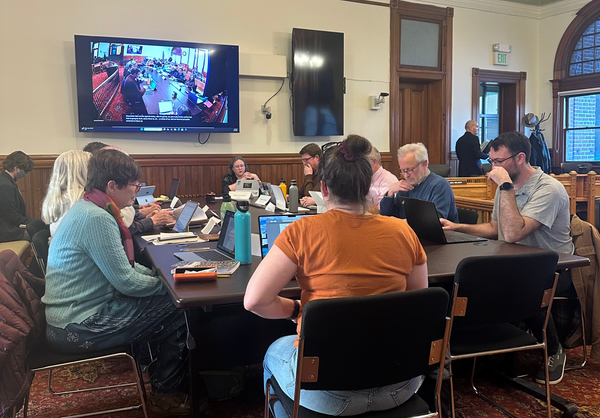
[caption id align="alignnone" width="2500"]

Photo by Scott Graham, Unsplash [/caption]
News by Blanchard Alice
Those who went to WashingtonHealthPlanFinder.org this fall to purchase insurance know that the outlook is bleak for Washingtonians next year. Many are seeing their insurance premiums more than double, and 200,000+ are estimated to be priced out of ACA plans on top of the 250,000 - 500,000 estimated to lose Medicaid in this state alone.
According to a press release from Senator Maria Cantwell's office, the average increase across all 39 WA counties is $1,049/month, or $12,590/year more for the same insurance. This is sure to add financial strain to Washingtonians, 6.5% of whom are already in medical debt, as well as strain to an already struggling system that estimates 7,500 avoidable deaths annually, even before next year's insurance changes take place.
“This system, where the employer acts as a health insurance broker, is a remnant from WW2 labor shortages. At the time, wages were frozen in an attempt to mitigate inflation, so in order for businesses to entice employees, they offered attractive perks such as health insurance.”
Many people earn too much to qualify for Medicaid but not enough to afford the higher insurance premium rates or the high deductibles and copays that come with even the most basic insurance options. Those who get insurance through their employers are no better off, financially speaking. Arguably, they are worse off in some respects, considering how their health, and possibly the health of their family, is entirely tied to maintaining that job, at least until open enrollment next year.
This system, where the employer acts as a health insurance broker, is a remnant from WW2 labor shortages. At the time, wages were frozen in an attempt to mitigate inflation, so in order for businesses to entice employees, they offered attractive perks such as health insurance. It is by no means an intentional system we have today, where a bit over half of people in the US receive employer-sponsored healthcare, and where the quality of your health might come down to the job you have.
Employers are more likely to choose insurance plans based on bottom lines than on workers' well-being, and employees are usually given only a few plan options at best. This one-size-fits-all-employees approach leaves some employees underinsured, and many times the premiums and co-pays associated with the plans employers provide are prohibitive and have deductibles and co-pays not appropriate for the wages they are paying.
Purchasing insurance through the marketplace, known as Obamacare, changed things by providing alternate paths for people in these situations, and importantly, it also gave those with pre-existing conditions an opportunity to have health insurance. Additionally, it formalized the social contract by providing basic healthcare, known as Medicaid, to anyone who is unable to afford insurance, regardless of their situation.
No solutions from the Trump administration
The Trump administration was set to unveil its healthcare solution at the end of November, but postponed without further information about rescheduling. There is no indication that any healthcare plan has been developed, which fits a decade-long pattern of the Trump administration insisting it is soon to reveal a healthcare agenda without doing so.
Instead, the administration has recently discussed the possibility of giving one-time payments of a few thousand dollars to Americans to use toward healthcare costs, a move that some claim is discriminatory against the unhealthy and disabled, for whom this payment is inadequate. Conversely, for the able-bodied and healthy, this payment is unnecessary extra money in their pocket.
There is no current sufficient Republican alternative plan in development despite continuing promises to the contrary. Washington State, however, started working on this issue in the 90's and renewed the effort in 2018 to create a universal healthcare plan for state residents that is still progressing today. For many Washingtonians watching healthcare evaporate, this is the lifeline they have been hoping for.
COVID-19, subsidies in; H.B. 1, subsidies out
The pandemic provided an opportunity to run an experiment with healthcare. In an attempt to get more people insured rapidly, tax credits were provided that lowered insurance premiums. It was successful by all measures, essentially doubling enrollment.
This year, members of the Republican party is fighting against these premium tax credits, causing the rates to rise so significantly. While some argue we are no longer in the health emergency state that we were in when the credits were put in place, there is a long history of employer-sponsored insurance being highly subsidized, so, in general, it makes sense to subsidize health insurance for anyone without employer-sponsored insurance as well.
The greater the need, the greater the shortfall
Due to the new work requirements passed in this year's legislation, H.B. 1, or the “Big Beautiful Bill”, many Washingtonians will lose Medicaid, a service that insures people who have debilitating health issues that our system doesn't classify as a disability. Many people who are unable to work according to their doctor are still rejected by the disability system.
“Due to the new work requirements passed in this year’s legislation, H.B. 1, or the “Big Beautiful Bill”, many Washingtonians will lose Medicaid, a service that insures people who have debilitating health issues that our system doesn’t classify as a disability. Many people who are unable to work according to their doctor are still rejected by the disability system.”
This system to determine financial assistance for disability punishes some surprising populations, such as stay-at-home parents who don't have much of a salary history. Disability assistance is related to earning history, so the less you have earned (or the more disabled you have been historically), the less likely you are to receive a livable level of assistance and the more likely you are to be completely reliant on other social systems, such as SNAP and Section 8 housing.
Additionally, long-standing successful programs for the disabled, such as Meals on Wheels, have been cut and labeled as waste, leaving the responsibility of caring for the starving and vulnerable to the better natures of the general public and a poor patchwork of charities and dwindling social safety nets to fulfill the social contract.
Health care and the social contract
Economists Amy Finkelstein, of MIT, and Liran Einav, of Stanford, have studied healthcare systems in the context of economics and argue that the social contract needs to be front and center when redesigning a healthcare system. Their vision for healthcare revolves around a realization that we already provide universal healthcare through a patchwork of systems that interact with this social contract, and since the alternative is to break the social contract entirely, the debate over whether or not to provide universal healthcare is unnecessary. “Our taxes are already paying for the cost of universal basic coverage. We're just not getting it,” Finkelstein explains as she describes a system of universal healthcare that goes by thousands of individual program names.
It turns out that we can and should do it much better.
Whether people believe in the social contract or not, we can observe that it accurately describes both personal and policy tendencies of our society throughout history. “We don't just let people die in the streets,” Finkelstein points out. We provide life-saving and stabilizing care to everyone, and even have many programs to solve specific problems for specific populations. People fall through the cracks, and we respond by creating new social safety nets. Between the conservative desire to cut back on social programs and the progressive priority to maintain social safety nets, universal healthcare walks the line between the two, satisfying both at the same time.
Finkelstein and Einav are not alone in their solution. Whole Washington, a non-profit working for universal healthcare in WA State has a plan to fulfill this social contract that is already in the legislature.
Universal Healthcare in Washington State
Whole Washington is a non-profit and the author of the WA Health Trust (HB.1445 & SB.5233), which is the only UHC bill in the legislature. Whole WA is also the force behind the ballot initiatives for universal healthcare in 2018, 2020, and 2022, with plans for another campaign in 2026. They've been making progress on basic universal healthcare for all Washington residents and have forged relationships with politicians such as Bob Hasegawa in the Senate, who is the prime sponsor of the universal healthcare bill.
“I can tell you, Whole WA as an organization in this entire movement is probably the least patient organization,” Thomas Kennedy, Social Media Lead at Whole WA, said in an interview with the Beacon, “We most want a solution like Taiwan's, what happened over two years.” And this isn't a distant hope, Kennedy insists, “With political will, this could happen in a year or two, truly.” Even with sponsors and some support in the legislature, universal healthcare in WA is stuck until residents voice this as a larger priority to their representatives.
When asked about obstacles, it appears there are forces of propaganda at work. “There's a lot of misinformation about the benefits,” Kennedy explained, “The WA Policy Center is probably the biggest think tank that works in opposition to our movement.” It's important that anyone opposed get involved to help balance the influence of these efforts, “they always come out and post negatively and public comment to anything we do.”
A large part of Kennedy's work for Whole WA is combating misinformation created by the think tank. He creates and posts videos correcting this misinformation on social media for Whole WA, but he is just one person, and Whole WA is a tiny non-profit that didn't even have an official employee until a year ago.
There is something hopeful in what Whole WA has done without proper funding. It means that an enormous effort has been made entirely by volunteer contributions to write this bill and get it sponsored, and to run 3 ballot initiative campaigns. “We are not a rich organization, but we are rich in people”, Kennedy explains. Much can be accomplished by the people alone.
Right now, Kennedy says, “there isn't political will,” but as we have seen with the pandemic, political opportunity is at least as important. With so much attention on the rising cost of insurance, and with Oregon also pursuing universal healthcare through its own commission, we have a window to create some momentum toward accomplishing this.
Annette Cleveland, Chair of Senate Health & Long Term Care, and Dan Bronoske, House Health & Wellness Chair, will be important figures as committee hearings begin in 2026. “They are the gatekeepers at the moment for any healthcare legislation”, Kennedy said, and so they, and our state representatives, are the people with actual power in this fight, and the appropriate place to direct our vision for a new healthcare system, now that destruction has made space for new ideas.