New Mural Brings Light to the Hoh Tribe
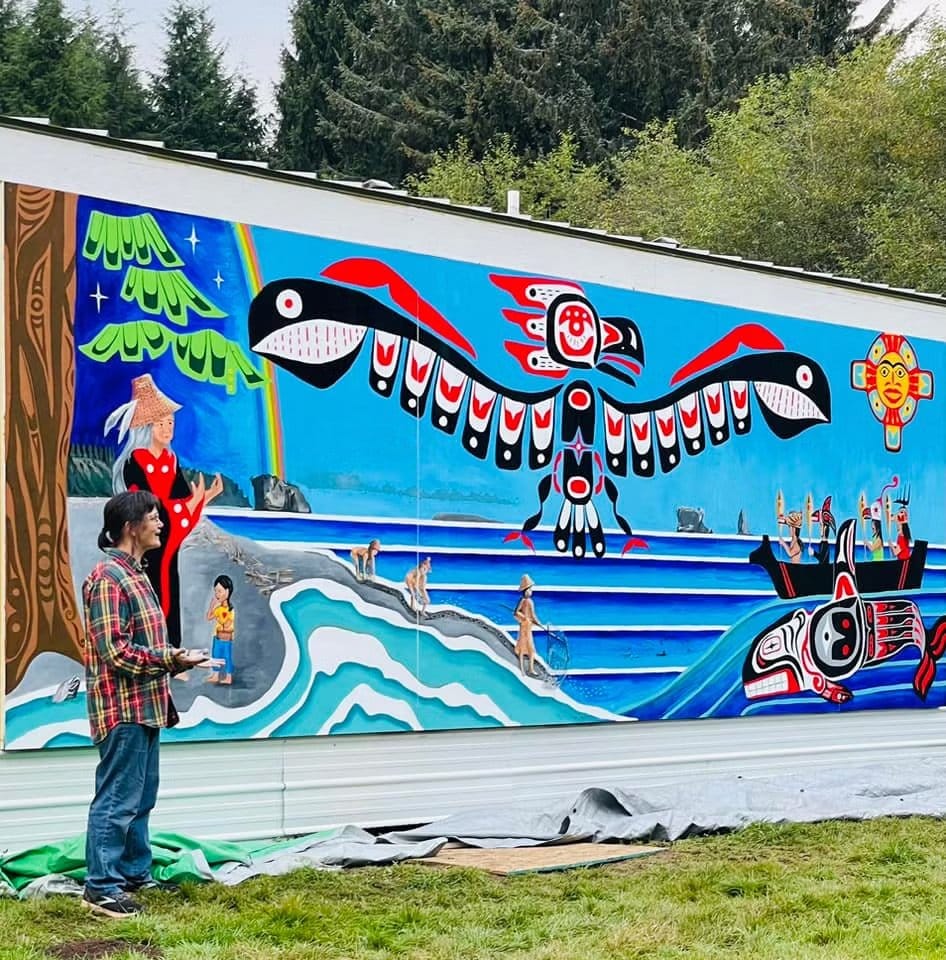
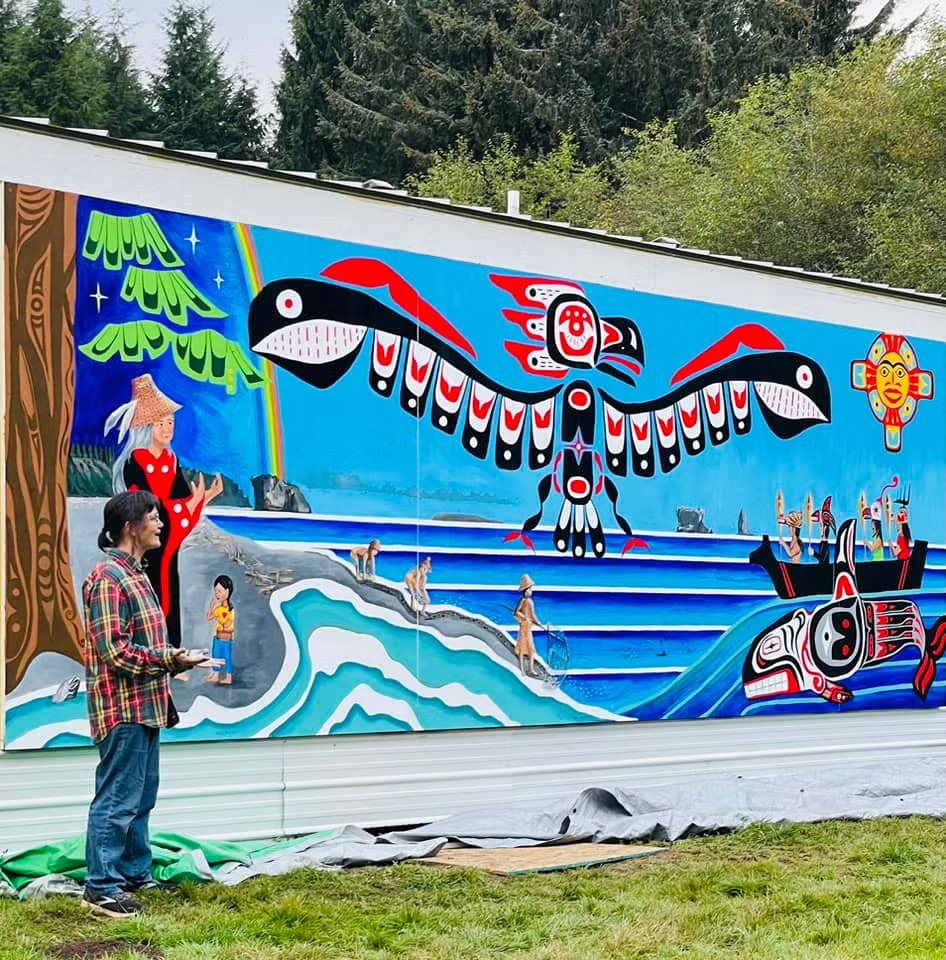
Danielle Fodor stands next to the mural she helped create in conjunction with members of the Hoh Tribe. Fodor has been painting murals for over 20 years but only recently brought those skills to the New Old Time Chautauqua on her second tour with the troupe. All photos courtesy of Jo Blair [/caption]
The west side of Jefferson County is often forgotten, blocked off from the more populated east by the Olympic Mountains. The Hoh Tribe have felt this separation even more keenly, having been pushed to the margins by colonization. So when the New Old Time Chautauqua offered to tell their stories with a new mural, it was a big deal in more ways than one.
The 8-foot tall and 24-foot wide mural went up last Thursday, September 19, outside the Hoh Tribal Library. It was created as a service project by the New Old Time Chautauqua (NOTC) in conjunction with the Hoh Tribal Council, elders, and youth.
NOTC traveled the 130 miles west from Port Townsend for six days in June during the Hoh Days celebration where the mural project first took shape. Danielle Fodor, a Port Townsend-based mural artist of more than 20 years, spearheaded the project, working with members of the Tribe to properly represent their culture in the work.
“I visited with the youth at the library, visited one-on-one with a number of elders, and then sat there and took feedback during Hoh Days from different people of all ages who came by,” Fodor said while speaking of the design process during an interview with The Beacon.
The entire process was also in collaboration with an artist from the Hoh Tribe named Bryan Cole. Cole makes traditional art like rattles and masks with his own personal style, as well paintings, end tables, and designs for apparel. Cole said he was surprised when he learned of the scale of the mural project, before immediately jumped in with ideas to fill the space.
“I had a picture of one of the drums I made with a Thunderbird on it, and I said, ‘What if we just take this Thunderbird and spread its wings almost all the way across,’” Cole explained during an interview after the mural had been completed. “And then it just kind of manifested from there.”
Underneath the wings of the Thunderbird, the mural contains many other reference points in the life of the Hoh, from a historic canoe built in the 1880s which the Tribe still keeps on display to this day to the less easy-to-see Sasquatch.
“There’s a lot of stories inside the mural that are specific to the Hoh, some of which are really ancient stories and some which are relatively recent,” Fodor said.
[caption id align="alignnone" width="1712"]
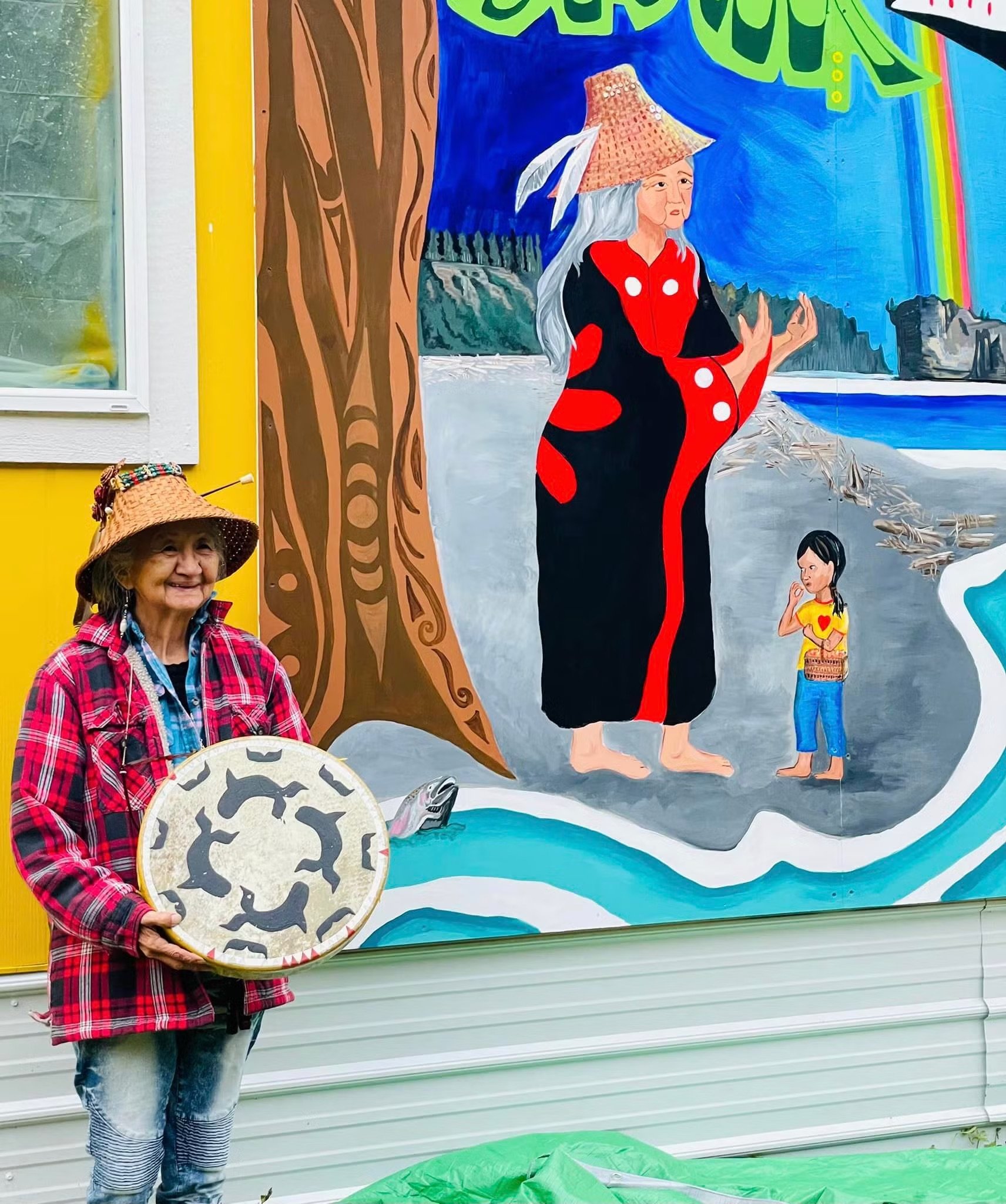
Storyteller Vivian Lee was one of the women used to model the Grandmother figure in the mural. [/caption]
“I’ve been really moved by how strongly the Hoh people have been able to hold onto their culture, how many people still have a really strong relationship to the water and the land and the air,” she added.
Some of the figures within the mural were modeled after the very people involved in the project. In the closest perspective on the left side of the mural, a Grandmother telling a story is modeled after various aspects of women from the Tribe. To the right, the historic canoe carries men in masks familiar to the Tribe, particularly to Cole.
“You look at the first one, and he doesn’t have a shirt, and he’s got on a Wolf Mask,” Cole said. “That’s how our paddlers would paddle long ago out on the ocean, no shirt. And when we’re pulling up to a neighboring tribe, our people would put our masks on like that, and it would let them know where we’re from. That Wolf Mask, that’s a mask that I carved and gifted to one of our Quileute friends. I told my Quileute friend, ‘That’s you on the front of this canoe on this mural.’”
“And then behind it is the Whale, and then the Eagle, and then the back is the Elk. The one on the back, the Elk, that’s me. I keep the Elk song,” he added.
By the time the diverse array of people from the Tribe had been consulted on the design, Hoh Days were over, and the Chautauqua had to head home before the painting could be completed. Fodor later returned for another 10 days to complete the work and traveled from east to west once more to hang it.
Part of her dedication to the project was because she wanted to bring attention to the Hoh Tribe during a difficult transition. During her travels to the coast, Fodor viewed a presentation from the National Oceanic and Atmospheric Administration’s Sea Grant program discussing the problems the Hoh are facing due to climate change. The issue of rising sea levels is of particular significance to these coastal people. Additionally, more severe rainfall events in conjunction with rising sea levels greatly increase the flood hazard to the village.
To adapt, the Tribe is relocating their village with a plan stretching over the next 100- and 500-years. Their plan consists of multiple stages, and after completion the existing Hoh Village on the Reservation would be abandoned and decommissioned.
“Nobody is really talking about this on the west side of the county, and we’re able to be a lot more removed from the changes that are happening in the sea even though we’re surrounded by water,” Fodor said.
Many Hands Work Light
Paul Magid, founding member of the Karamazov Brothers whose juggling antics helped toss together the very first New Old Time Chautauqua over 40 years ago, talked to The Beacon about how the thoroughly collaborative element separated this mural from past projects.
“This one was different in that really it wasn’t one person’s vision. Many different people had different stories,” Magid said.
Magid spent the last three years building connections with the Hoh to get to the point that so many would trust the Chautauqua with their stories. Beyond that, Magid has worked on service projects in conjunction with various Native American tribes since the early 1980’s. Usually, though, he travels much farther to reach the various reservations, but Magid was grateful for this chance to work with people somewhat closer to home.
“I’ve been really wanting to actually get on a much more intimate level with the Hoh in part because they’re members of Jefferson County and also because they were kind of the last ones touched by colonization. They were living in the longhouses with no electricity up until the ‘60s,” Magid said.
He went on to describe how some of the elders consulted for the mural—like the Hoh’s Hereditary Chief Howieshata and storyteller Vivian Lee—shared stories from their lives which carry an unbroken lineage of experience that their people have held for thousands of years.
The rapidly changing world of rising waters now forcing them to move makes holding onto this history that much more important.
“The young ones need to know these stories and they need to continue to live on,” said Tribal Vice Chair Maria Lopez when asked what she hopes the mural will do for her community. “To make certain that this history is continued on from generation to generation.”
Lopez went on to highlight the significance of the Chautauqua, which brought around 60 volunteers to the Tribe, which consists of less than a hundred people in the village.
In addition to the mural, NOTC volunteers did maintenance on elders’ yards, built carts to help them transport their belongings, and taught guitar lessons to youth before giving away 17 guitars that had been donated for the project.
“Most of the guitars came from Cross Roads Music, and some came from George Rezendes, but all from Port Townsend for the most part,” Magid said.
“I think I can safely say that because there’s not that many people at the Hoh Reservation, there are more kids who have guitars per capita there than any other reservation in the country,” he added.
Magid also hopes that people from Port Townsend will join him on regular trips to visit the Tribe and continue teaching lessons.
The Art of Moving Forward
In a very literal way, these stories were carried by the mural from the past to the future. The physical work of painting the three panels was done in the old Tribal Center, which is no longer in use because of its location in a floodplain. The panels were then moved by hand, one by one, up to the higher ground of the library.
[caption id align="alignnone" width="960"]
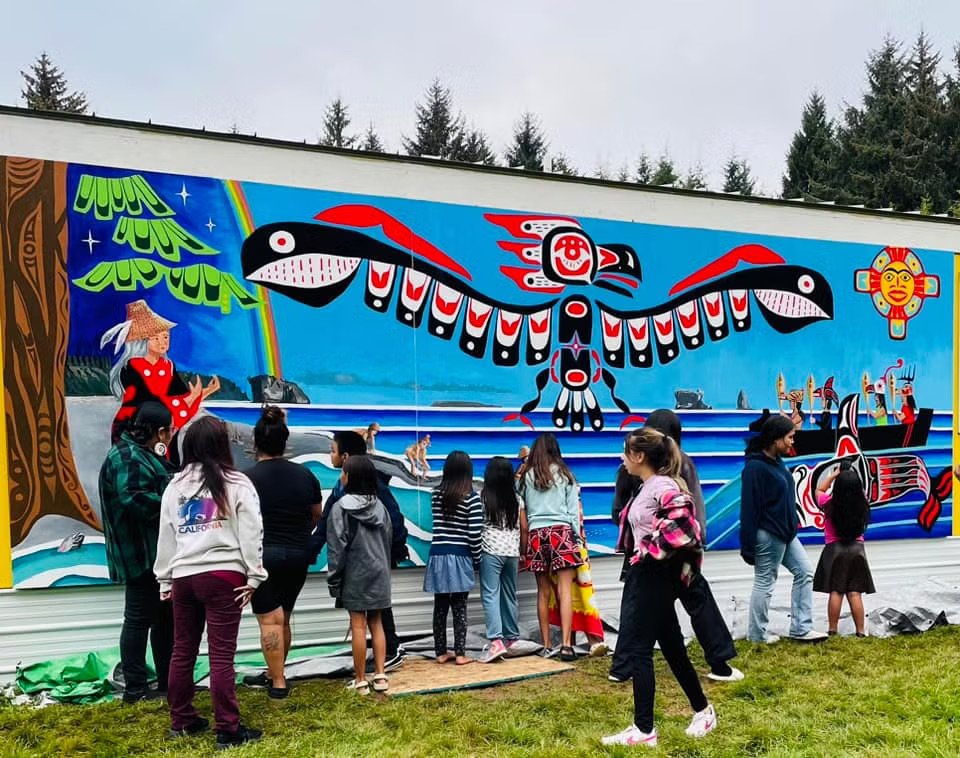
Children from the Hoh Tribe immediately ran up to soak in the painting. [/caption]
“That mural has a lot of our spirits that we carry with ourselves and our community. It’s right on the main road that goes right through our reservation. Everybody will see it when they drive by,” Cole said.
“Hopefully, it will bring more notoriety to our tribe,” he added. “We don’t have a lot of artwork displayed around here, but that’s by far the biggest one installed anywhere on our reservation.”
Before taking the mural apart to install at its final location, Cole offered songs and drumming to honor the work and those gathered to carry it. As music shook the room, those present were moved by the experience.
“When he was singing that song, everybody there, I’m telling you everybody, saw the whole thing come alive,” Magid said. “It was weird and wonderful. You could hear the water moving and the canoe going through the water. It was amazing.”
“There’s a lot of power coming out of that mural,” he added in reverent tones.
In addition to the power witnessed in that moment, Magid noted the work was a hit with the children.
“Another thing I thought was really telling about the mural and how successful it is as an object of teaching and power and truth for their culture is that after it was unveiled, all the kids there, who are so used to their phones or whatever, went running up to the mural. I’ve got this great picture of kids gawking as close as they could get to the mural,” Magid said.
If you want to witness the mural for yourself, the Hoh Tribe is located at 2269 Lower Hoh Road, thirty minutes south of Forks. And if you’d like to offer support to the library on which the mural hangs, all are welcome to join local organizers from Native Connections who will discuss raising funds to donate new books to the library at a meeting on October 8 from 10 am to noon at the Quimper Unitarian Universalist Fellowship.