Notes from the Bookshop: Promised Lands, Utopias Lost and Found

Notes From the Bookshop is a monthly column dedicated to the fine art of reading by Conner Bouchard-Roberts, publisher and bookseller at Winter Texts.
All significant political acts are gestures towards Utopia: An imaginary paradise within one’s own mind imposed upon our certainly imperfect world. In this month’s column we delve into four books that negotiate the long story of human attempts at ‘paradise on earth’ and suggest how we may still attempt to intentionally write the next pages without falling prey to simple narratives.
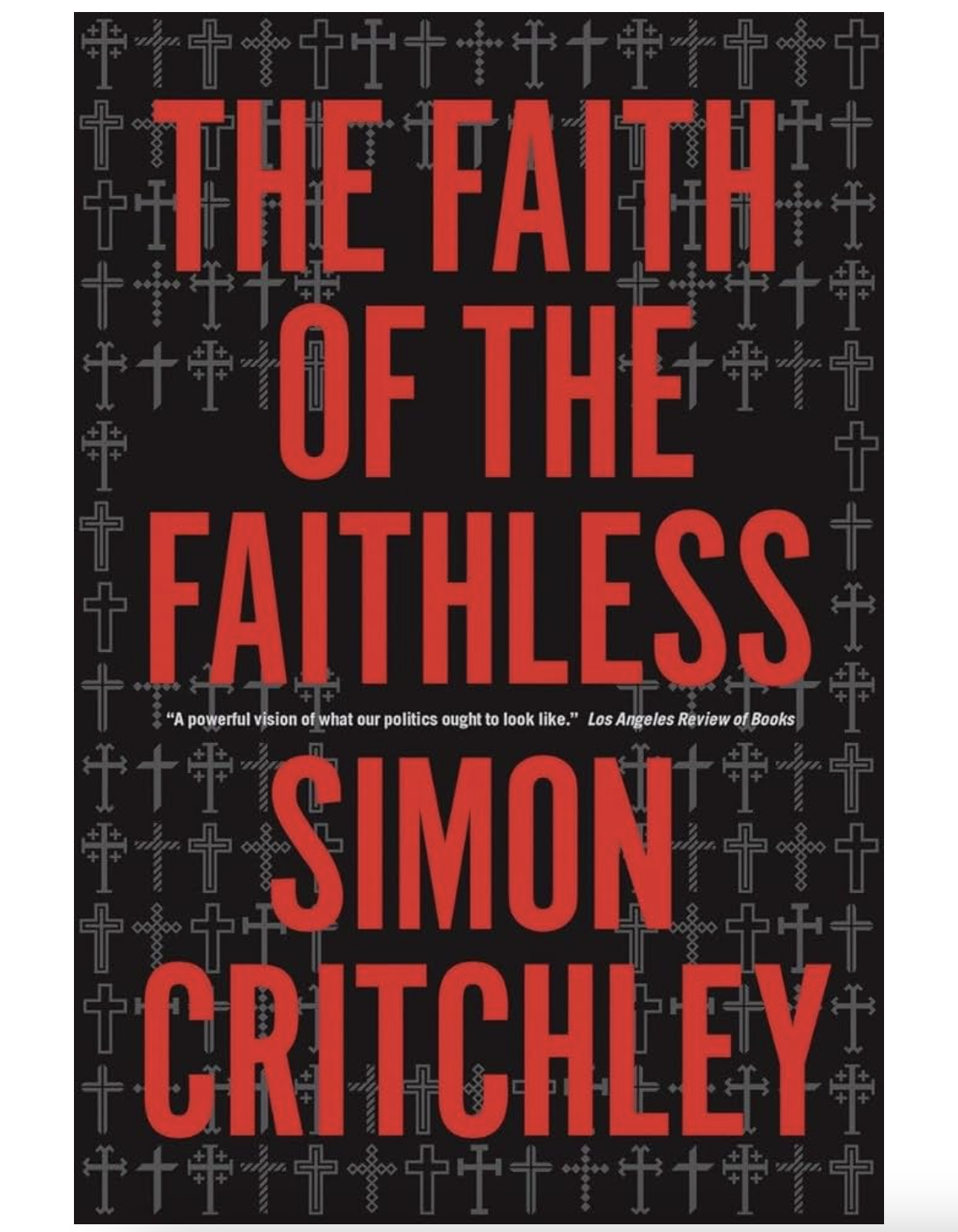
“The Faith of the Faithless” by Simon Critchley (Verso Books, 2014)
Published nearly a decade ago, British Philosopher Simon Critchley writes a theological history of our present political landscape, and lays out a vast and nuanced argument about what “faith” is in our civic lives. It is a book that feels more relevant in relation to the recent U.S. presidential election’s deification of politicians, rhetoric of vague yet universal cosmic wars on ‘terrorism’ or ‘Western values’, and the return of the evangelical right’s influence. The crux of the book is this: modern state politics is but a brief chapter in the history of religious conflict. I tend to agree with this thesis. Overall, Critchley’s book is wordy and academic but eloquent in turns, and his insistence on maintaining focus on the force of belief (and the many ways it manifests in genuine political action and/or violence) is deeply admirable.
And yet…
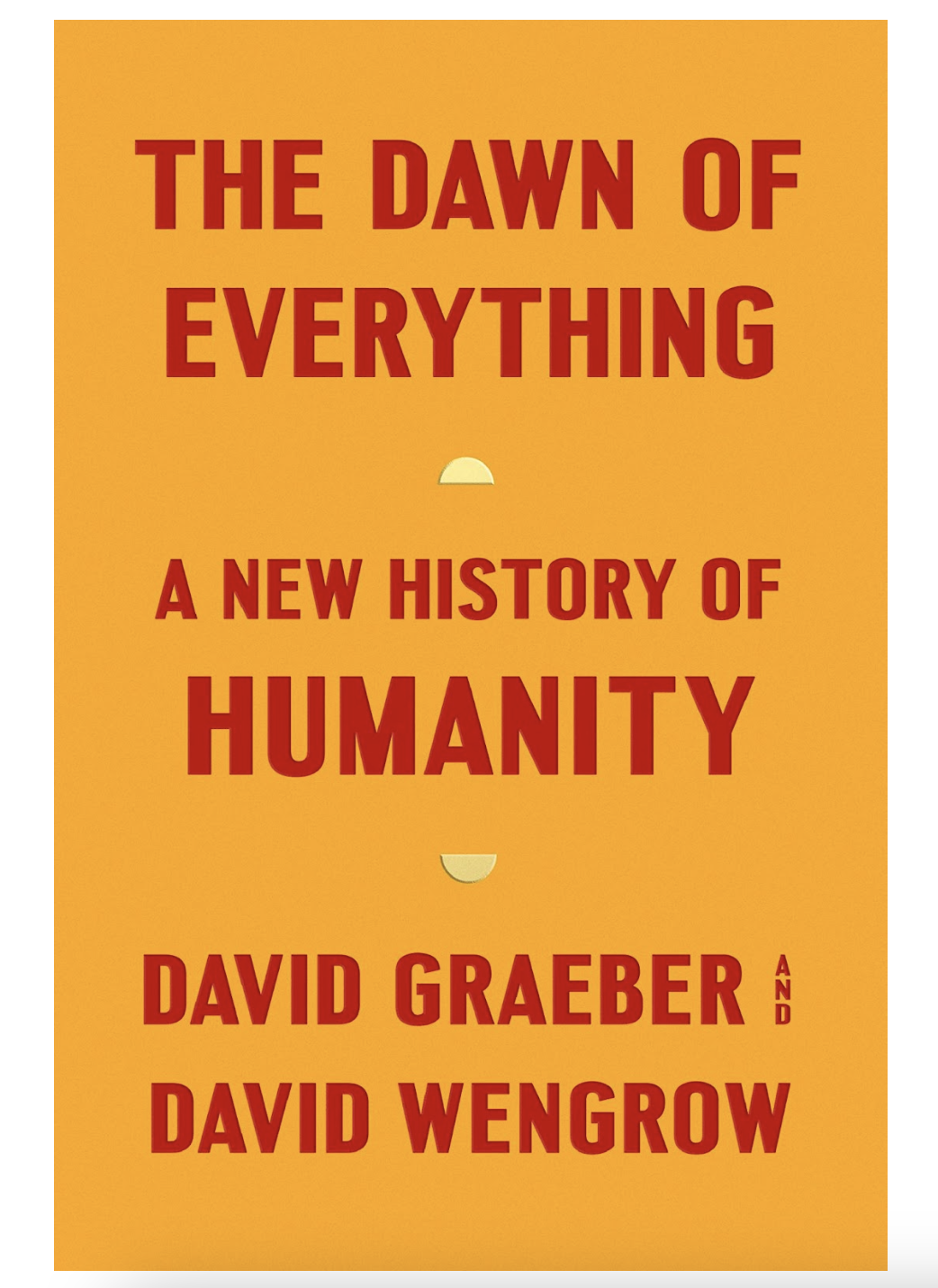
“The Dawn of Everything” by David Graeber & David Wengrow (FSG, 2021)
My main critique of Critchley’s book is found in this wise, vast, humane, text-book-size volume of history by Anthropologist David Graeber & Archaeologist David Wengrow. And that critique is simply: the history of humankind is vast, with myriad eddies in the flow of culture, power, and organization. Any and all teleological arguments (aka linear narratives) that see our current political and cultural paradigm(s) as the end of one big historical progression, Graeber & Wengrow write, are folly and fiction. We are submerged within but one confusing, contemporary eddy. With clear-sighted and deep research, the authors show that not only are other cultural and political arrangements possible but they are archeological fact. This book is an academic balm/boon to those of us who’ve had the good fortune to walk between worlds.
Speaking of…
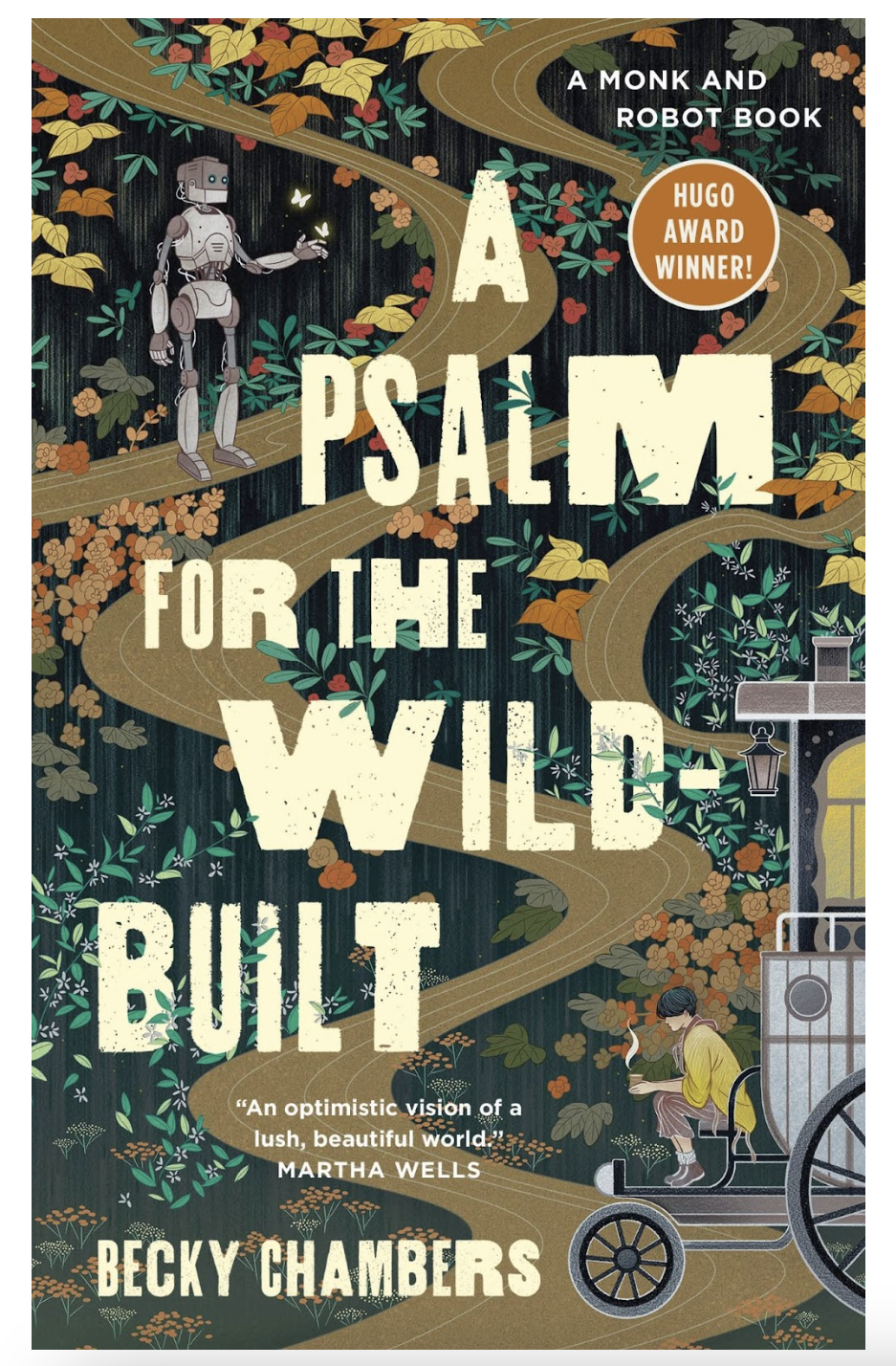
“A Psalm for the Wild-Built” by Becky Chambers (tordotcom, 2021)
In Becky Chamber’s sci-fi novella, a young tea-serving monk named Dex heads out into the wilderness for no good reason other than the (age-old) impulsive draw of “What do I need?”. Out there, beyond all threads of obligation, Dex meets a mythic creature who was tasked by its kin, to honor their (age-old) promise, to seek out the humans and ask the simple question of “What do humans need?” The question of need and being draw inwards and outwards across countless frontiers. What follows is a quiet, intelligent, cute, and deeply serious exploration of humankind’s pursuit of “utopia”: that fictional and religious ideal of perfect social order. The mastery of Chamber’s writing is in its unassuming and comforting novelistic artifice. Yes, It is an easy read, but do not be deceived into thinking it is simple. It is a novella written for the road-weary that pursues with great care and complexity the questions we have always pursued.
And will always pursue…
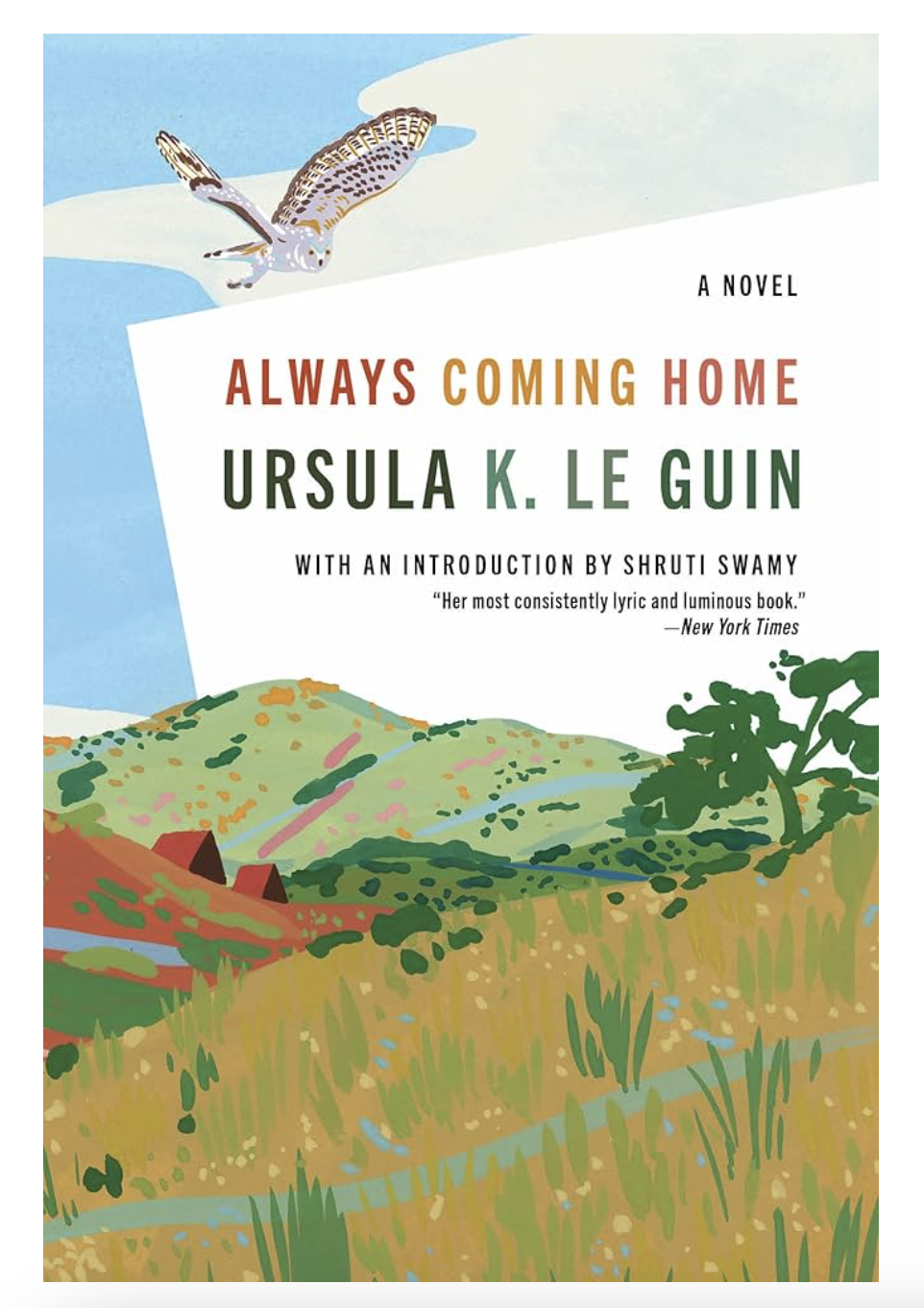
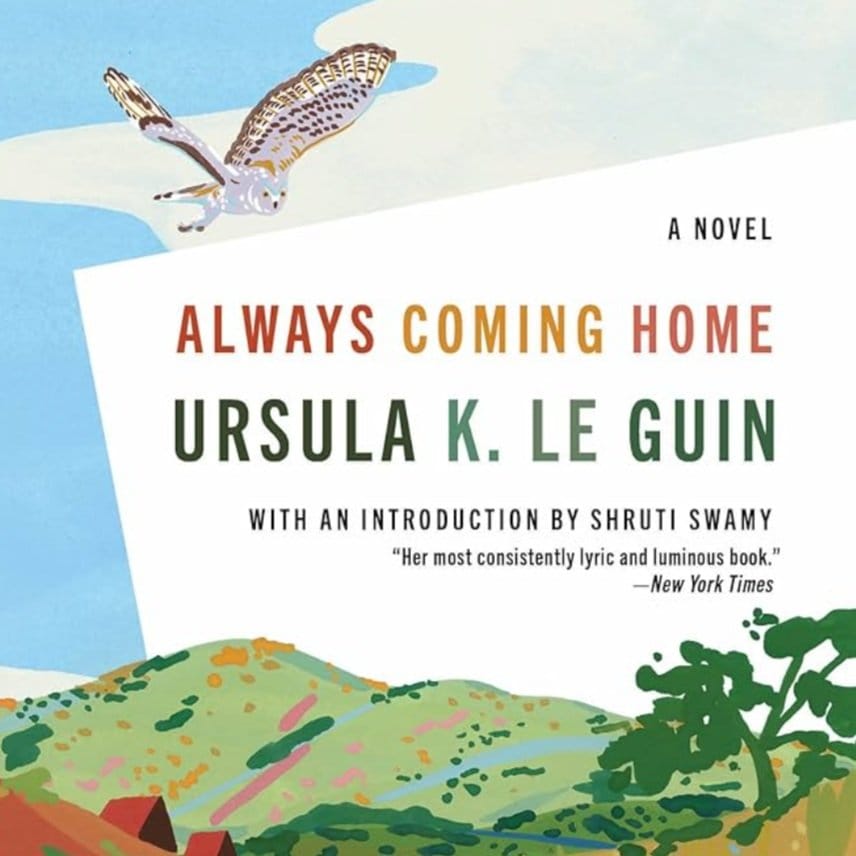
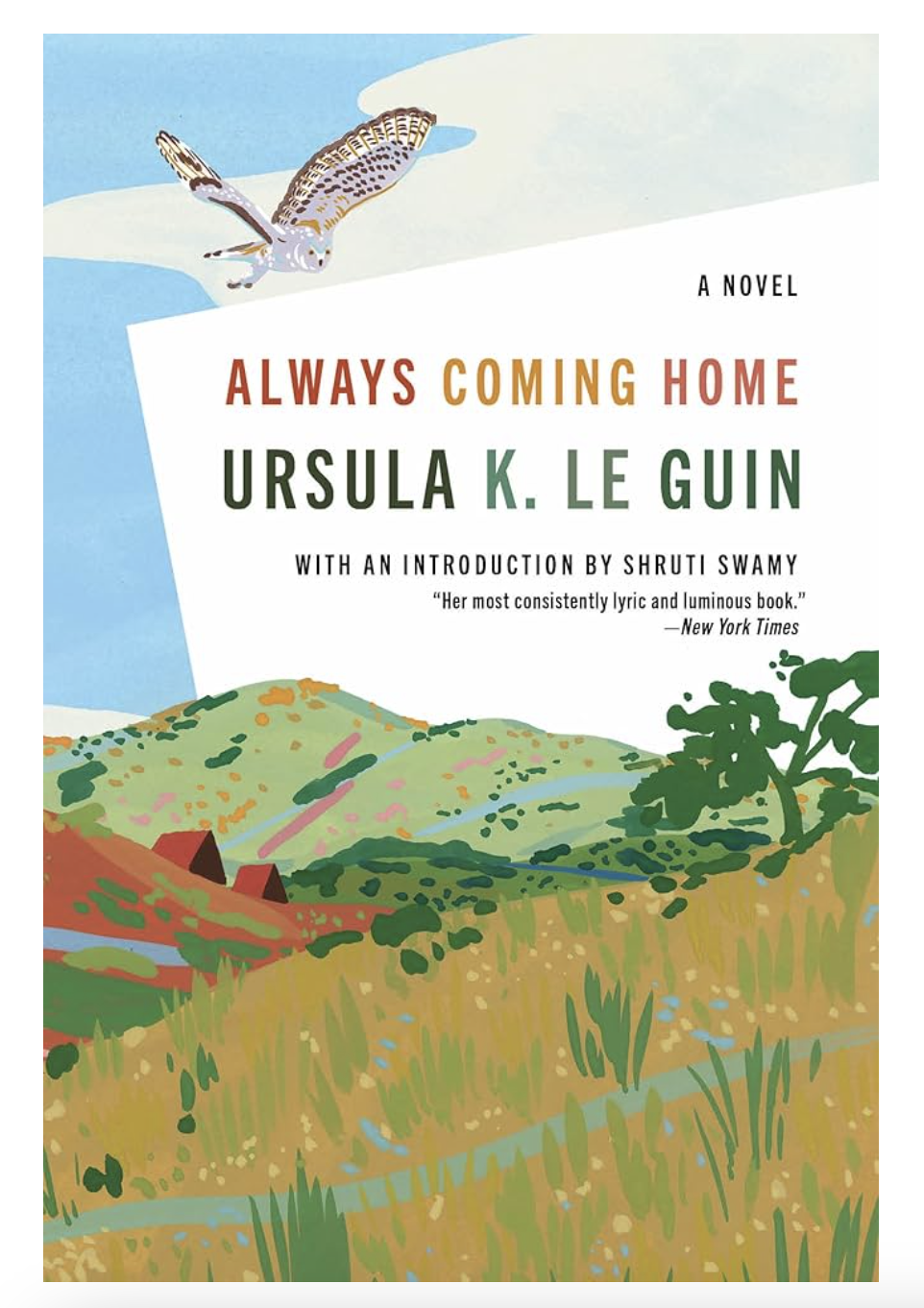
“Always Coming Home” by Ursula K. Le Guin (Harper, 1985)
As is the main premise of Ursula K. Le Guin’s mid-career masterpiece, Always Coming Home. Over the course of nearly 700 pages (depending on the edition), Le Guin maps out in detail a society deep in our collective future, post-collapse, post-internet, post-post. It is a sort of novel. More akin to her father, famed ethnographer Alfred Kroeber’s, anthropology treatises than the Lord of the Rings (although it does contain a journey to Mordor). It is a complicated attempt at writing towards a deep-time way of living and trying to ground that understanding in something very old as well as very yet-to-be, aka very utopian. Yet, Le Guin knows too well that all utopias contain the nativist seeds of their own undoing unless they also contain tenets of exit, renewal, change, and return. And so allow me to end this book column with a poem from a fictional people in a fictional future that holds open a heart-shaped doorway away from our current moment of tech billionaires preaching so called ‘America first’.
Please bring strange things.
Please come bringing new things.
Let very old things come into your hands.
Let what you do not know come into your eyes.
Let desert sand harden your feet.
Let the arch of your feet be the mountains.
Let the paths of your fingertips be your maps
and the ways you go be the lines on your palms.
Let there be deep snow in your inbreathing
and your outbreath be the shining of ice.
May your mouth contain the shapes of strange words.
May you smell food cooking you have not eaten.
May the spring of a foreign river be your navel.
May your soul be at home where there are no houses.
Walk carefully, well loved one,
walk mindfully, well loved one,
walk fearlessly, well loved one.
Return with us, return to us,
be always coming home.
(Initiation Song from the Finders’ Lodge. Always Coming Home (1985). Ursula K. Le Guin.)
If you like the look of any of these books, you can find them and more at Winter Texts, located on the second floor of Aldrich’s Market, 940 Lawrence St, Port Townsend