Nowhere To Go: The State of Housing in Jefferson County

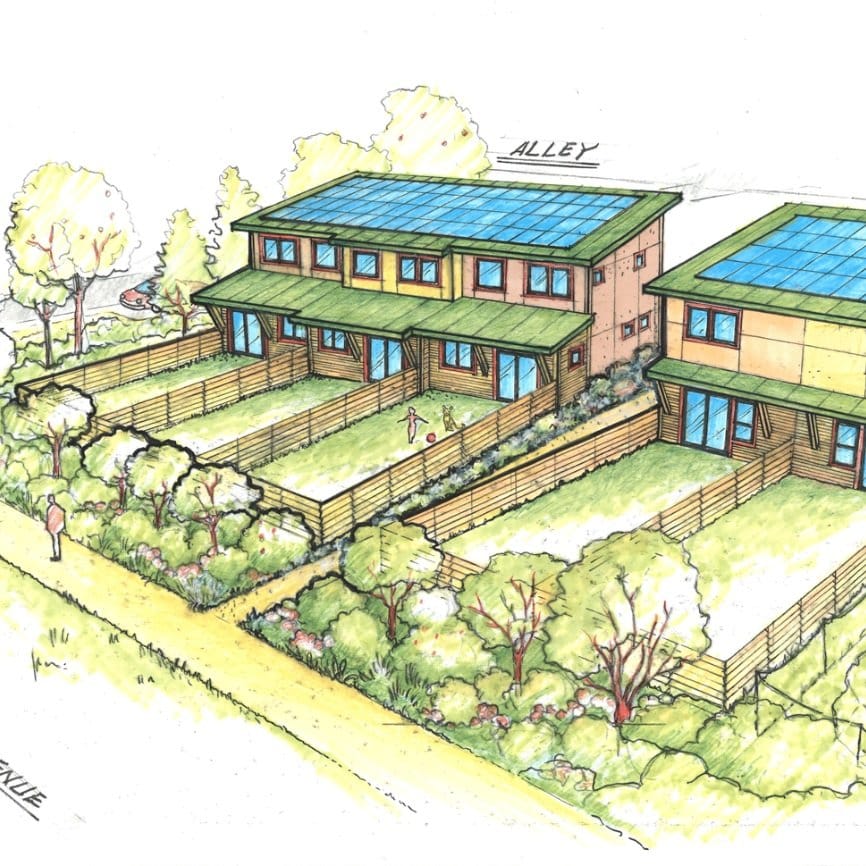
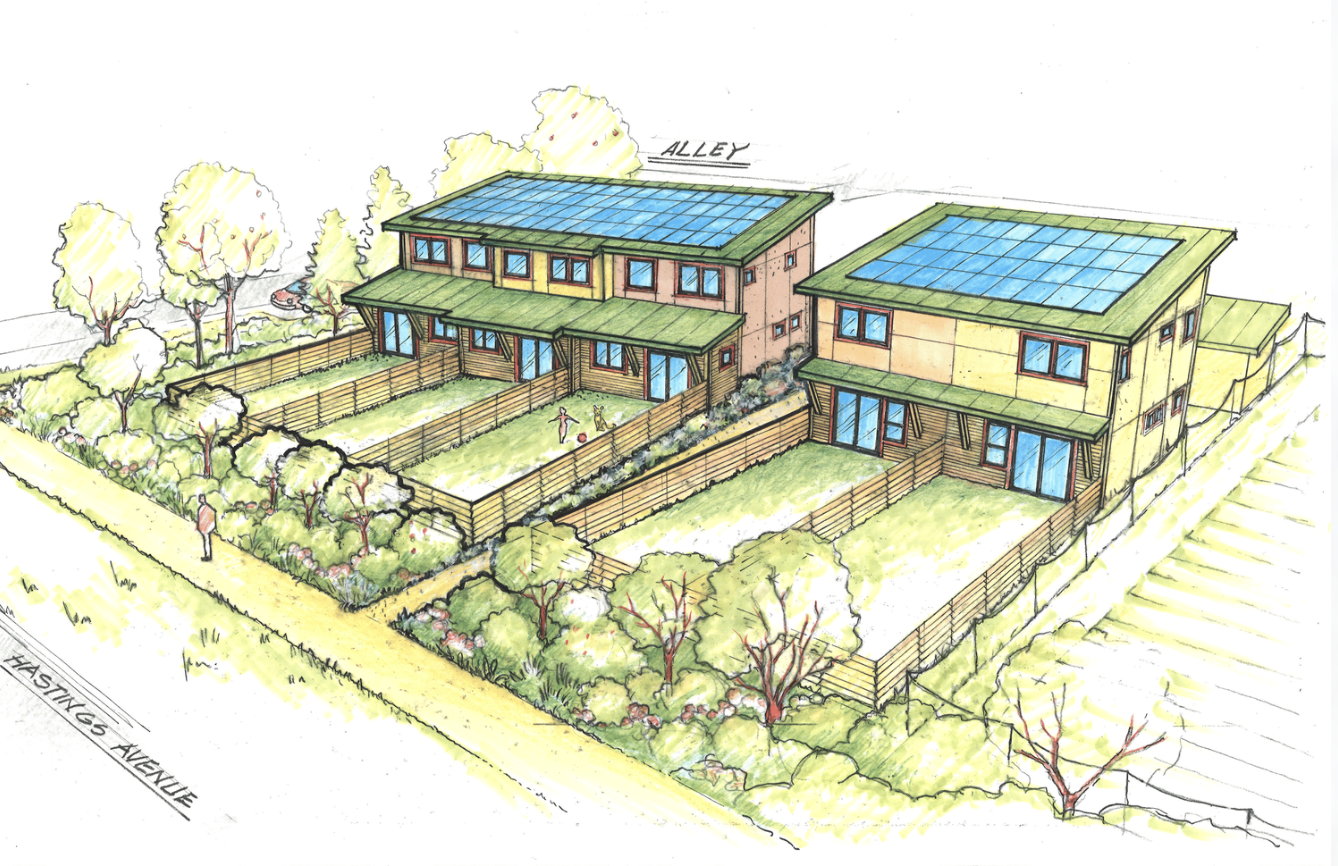
Renderings of Dundee Hills townhomes and community garden, the project of Olympic Housing Trust, that will be located in Port Townsend. [/caption]
This is a Beacon-exclusive monthly column by different housing experts in Jefferson County.
This month’s column is by Peggy Webster, who works for Olycap.
For those who are unhoused who are unsheltered:
There are roughly 100 people who are unhoused in Jefferson County. This is based on Housing and Urban Development’s annual Point-in-Time count done every January. In 2023 the number was 79. This is an acknowledged undercount as the rules do not allow counting of persons who are “couch surfing” or living in substandard housing without things like water and septic. Agreeing to be part of a government database is also a barrier to participation.
Ideally the unhoused would have access to shelters or transitional housing. Currently in Jefferson County we have roughly 140 beds in shelters and transitional housing. They are all full.
There is a project in development to add shelter beds at Caswell Brown, the community located off of Mill Road and managed by OlyCAP, but those would only replace the existing beds at the American Legion, where the shelter has been operating for about 15 years.The intention of this project is to move the shelter at the Legion to a more permanent structure at Casewell Brown. It should be noted this project is not yet fully funded and realistically is 3 to 5 years out from being operational.
Right now, there is nowhere to go for the unhoused who are unsheltered.
[caption id align="alignnone" width="2048"]
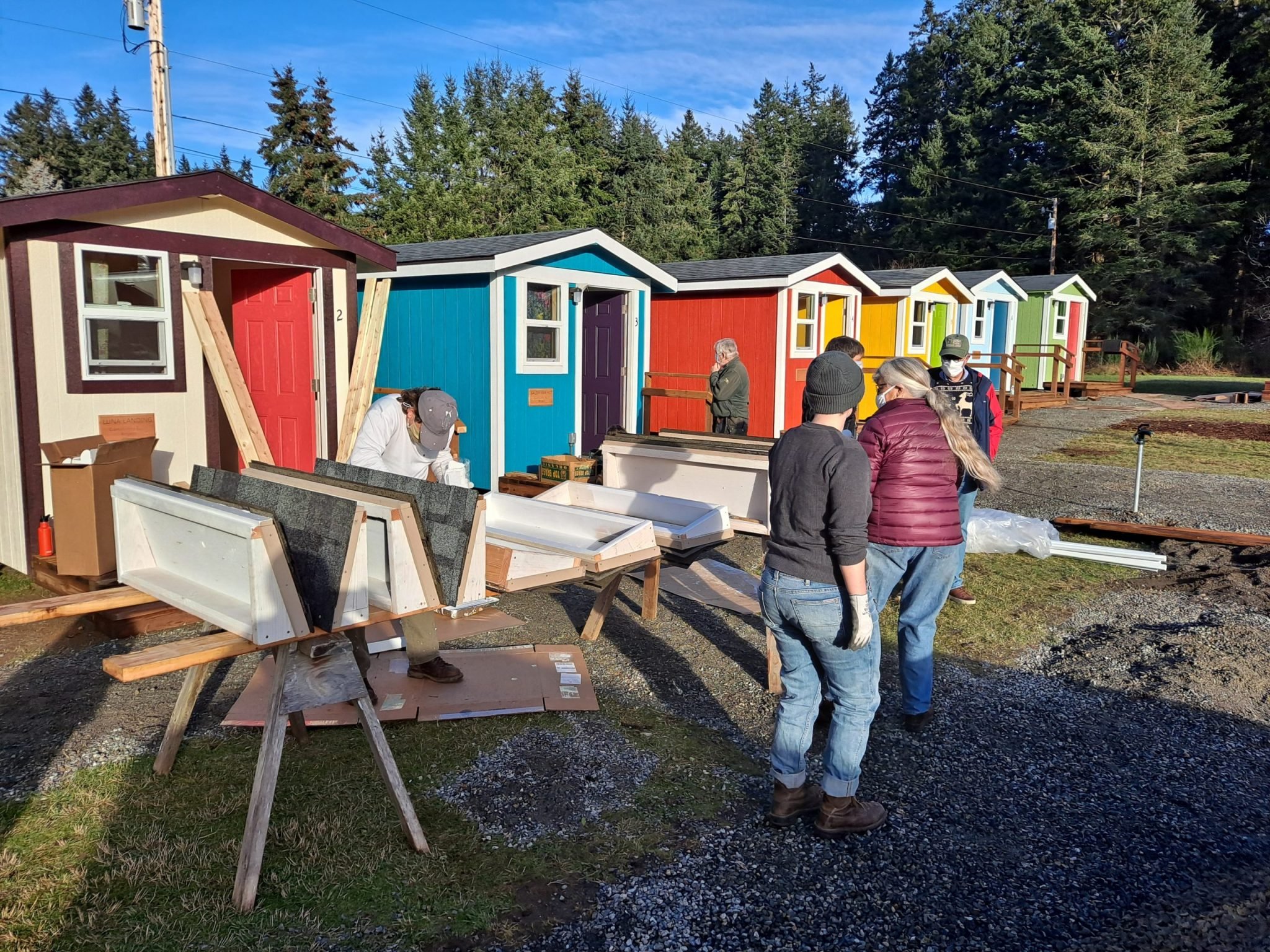
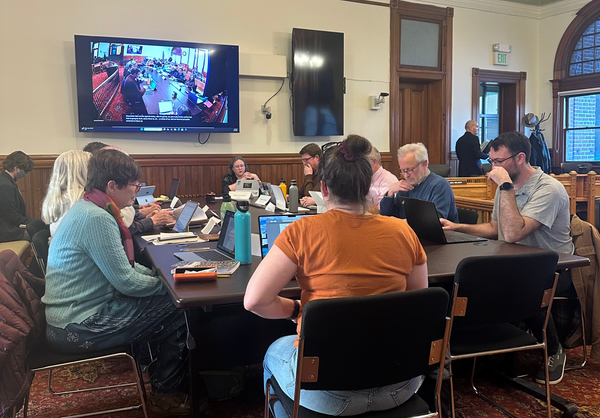
Tiny Shelters built by Community Build volunteers in partnership with Bayside Housing. [/caption]
For those in shelters or transitional housing:
Shelters and transitional housing serve a purpose but are not designed as long-term solutions. Shelter accommodations are intended to provide around 45 days of security, while transitional housing can only provide a maximum of 2 years, as outlined by State and Federal Funding. What many individuals and families facing homelessness need is permanent supportive housing.
These units fall into two categories: those designated for the elderly and those designated for persons needing “supportive services”. Supportive services are services that address the special needs of people served by a project, program, or activity. They are necessary to enable an individual to participate in activities such as education, employment, health care, housing, and social services. Supportive services may include child care, employment assistance, case management, counseling, outreach, advocacy, legal services, transportation, and other assistance.
In Jefferson County, roughly 230 units are designated for the elderly and 38 for supportive services; their wait lists are a minimum of 2 years out if even open at all.
There is a project in development, being spearheaded by Bayside Housing & Services, that would add 18 units for the non-elderly in need of intensive supportive services. This should be operational in the next 18 to 24 months. There is another longer term project, Vince's Village, which is not yet fully funded and is realistically 5 to 6 years from being operational.
Right now, there is nowhere to go for those in shelters and transitional housing looking for permanent housing.
For those in need of low-income housing without supportive services:
According to the Census Bureau, in 2021, there were a total of 2,700 workers commuting into Jefferson County to work, compared to a total of 4,395 who are both employed and live in our county. While we don’t know how many of those commuters are low-income, we know by anecdotal evidence that many do so because they can not afford housing in our community.
There are a handful of subsidized apartment complexes and single-family rentals available, but the waitlists for the rentals are long. At any time, a single-family landlord can decide to sell. For example, in the Hamilton Heights neighborhood, the number of single-family rentals decreased by half over the last few years.
With a rental vacancy rate that hovers between 0-1% in our County, it is a tough and challenging road to secure this type of housing.
Many have nowhere to go.
For those who can qualify for Homeownership:
There is a bright spot in our story. Habitat for Humanity East Jefferson County is working tirelessly on the Mason Street Development, a 150-unit permanently affordable housing project located in Port Hadlock. The current plan expects to build 50 homes for Habitat-eligible buyers and about 80 or so homes for those in the workforce at higher incomes. It is also anticipated there will be housing for adult disabled persons. As of July 2024, construction is scheduled to start in late 2026 and will be set up on the Port Hadlock sewer.
Additionally, Olympic Housing Trust’s Dundee Hill will offer 5 town-home style housing units, for ownership, located near the corner of Sheridan and Hastings in Port Townsend. They are also moving forward with Chimacum Commons, a farmworker’s housing development located behind the Chimacum Farmstand, in partnership with Jefferson Land Trust. The units at the Commons will be available for purchase or rent and will be held in permanent affordability!
A lack of housing affects everyone.
Consider that employers such as Jefferson Healthcare, the Mill, and many other service-based sectors are struggling to hire necessary staff due to the unavailability of housing. We do not have a pediatrician in Jefferson County. How can you have a vibrant community with families and children without a pediatrician?!
What can we do to address our housing crisis?
We need to think creatively across the entire spectrum of housing.
What about establishing a mobile home or tiny home (home—not shelter) community on a City or county-owned property? Until a developer shows up at Evans Vista, Cherry Street, or another City or county-owned property close to infrastructure, why not a mobile or tiny home community? Trade a bit of the aesthetics for a solution that is reasonably priced, does not require a massive subsidy from the government, and is doable now.
Other topics we need to address are vacant homes, seasonal homes, and short-term rentals. Right now, Housing Solutions Network is proposing guidelines for short-term rentals like Air BnBs, VRBOs, and the like. Help support regulations that support more housing for local families!
We can also license rental properties with required standards on habitability and safety for all tenants.
Additionally, rezoning commercial areas as mixed-use to include housing can help expand areas to allow more housing in our community. Making areas like the Rainier Street sub area, located across from Goodwill, attractive for residential development that could help add to our housing stock.
If you have any ideas on how to increase housing, share them with City and County leaders! We cannot give up. It will take all of us to create a community where there’s housing for all.
Peggy Webster represents Olycap and has supported affordable housing efforts for 14 of years. Previous to her move to Port Townsend to join her family, she was the Director of Planning and Development for the Housing Authority of Baltimore City, Maryland, and Chief of Staff for the Baltimore City Housing Department Planning and Development group, helping achieve the financing of about 3,000 units of affordable housing over 7 years for the community. Her last project involved planning the redevelopment of 44 acres of the City to achieve over 1500 units of mixed-income housing, a new school, and two new parks. In Jefferson County you can find Peggy wearing multiple hats as she serves as Chair of the Peninsula Housing Authority, Project Manager at Olycap, and on the Mason Street Development Steering Committee for Habitat. For her work on this article, she was supported by representatives from multiple local housing organizations.