Petition Threatens to Stall Port Townsend’s Housing Progress, Though Plan Remains in Effect for Now
Critics say appeal aimed at blocking density could worsen the housing crisis, as the city confirms zoning changes remain active during review.

News by Rachael Nutting
PORT TOWNSEND, WA — Just two months after the Port Townsend City Council approved the city’s 20-year comprehensive plan, a new local group has formally appealed the decision to the state, seeking to invalidate the zoning changes intended to address the city‘s severe housing shortage. However, the City of Port Townsend confirmed Monday that the new plan remains in effect while the legal process unfolds.
Affordable Hometown Port Townsend (AHPT) filed a petition Friday with the Washington Growth Management Hearings Board (GMHB) seeking to invalidate Ordinance 3361, which was adopted Dec. 15, 2025. The appeal challenges the city’s updated housing element, infrastructure planning, and zoning density increases on multiple grounds.
In a press release issued Monday, City Manager John Mauro acknowledged the appeal. Still, he stressed that “the City’s Comprehensive Plan and implementing development regulations remain in effect and are presumed to be valid” during the GMHB’s review process. The city has stated it will not comment specifically on the petition’s merits as the legal proceeding moves forward, but vowed to “defend in earnest the substantial work and contributions of the public culminating in the adopted Comprehensive Plan.”
The legal action comes after what city officials describe as the most extensive public outreach effort in Port Townsend’s history in the two years leading up to the adoption of the Comprehensive Plan. Consultants, council members and city planners hosted more than 60 meetings, workshops and events, including visioning sessions, farmers market tabling, school visits and open houses.
A familiar opposition
The four individual petitioners—Todd McGuire, Mary McCurdy, John Capps, and John Watts—former members of “Accountable Port Townsend,” all submitted public comments during the planning process and now serve as leaders of Affordable Hometown Port Townsend. This new nonprofit describes its mission as supporting affordable housing “while minimizing negative impacts on existing Port Townsend neighborhoods.”
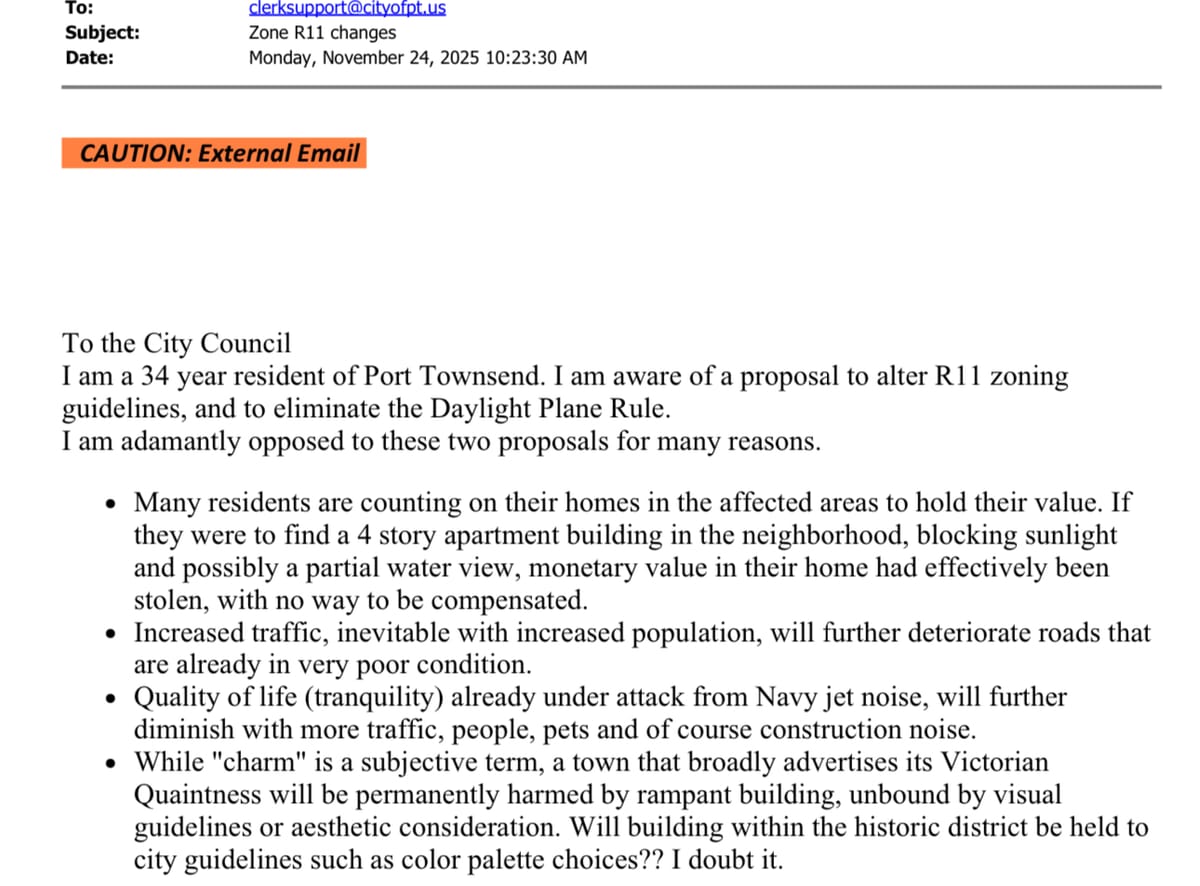
But records from the multi-year planning process tell a more complicated story. During last year's outreach phase, some of the same individuals who now frame their concerns around affordability and anti-displacement raised objections focused on entirely different issues: loss of sunlight for gardens, increased street parking, and changes to neighborhood character.
Mary McCurdy, one of the petitioners, wrote in a December letter to the Port Townsend Leader that the zoning changes amount to a “gentrification bomb” and argued that allowing sixplexes and increased lot coverage in the historic district would endanger preservation efforts.
“Density does not equal affordability”—but it's a start
The central tension in the appeal mirrors debates that played out throughout 2025: Should the city require developers to include income-restricted affordable units in exchange for increased density, or does simply adding more housing stock—any housing stock—eventually ease pressure on prices?
“Density alone will not solve affordability, but it is a necessary precondition,” resident Cameron Jones commented to the council in December. “Tools like inclusionary zoning, development incentives, and clear affordability requirements are how increased capacity translates into homes people can actually afford.”
City staff acknowledged that affordability requirements were not fully included in the current update. Emma Bolin, the city’s planning director, noted during final deliberations that while affordable housing was “baked into the Comp Plan review,” the current update focused primarily on middle housing. Middle housing is defined as housing affordable to individuals and families at 60% to 120% of Area Median Income (AMI).
Common jobs in this range include teachers, nurses, police officers, firefighters, office supervisors, paramedics, and skilled tradespeople, such as electricians and mechanics.
Conversations specifically on affordability for lower incomes are scheduled for the 2026 docket, along with amendments to the comprehensive plan.
Public Works Director Steve King laid out the stark math facing the community: “We have a deficit of investment of $17 million a year in order to get the 85 units of affordable housing that we need. It is not a reasonable expectation for a community of this size to come up with $17 million of subsidy.”
The city’s approach relies on mixed-income development to reduce that subsidy burden to $5 million or $6 million annually—still significant, but potentially achievable through the density increases now being challenged.
What's at stake
If the Growth Management Hearings Board finds merit in the petition, the city could be forced to revisit and revise portions of its comprehensive plan. This process would consume staff time and legal resources in 2026 and beyond.
The immediate consequences of the appeal are more procedural. The city must now respond to the petition, and taxpayers will bear the cost of defending a planning process that spanned two years and involved thousands of hours of staff and volunteer work.
Mauro emphasized during December deliberations that failing to adopt the plan by the December 31 deadline would have rendered the city ineligible for numerous state grants—funding needed for aging infrastructure, transit improvements and conservation projects. The appeal, while not triggering those immediate penalties, creates new uncertainty. The City of Winslow, on nearby Bainbridge Island, has recently faced these penalties for failing to adopt an updated comprehensive plan.
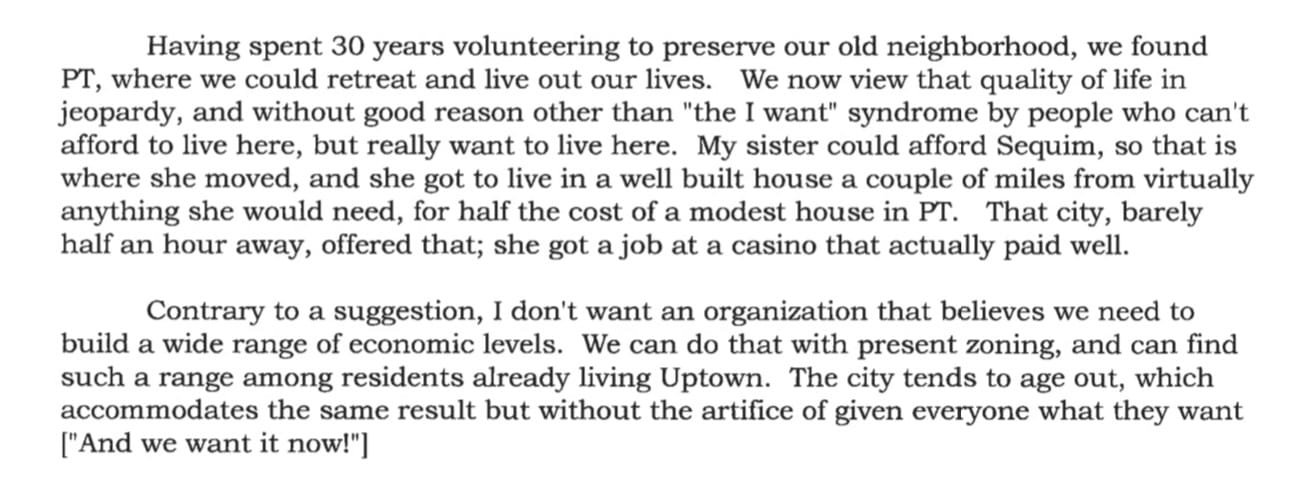
Council member Libby Urner Wennstrom expressed frustration during December city meetings with what she characterized as last-minute opposition after years of public outreach. As an example, she read a public comment that said, “that quality of life is in jeopardy because of ‘I want syndrome’ from people who can’t afford to live here.” Wennstrom noted that such language dismisses the very real housing insecurity facing longtime residents.
The process question
A recurring theme in the appeal is the adequacy of public participation. Petitioners argue the city failed to provide “early, continuous, and meaningful” engagement as required by the Growth Management Act.
Yet the public record suggests otherwise. The city’s outreach included 63 public events between May 2024 and December 2025. The city adopted a formal Public Participation Plan in April 2024 and maintained a dedicated website with all draft documents, exhibits, and meeting schedules.
John Capps, a petitioner with AHPT, told the council in December, “I have to tell you, public notices and ambiguous public hearing announcements are opaque. They are the opposite of transparent, and many of these issues were not brought to our attention until four to six weeks ago.”
Staff responded that the meeting notices complied with all legal requirements and that the comprehensive plan website had been active for more than a year, with complete documentation.
What's next
The GMHB will now schedule proceedings on the petition in the coming months. Meanwhile, the city has directed the public to its website for all related documents and to the GMHB website for information on the review process.
“The record shows that people overwhelmingly wanted affordable housing measures and gentrification protections,” John Watts, former city attorney and president of Affordable Hometown Port Townsend, said in Friday’s announcement of the appeal. “We hope we can come to a quick resolution with the City that will eliminate the need for further litigation.”
For residents watching from the sidelines—those priced out, doubled up with family members, or spending more than half their income on rent—the legal battle represents another delay in a decades-long housing crisis, even as city officials confirm that, for now, the plan intended to address that crisis remains in effect.
The adopted Comprehensive Plan, past public engagement events, the petition for review, and the city’s press release can be viewed here.