Port Townsend City Council Approves Comprehensive Plan, Aims to Tackle Housing Crisis With New Regulations

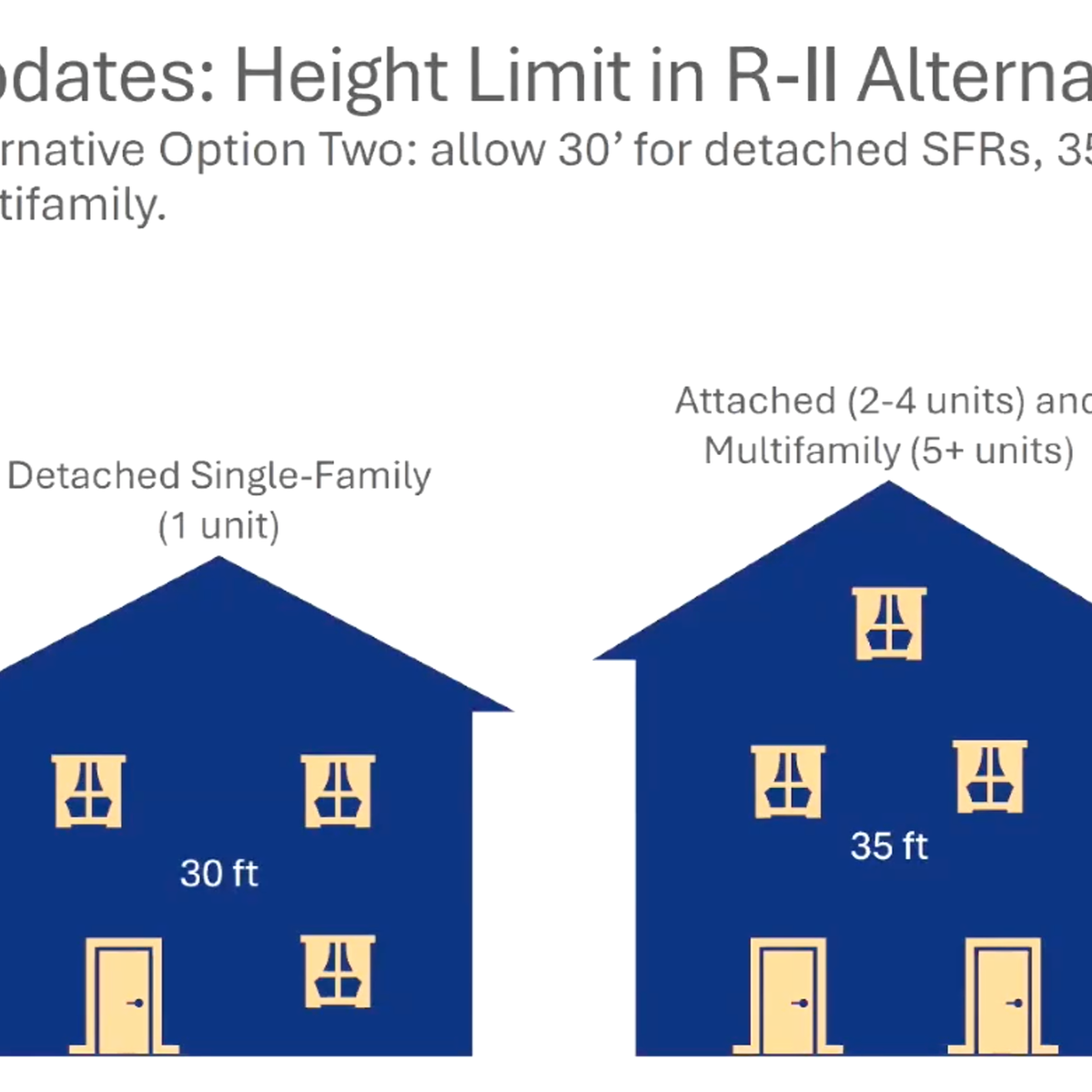
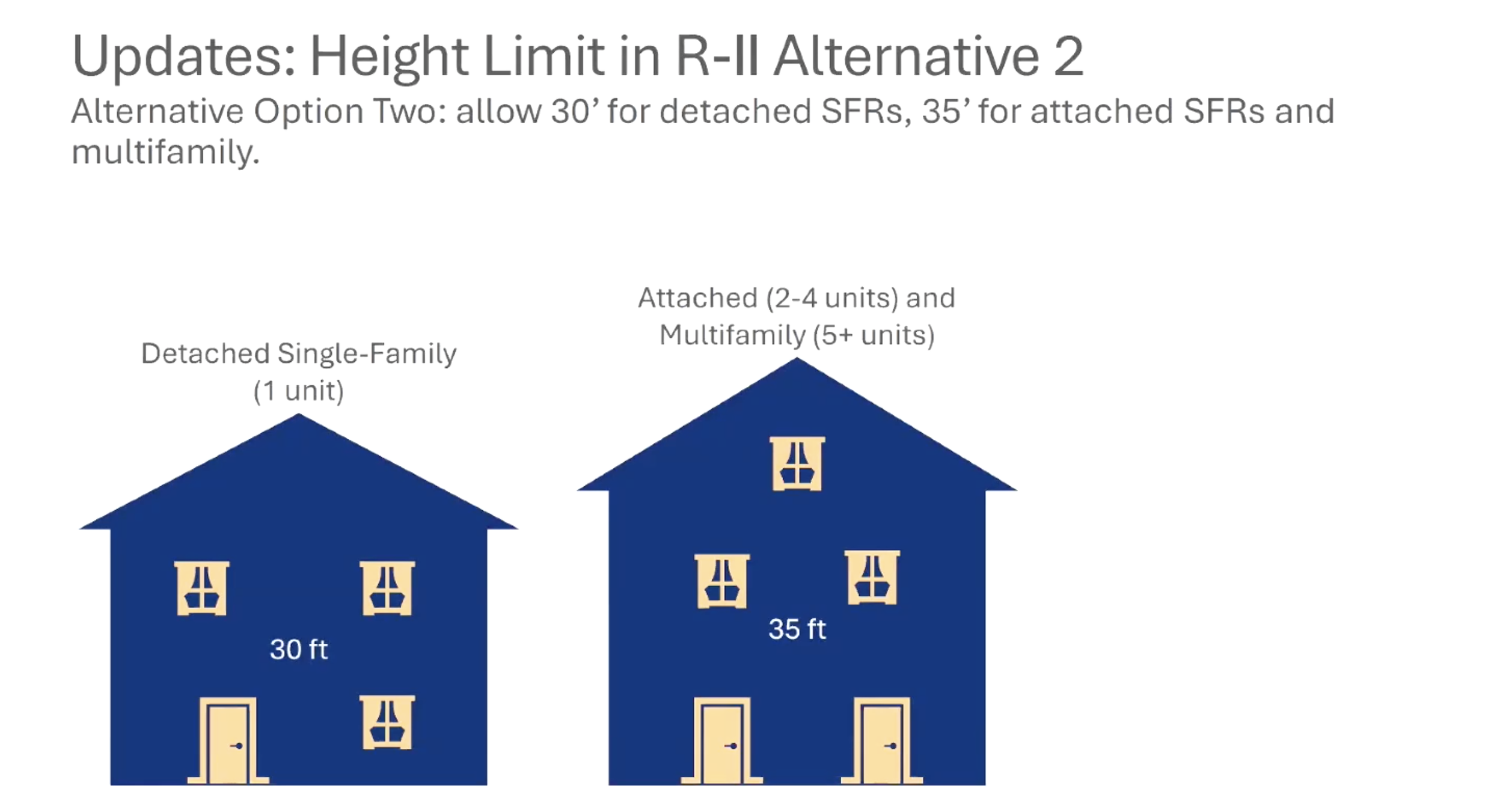
City Council voted to accept alternative two to allow houses that currently do not have a livable third floor to utilize their attic space for residential use. Photo from city council packet [/caption]
News by Angela Downs
On December 15, 2025, the Port Townsend City Council approved the Comprehensive Plan ten-year periodic review, officially meeting Port Townsend’s deadline requirement. This has been an extensive two-year process, igniting citizen participation at different stages along the way. The work is not done for city planning; with a full 2026 short-term docket and annual reviews, both city staff and city council encourage high-level participation.
The night focused on final decisions around bulk density and scale. Further refinement of development regulations for subdivisions, historic preservation, and code cleanup will take place in 2026, and any potential unintended consequences of the recent periodic review can be addressed in the annual amendment process.
With 15 to 20 years of relatively little effort to build affordable housing and apartments, Port Townsend is, and has been, in a housing emergency.
“[W]e have a deficit of investment of $17 million a year in order to get the 85 units of affordable housing that we need. It is not a reasonable expectation for a community of this size to come up with $17 million of subsidy,” Steve King, Director of Public Works, said in the December 15 meeting.
To address this lack, city staff have looked towards mixed-income development approaches. “One of the fundamentals for allowing these densities is to allow for mixed income ranging from workforce housing all the way down to affordable permit Supportive Housing,” King said. To their calculations, these mixed-income-density builds would drop the debt to 5 or 6 million.
“85% of the housing units permitted each year over the 20-year planning period must be multifamily,” Emma Bolin, Director of Planning and City Development, explained in email correspondence with the Beacon, “This is based on [Office of Financial Management] OFM population projections and Housing Action Planning Tool by the Department of Commerce, which aggregates the projected housing need by income for the city. The Department of Commerce defines affordable units in communities like Port Townsend as those that are in mid-rise buildings and are “multifamily.””
On average, 13 units of multifamily housing are built a year in Port Townsend, but as Bolin explained, some are affordable single-family Habitat units, and don’t count towards the 85 unit requirement. To make this 550% increase in multifamily development growth, changes are going to need to be made.
While affordable housing was “baked into the Comp Plan review,” as Bolin said in the final meeting, middle housing was the primary focus of the plan. The 2026 docket will host conversations specifically on affordability.
Incremental development, a building strategy where pieces of complex systems are implemented in small, usable steps, fostering diversity, is an ideal tactic for urban development. A consistent issue the city has faced in incremental development applications are barriers for those who have less financial access, limiting the ability for their projects to occur. One example is the Daylight Plane code, meant to limit buildings that block light to neighbors.
While Daylight Plane is very costly and time-consuming for small builders, with extra time billed for extensive and complex math calculating slope and angle, as well as extra materials, it was one of the criteria that the Hearing Examiner granted relief on as part of the Planned Unit Development permit. So large development projects, such as Madrona Ridge, do not have to observe the code.
“Ultimately, what we're talking about here is incremental development. There's nothing ultimately happening here that is a gigantic change,” said Mayor David Faber, “These are moderate changes, combined with simplicity that gives average people easier access to building.”
Many of the codes discussed in the Comp Plan are already actionable. Bolin said, “So what could happen tomorrow could have happened today.” She explained that someone can already apply for converting homes into four-plexes, and unit lot subdivisions to build rows of townhouses.
Mayor Faber included disability accessibility as a priority in the state code and as a priority in the vision for Port Townsend. Commercial development code requires accessibility. Residential code could also include accessibility as a value of the city. “That's the purpose of this additional density,” he said.
City staff are expected to follow the requirements of state legislation in their planning through HB 1220 Washington State Legislature, first signed in 2021. A significant part of the Growth Management Act updates the bill dictating that Washington cities and counties plan for the spectrum of housing needs and incomes, including permanent supportive housing (PSH) and emergency shelters.
Significant time was spent discussing the possibility of pausing the process altogether or even just delaying a decision on the sections that elicited the most public concern. It is important to remember, Jefferson County is among nine other counties given deadline extensions by the Washington State Legislature for their Comprehensive Plan updates, from June 30, 2025, to December 31, 2025.
City Manager John Mauro wrote in an email correspondence with the Beacon, “Essentially, staff presented accurately during the council meeting on two of the important legal ramifications of delay, including becoming ineligible for many grant funding opportunities and reverting certain sections of the city’s code to state statute instead of something tailored to the community of Port Townsend.”
With aging infrastructure as a primary burden on the city, it would be a major risk to submit the Comp Plan late and miss out on these grants. The sewer line break downtown last Christmas, which caused a sinkhole, is a warning sign of the looming emergencies the city faces and continues to motivate city staff to act and respond.
While several council members stated it was their first time hearing about the repercussions of a delay, Bolin said in email correspondence, “Council was aware that Dec. 31, 2025, was the deadline for finishing the Comprehensive Plan and the null alternative: grant ineligibility or low competitive rankings if non-compliant.”
Grants the city would be ineligible for include transit infrastructure to help with potholes, emergency management, preserving clean water and drinking water, funding for recreation and conservation and labor benefits.
The final plan will be published here by December 24.