Port Townsend Council Charts Course for Mixed-Income at Evans Vista
Council directs staff to prioritize economic diversity in development solicitation, and seeks community amenities.

News by Rachael Nutting
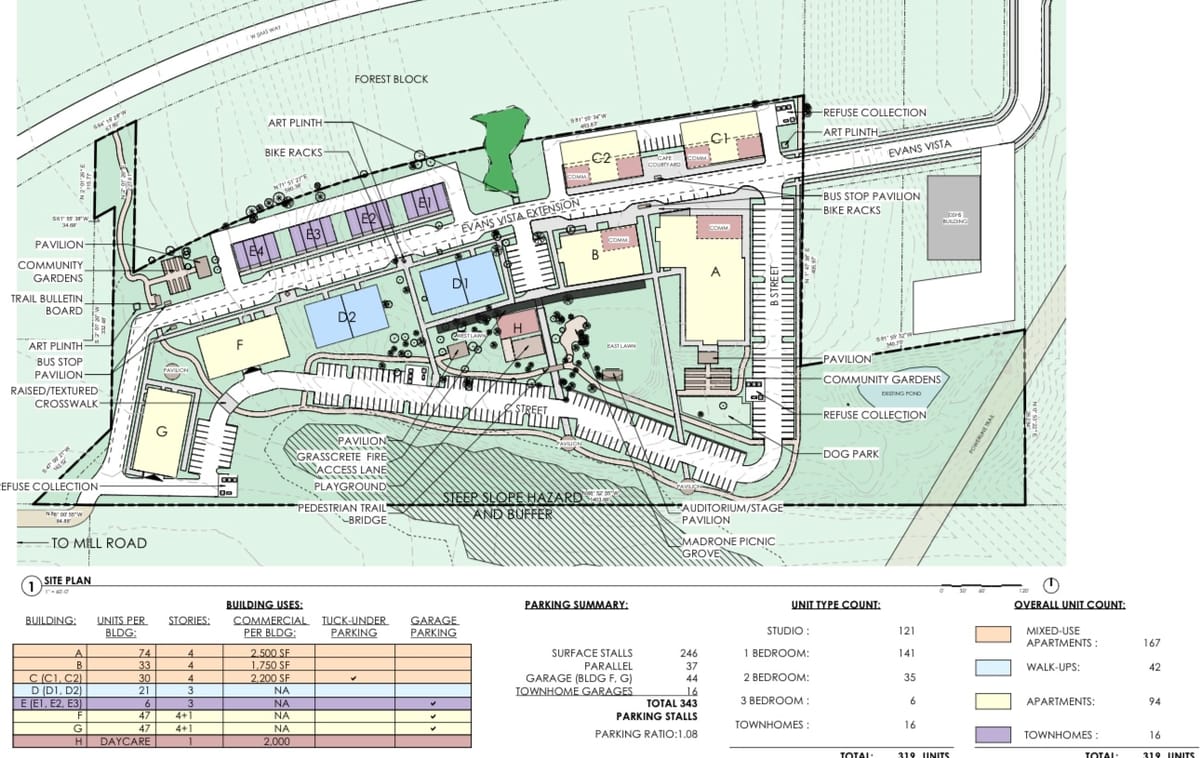
PORT TOWNSEND, WA — After months of behind-the-scenes conversations between city staff and more than two dozen developers, the Port Townsend City Council has provided direction on what it wants to see in the upcoming solicitation for the Evans Vista neighborhood: a financially viable, mixed-income community that prioritizes economic diversity and, ideally, includes a park and childcare facility.
During a meeting on February 17, 2026, council members reviewed a detailed agenda packet and heard a presentation from Planning and Community Development Director Emma Bolin and Housing Grants Coordinator Renata Munfrada. The discussion focused on how to balance the city's ambitious vision for the 14-acre site with the financial realities of modern development.
A flexible approach to solicitations
City staff recommended, and the council concurred, that the city should issue a Request for Expressions of Interest (RFEI) rather than a traditional Request for Proposals. The distinction is significant: an RFEI allows developers to submit more flexible, creative proposals without the rigid constraints of a formal bid. This exploratory approach lets the city gauge market interest and refine project expectations based on real-world feedback.
"We've heard from developers that a less prescriptive approach will encourage more interest and allow them to bring ideas to the table that we might not have considered," Bolin told the council.
The affordability balancing act
The central question posed by city staff to council members was philosophical: how do you maximize affordability while ensuring socioeconomic diversity?
Several developers expressed interest in building Evans Vista as 100% affordable housing—an offer that initially seemed like a dream come true for a city grappling with a housing crisis. But colleagues and council members alike urged caution. A development entirely restricted to low-income households, they argued, could concentrate poverty rather than create the integrated, diverse neighborhood envisioned in the 2023 Master Site Plan.
Council members were unanimous: mixed-income rental housing is the preferred path forward. The project will aim to blend affordable units—targeting households earning 80% or less of Area Median Income—alongside "middle housing" for essential workers like teachers and firefighters earning between 80% and 120% of AMI.
What's feasible vs. what's desirable
Developer feedback revealed hard truths about the original vision. Vertical mixed-use buildings with ground-floor commercial/retail space—once a cherished goal—are proving difficult to finance and sustain in Port Townsend's current economic climate. Similarly, "four-over-one" podium buildings with tuck-under parking carry prohibitive construction costs.
Staff recommended that mandating these elements could risk receiving no proposals and that such features should be encouraged through bonus scoring rather than required, to which council agreed.
However, council members did signal support for prioritizing community-oriented amenities, including a dedicated open space for gatherings, a formal park within the development, and a childcare facility, if feasible.
Staff noted that converting some open space into a city park could unlock additional funding from the Washington Recreation and Conservation Office. However, it would also entail long-term maintenance responsibilities.
A rigorous financial lens
City Staff announced that last year's CHIP grant application for the project was unsuccessful due to not being ready to proceed within 24 months of grant award and unmet affordability requirements. At a minimum, 25% of the units must be affordable to households earning 80% AMI or less for at least 25 years. The state has encouraged the city to reapply after a developer has been selected and the project is shovel-ready.
Steve King, Director of Public Works, grounded the discussion in hard numbers. With construction costs ranging from $250,000 to $350,000 per unit, every proposal will be evaluated against a detailed financial pro forma.
"There's a balancing act," King explained. "If you have to borrow too much money, and the rents won't pay for it, then you need to find more grant funding. A developer with experience assembling that conglomeration of funding is what's going to get us the most viable project."
Low-Income Housing Tax Credits, state Housing Trust Fund dollars, and local subsidies will all be part of the equation. The city has already committed $3 million for infrastructure, including a sewer lift station and road connections.
Next steps
The city will now finalize its RFEI documents, with an official release targeted for June 2026. A to-be-formed evaluation committee will review submissions over the summer, and the council will consider a shortlist of top-scoring developers at a public meeting in September.
From there, selected developers will be invited to "sharpen their pencils" and submit more detailed proposals to execute a development agreement by spring 2027.
The Evans Vista Development Opportunity can be viewed at the following link:
https://cityofpt.granicus.com/MetaViewer.php?view_id=4&clip_id=3758&meta_id=252570