Port Townsend Council Implements Key Changes to Ethics Code

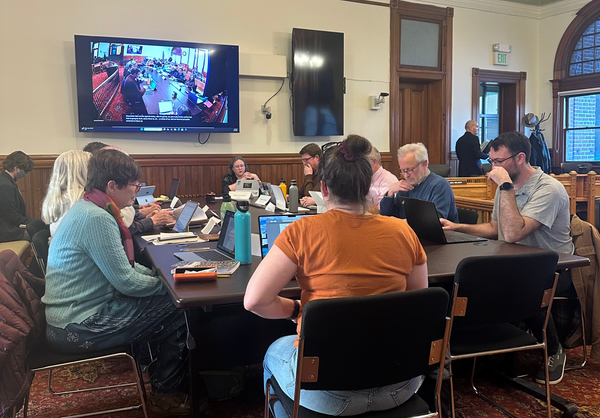
[caption id align="alignnone" width="3024"]

Photo by Angela Downs. [/caption]
News by Angela Downs
It’s wise to be skeptical of the government and to insist on upheld standards of practice. Criticism of City Council members is a citizen’s right and essential to maintaining a balanced system. In a world with deep division, however, scrutiny can become a tool for political retaliation and can result in a hefty price for the taxpayers. Regular reevaluation of codes and regulations is important to help find the balance between having easy public access for reporting concerns and limiting process abuse, which is exactly what city council members set out to do during the March 17th council meeting.
There were no complaints between 2017 and 2024, and because Port Townsend historically has only updated its ethics code in response to fillings, the ethics code had not been updated during that time period. Ideally, reviews of the ethics code happen at least every other year, a practice that the City acknowledges would be beneficial going forward. Council member Amy Howard said, “I believe that moving toward a more proactive review process would be beneficial and have been encouraging the City to move to a regular review practice.”
Municipalities in Washington are bound by an ethics code at the state level. Port Townsend’s local rules were last updated in 2017, looking very similar to standard Washington ethics codes around the state, like this one from the city of SeaTac. It is also standard that each legal proceeding addressing complaints costs upwards of $20,000- $25,000 in legal fees, paid by the taxpayers, which is a very real burden regardless of if the allegations are false or superficial.
This review, which began in December 2024, was in response to changes suggested by Ethics Officer Phil Olbrechts when a complaint was filed against Mayor David Faber. The complaint was later dropped.
The full council tasked the Culture and Society Committee (CSC), a council charter meant to address city policy, operations, rules, and codes commonly applied to council and staff, with deliberating on the suggestions. Their discussions began on February 12th, before the influx of current ethics complaints were filed against multiple council members.
Before the council discussed amending ordinance 3349 Port Townsend municipal code chapter 2.80, Council member Wennstrom, Mayor Faber, and Council member Howard voluntarily recused themselves from the proceeding due to outstanding ethics complaints against them.
Changes made during the March 17th meeting will not be applied to the current outstanding complaints, which will proceed under the regulations they were filed under.
Two members of the public spoke, stating their discomfort with how fast they perceived the process to be, likening it to the behaviors in the current federal administration. They also suggested instating filing fees to help reduce process abuse and a desire for the complainant’s standing (grounds which make them eligible to file) to be more open for those with a nuanced relationship to the city.
Counselors incorporated the public’s suggestions into their discussion and did not avoid any details in their deliberations.
Changing code typically requires two meetings, with the vote to change the code occurring at the second meeting. But because of the special circumstances, and the potentiality of another counselor recusing themselves on the matter, Counselor Rowe motioned to waive council rules and finalize changes in one meeting. After a unanimous vote to waive, Council member Monica MickHager said, “We are always reviewing ordinances and policies; that is our job. So this can be relooked at again.”
The council voted to adopt four changes to the current code of ethics. The first being the statute of limitations– the time it occurred to the time put up for adjudication. It was decided to keep the three-year window from alleged violation and include one year from discovery. If new evidence is provided, the one-year clock would start again, allowing for new discovery. The second vote determined to remove the word "frivolous" from paragraph B, to read, “No person shall knowingly file a false complaint or false report of a violation of ethics.”
Third, the rejection of the complaint and refiling was written as “The initial determination shall be documented. If determined incomplete, it will be rejected and documented with rationale. The complainant is free to resubmit.”
Last, the reconsideration of complainant standing was written to not only require a complainant to demonstrate that they hold a current business license within the city, are currently employed with the city, or are a current resident or property owner within the city, but to include that they have done business with the city, or are a past resident of the city.
Council members decided a fee would reduce accessibility. It was also discussed that the council decides penalties if allegations are proven, and with standard UK Common Law, and no funds for an Inspector General role as an independent investigator on staff, the complainant will provide all evidence for the judges' review. Even if current complaints were to be processed under the new rules, they would still go to a hearing examiner and have their due process. There will also be no penalties for filing false or petty complaints, “As a community, it is best to forgive,” said Council member Monica MickHager.