Port Townsend Historian Susan Ferentinos Appointed to Smithsonian Board
Ferentinos brings inclusive history to the national stage.
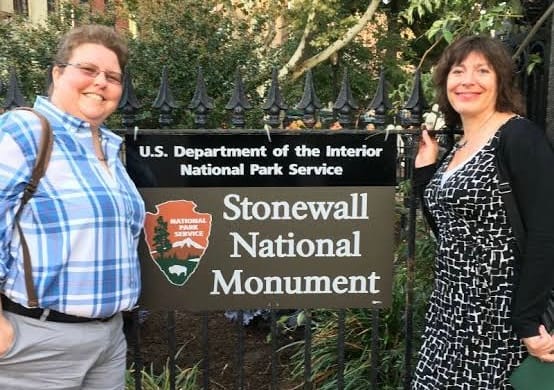
News by Rachael Nutting
PORT TOWNSEND, WA — When Susan Ferentinos attended her first board meeting at the Smithsonian’s National Museum of American History in Washington, D.C., she was not just representing her new hometown of Port Townsend. She brings a career’s worth of experience in uncovering stories that have long been hidden in plain sight.
"I had a great time last week in DC, attending my first in-person board meeting," Ferentinos said. "I was able to get to know my fellow board members a little better and hear reports from some NMAH staff members about various new initiatives in the museum's vast enterprise."
Ferentinos is a public historian with a PhD and a nationally recognized expert in LGBTQ+ and women’s history who has been appointed to the museum’s advisory board. She joined her fellow board members in the nation’s capital on February 26–27, stepping into a role that advises the director on major initiatives and helps shape how the story of America is told at one of the country’s most prominent cultural institutions.
Her appointment arrives at a critical juncture. As the United States approaches its 250th anniversary, public history institutions are under heightened scrutiny, making Ferentinos’s expertise in diversifying historical narratives both a local point of pride and a timely national story.
A pioneer in LGBTQ+ public history
Ferentinos’s appointment to the Smithsonian board is the latest recognition in a career defined by groundbreaking scholarship. She is the author of Interpreting LGBT History at Museums and Historic Sites, a seminal work published by Rowman & Littlefield in 2014 that serves as a guidebook for cultural institutions looking to integrate queer history into their interpretation.
The book, which won the 2016 National Council on Public History Book Award, was praised for demonstrating "that these histories can be unearthed, explored, and presented to enrich our understanding of the past.” Now, more than a decade later, Ferentinos is in discussions with her publisher about a second edition. "So much has changed in the museum field since then," she explained. "In a second edition, I'll be able to draw on a much wider range of experience, since so many more museums now include these stories and I have ten years more experience in helping in this effort."
Her influence extends beyond theory into tangible preservation. In 2024, she authored nominations for two historic sites with immense significance to African American LGBTQ+ history: the Azurest South in Virginia and the Slowe-Burrill House in Washington, D.C. The Seattle Gay News reported on the significance of these nominations, noting that Ferentinos worked to ensure the properties were recognized not just for their architecture or association with prominent educators, but specifically for their role as refuges for Black queer couples in the early-to-mid 20th century.
Azurest South, a striking modernist home designed and occupied by Amaza Lee Meredith, an African American architecture professor, and her partner, Edna Meade Colson, from 1939 until 1984, was defiantly built across from the university administration building. "It was a really rough time to be African American or queer in Virginia," Ferentinos told the Seattle Gay News. "The fact that this couple was drawing attention to themselves and really going against the grain by building this property and living in it openly as a couple, I really felt that it was worthy of federal recognition.”
Navigating controversy with dialogue
When asked how she envisions translating her book's principles into work at an institution as vast as the Smithsonian, Ferentinos emphasized that the museum is already leading the way. "The Smithsonian museums are leading institutions in their respective disciplines, employing some of the most accomplished museum professionals in the world. As such, NMAH has been collecting and interpreting LGBTQ+ history for quite some time," she said, pointing to the museum's online LGBTQ+ history portal. "Thus, I see my role on the board as lending support to an ongoing effort on the part of the museum to tell the full story of the U.S. past."
Given current debates over history and identity in education and public life, Ferentinos sees the Smithsonian as uniquely positioned to foster thoughtful conversations. Although most of her work involves LGBTQ+ and women's history, she describes herself more broadly as a public historian, someone whose work "focuses on sharing the past with a wide audience."
"I chose this type of work because I truly believe that the past can provide perspective on the present and help shape the future," she said. "Part of how history can do this is by fostering a sense of community, as people explore the past together and debate its meaning and its lessons."
She added, "Museums are at their best when they spark public dialogue and inspire people to ask more questions, but to do that, they need to provide a full range of perspectives and be honest about what we know and don't know. NMAH does this so well, and I'm excited to lend my expertise to that mission, particularly in the current moment, when there is so much polarization in this country and most people don't get the opportunity to learn about perspectives that differ from their own."
A local historian on a national stage
As Ferentinos takes her seat at the Smithsonian, she does so with clear goals in mind. While she won't curate exhibits herself, she plans to serve as an ambassador, "offering ideas and introductions to the museum and spreading the word about the museum's work."
She identified two priorities for her tenure. "One is to bring in more LGBTQ+ visitors and donors. NMAH tells the story of all Americans, and I want LGBTQ+ people to understand that and know that they are a part of that larger story. That requires partnerships and outreach, and I hope that I will be able to facilitate connections between the Smithsonian and LGBTQ+ communities throughout the country."
Her second hope is closer to home. "As a relative newcomer to the Pacific Northwest, and as the only NMAH board member located in this part of the country, I want to make sure people in this area know what a national treasure this museum is. I look forward to raising awareness about the museum's virtual exhibits and events and seeking out opportunities for NMAH to have a greater presence here."
For Port Townsend, it is a moment of validation that a historian who chose to live and work in the community is helping to guide the nation's history museum. For Ferentinos, the appointment carries deep personal significance.
"I'm part of the first generation in my family to go to college," she reflected. "I was quite literally in my mid-twenties before I even realized that people like me could work in museums, and I've devoted my career to ensuring that museums are welcoming places for everyone. Just getting to be a public historian is a dream come true, and it never even occurred to me that I might one day get to work with the Smithsonian. Being asked to serve on the board of the NMAH is both a professional honor and an opportunity to learn from some of the best public history practitioners in the field."