Port Townsend Residents Voice Concerns Over Housing Density Changes at City Council Comp Plan Meeting

News by Angela Downs
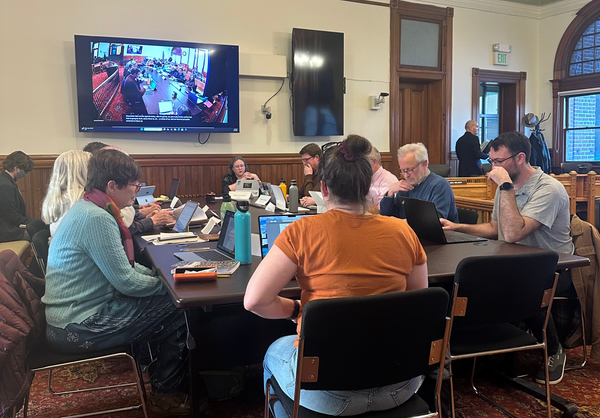
City chambers were packed on November 24, with people standing along the walls, mostly in the 50+ age bracket, many of whom, according to their public comments, moved to Port Townsend after retirement.
In the 30 minutes allotted for people to voice their opinions on the evening's topics, speakers focused on the city’s proposed density-height increase, maximum increases for R-2 zoning, a classification used in urban planning that typically allows residential properties to accommodate two dwelling units on a single lot, and the potential of striking the Daylight Plane code.
The Periodic Comprehensive Plan is a mandatory ten-year review of the city’s path forward through policy for land use, economic development, housing, transportation, and character of place.
The last Comprehensive Plan review was in 2016. The city staff and counselors have been working on the document for the last 18 months. The 2025 Comprehensive Plan is due December 31, 2025 and includes public feedback.
At the November 24 meeting, the counselors discussed housing and density code proposals.
Commenters expressed fear of overreach in growth, loss of sunlight and views, increased property taxes and gentrification, leading people to ask for a slower process. Commenters also requested a new SEPA analysis (environmental review process under the State Environmental Policy Act), reassessment of GMA (Growth Management Act) criteria and additional efforts to support housing alternatives. “Do we really understand the complex repercussions?” asked one speaker.
City Planners are including the 32 new building-related legislative measures passed by the state in their plans.
Port Townsend’s most critical issue is the lack of housing for middle-class, workforce and low-income residents. Decaying systems infrastructure and the cost of building are also major issues the city faces.
Contending with the history of incentivized sprawl and the downstream effects of past economic decisions, which are affecting younger generations' ability to own a home, city planners and city council members are exploring the options before them before the plan is due at the end of the month.
The Daylight Plane
One attempt to lower the cost of building is to strike the Daylight Plane code, a height limitation regulating building bulk by creating an invisible inclined plane to ensure light and air for adjacent properties. According to the city, this code is one example where overregulation negatively affects new building projects.
At the November 24 meeting, the planning department stated that the Daylight Plane currently has the greatest impact on those trying to build on small lots and closer together, disincentivizing the type of building the City hopes to encourage. It is a very complicated code, especially on sloping lots, that quickly becomes very expensive through extra labor hours, energy costs, and materials. It is relevant to designers and builders in every build.
The city councilors decided not to vote and that they needed more information on how the code works and to consult with the City’s Building Official, Mathew Logue, before making a decision before the Comprehensive Plan is due. Fortunately, there will be an annual amendment to the Comprehensive Plan, and any adjustments to the code can be re-evaluated then.
Councilor Ben Thomas asked city planners if there are other code options available to help address how we are all affecting one another as neighbors. They did not have a current answer but will look into what options there may be.
Code changes could provide help for home builders
Discussion turned to changing the code to allow tiny homes on wheels as primary residences, and to temporarily allow people to live in an RV while building a new home. Emma Bolin, Director of Planning and Community Development, recommended not including either in the Comprehensive Plan and delaying more discussions of zoning amendments with public engagement until a later December City Council meeting.
Bolin said that modular development is cheaper than tiny home builds, which often become vacation rentals, and do not provide permanent housing solutions. She said RVs are not in compliance with residential insulation standards and present compliance challenges when permit lapses or building permits are overextended. They also present disposal issues, and the community lacks tolerance for how they look.
Council members were eager to reopen the conversation about the RVs because rent costs during construction are a significant barrier to building. The council placed it as a priority on the 2026 docket. Mayor Faber and councilor Monica Mickhager expressed that allowing RVs during the construction process is within the view of “keeping Port Townsend weird”, and could allow for people to build immediately if they weren’t paying rent.
After the tiny home and RV detour, counselors returned to the current state of the Comprehensive Plan, addressing Grow Homes, smaller units, and commissioners asked city planners to add a clearer definition in the Comprehensive Plan of what they are exactly and how they support incremental development.
Density as a solution
Citing Seattle’s mandatory low-income housing as a failure and the lack of uptake of the existing fee waivers for low-income units in Port Townsend, the city council asked for more research and discussion to ensure such requirements will work.
Instead, they are turning to density building with a new maximum density in medium-density single-family residential R-2 lots.
When asked about how increasing density allowances will affect property valuations and taxes, assessor Jeff Chapman explained property valuation/tax is based on market value.
“Sellers typically market properties for what they believe they will sell for on the open market to willing purchasers that are from outside the neighborhood to recoup their investment,” Chapman said.
“If a parcel is divided into multiple homesites, the value of that set of parcels will almost certainly go up, even if each unit is smaller in size,” Chapman said. “Typically, six smaller units are worth more than one large unit, all other things being equal. This applies to both land and building values.”
Mayor Faber stated that four and six-plex density builds with pre-zoned cafes and markets are harm reduction for drunk driving. He also said the increased height addresses equity issues for people with disabilities because three-plexes do not allow for elevators but four-plexes do.
The cost of underdevelopment
City staff and council members agreed that the city cannot absorb infrastructure costs. With a 13% tax hike per year for sewer already in place, the city needs to build up a tax base with more people living on systems lines to pay for all the needs. With these density builds, city planners and commissioners are intending to ease the pressure from empty lots on infrastructure lines, avoid sprawl, and increase middle housing.
R-2 minimums are intended to preserve the future possibility to develop, not demand immediate development. They exclude measurements of critical environments, and reduce the likelihood that someone will build diagonally across several lots. Most concerns about the minimums are around keeping larger yards.
The low density, single-family lot– R-1 lot discussion resulted in offering a choice to convert a house into a four-plex, to have a duplex (two units) on one lot, or two ADUs per lot with a single-family home. To leave the choice open keeps with the intention of the Comprehensive Plan to “build in flexibility, diversity, and different opportunity at every end,” according to Mayor Faber.
While the hope is to create work for local builders, the scale the city hopes to grow will require outside help. It’s a balance of creating housing for current locals with the risk of also creating an outsider influx. But the city council members are hoping to “build in lower rent”, with induced demand.
The next Comp. Plan discussion will take place on December 8, and will be a joint meeting for the five-year Housing and Homelessness Plan, so the city is anticipating the need to use the backup December 15, meeting to finalize the Comprehensive Plan.
Because the agenda is packed, they recommend writing in comments, which they read all of beforehand, instead of speaking in person to preserve time.
You can read the comprehensive plan here.