Port Townsend School District Reconsiders Student Resource Officer Program After Candidate Withdraws

By Kevyn Royce Rubio and Nhatt Nichols
The Port Townsend School District has delayed a decision to partner with the Port Townsend Police Department to reinstate the School Resource Officer (SRO) program after the candidate for the position withdrew his application.
The SRO program, which was paused in 2021 due to budget constraints, assigns a uniformed and armed officer to the elementary, middle, and high schools.
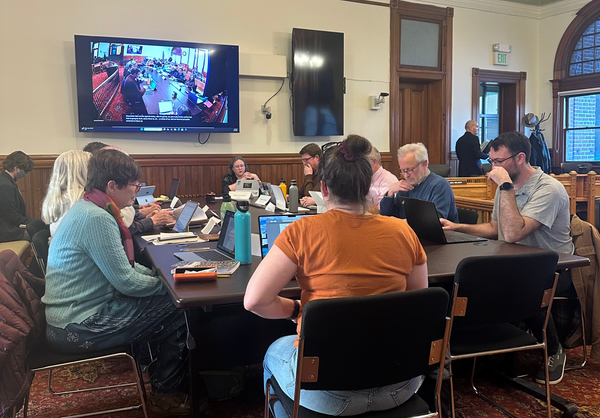
Port Townsend School District superintendent Dr. Linda Rosenbury hosted a public meeting on May 29th to familiarize the community with the appointed officer to take over the new role as SRO.
The reason the school district is considering reinstating an SRO
The schools are considering reinstating the SRO for a few reasons. They constantly communicate with the police already, sometimes several times a week. In the handout the school gave attendees at the meeting, they say the reasons for those callouts range from “families wanting to report a crime, students missing from their homes, stolen bicycles, and concerns about firearm access.”
The school district’s main argument was that having an appointed SRO allows an officer to always be available if an issue arises at one of the schools. Without a dedicated officer, the school would have to wait until an officer becomes available, and having an SRO on campus would give students a familiar face to feel safe with. Not having a dedicated SRO could mean that different officers would come multiple times a week, depending on who's available.
The superintendent reassured attendees that the SRO would not walk the halls, make unjustified arrests, or intervene in matters unless directed by the schools.
A split community perspective
The people in attendance at the community meeting who supported having an SRO said they would feel safer knowing that there was a police officer on campus, even though the superintendent made it clear that the officer wouldn't have much power in the schools.
Concerns about reinstating the SRO program include the school-to-prison pipeline, racial bias, and a fear of students learning to trust the police outside of school because of the good interaction they may have had at school with an individual SRO.
There was also concern about having an officer in uniform with a firearm around students. According to police, the SRO needs to be in full uniform because if the officer is called to an outside issue in the city, the SRO might be pulled from their duties and need to be "officer" ready.
Community members concerned about having an SRO aren’t alone in their worries. The National Education Association has also been concerned about SROs' role in schools. According to an article in NEA Today, Cameo Kendrick, the former chair of NEA’s Aspiring Educators, says she and other new educators believe this is a critical social justice issue.
“It is frightening, especially for a Person of Color,” Kendrick said. “And, as I’ve grown to understand this issue, I also know that it has deep roots in racial injustice and is a cog in a system that unfairly and more severely disciplines minority students.”
Next Steps
As no officer is currently interested in taking the position, the schools are proactively speaking with students, their families, and city officials to find the best solution for everyone. The city’s newly formed Equity Access and Rights Advisory Board has expressed an interest in examining the issue as the city is funding the program. Council Liason Amy Howard said that though SROs weren’t currently on their agenda, anyone could introduce the topic through the public comment process. Their next meeting is on June 13th; more details are available on the city’s website.
Rosenbury recognizes that this is a decision that needs careful consideration. “We heard at the informational night last week that many families and community members don't feel comfortable having a police officer in schools. I was grateful that people felt comfortable sharing their stories and were listening and learning.”
Rosenbury also said that she believes it’s important to center the student perspective in this dialogue, a task that Student Body President Zen Cook doesn’t take lightly, saying, “It's easy to think of safety as something objective, that you're either safe or not safe, but it can be subjective to the person. I've talked to many students who think implementing an SRO would make them feel safer, and a lot of students think implementing an SRO would make them feel a lot less safe. It's a complicated decision on a complicated topic in our community and all over the country. I'm glad the school is taking its time and really considering both sides.”