Port Townsend, We have a Problem. Or Do We? Agreement on Problems, Solutions to Parking in Port Townsend Remains Elusive

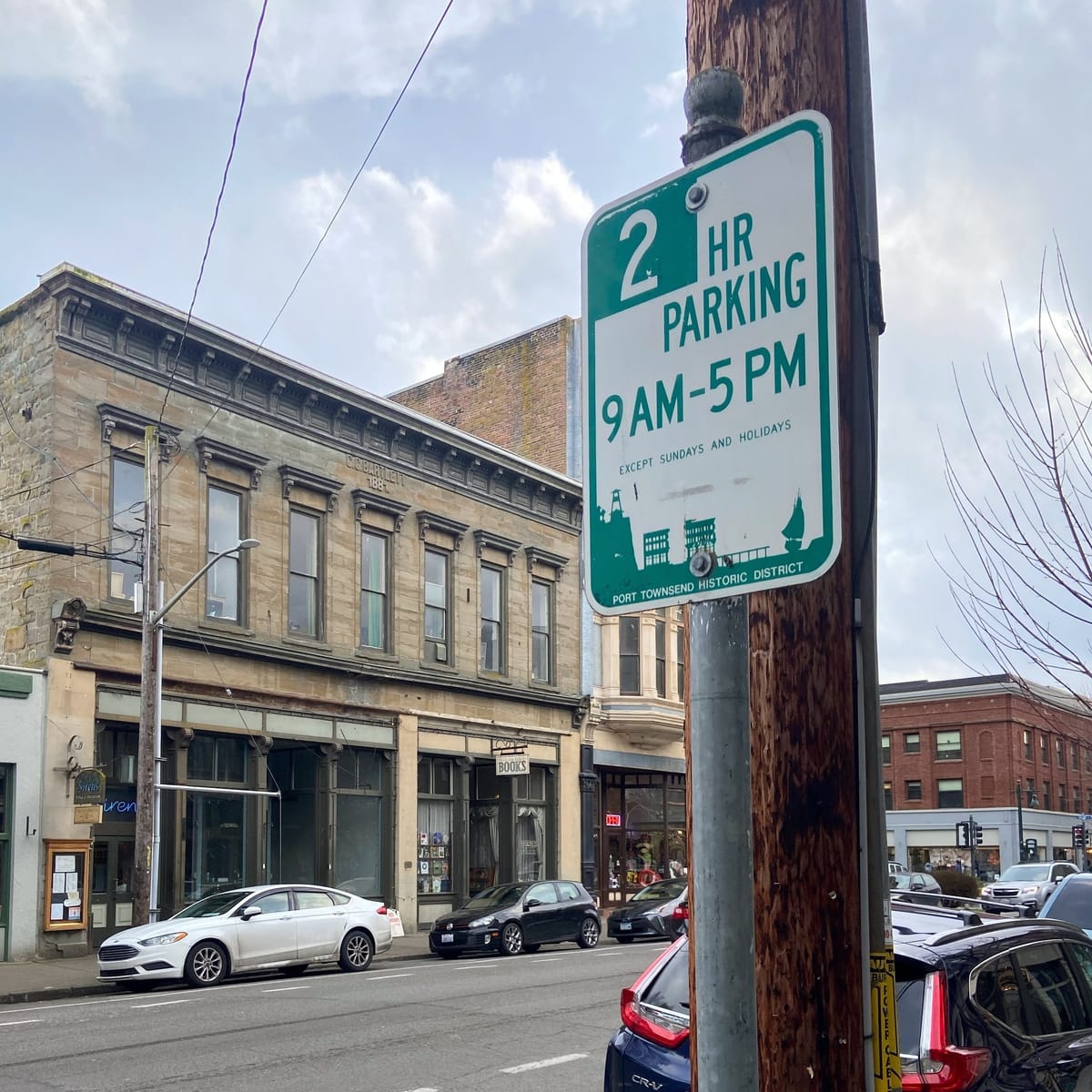
[caption id align="alignnone" width="2842"]
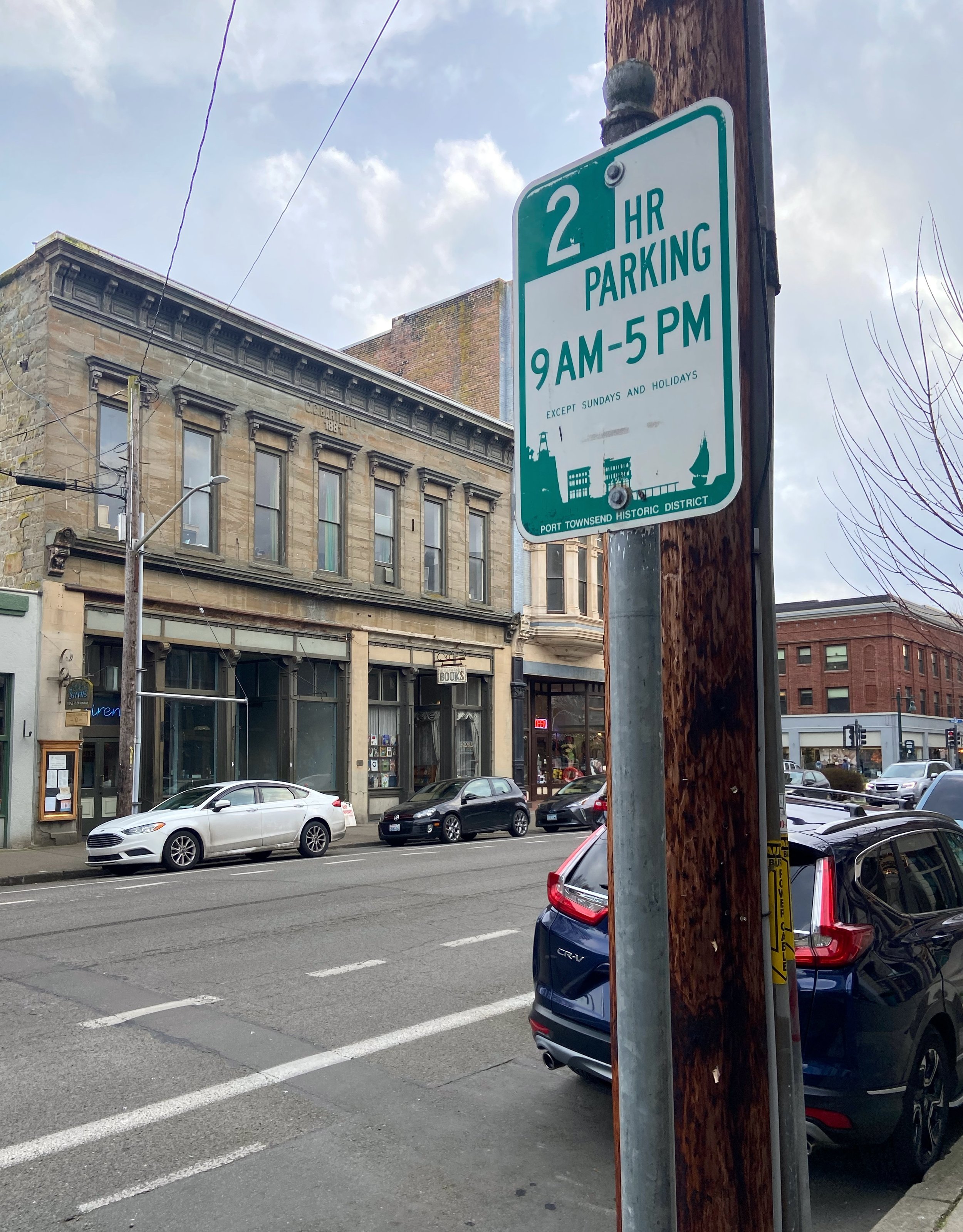
A sign designating two-hour parking in front of Imprint Bookshop. Parking restrictions are not currently enforced by the City. Photo by Nhatt Nichols [/caption]
News by Scott France
Port Townsend city leaders find themselves at the center of a fray rife with abundant citizen discussion, widely varying opinions, and a lack of consensus toward an optimal approach to parking in the city.
As a City Council meeting on March 17 approaches to consider a paid parking pilot program for a section of downtown, local discussion is rising on the topic of parking, primarily in parking space-challenged downtown. Mayor David Faber acknowledged the high interest in the issue in an essay in the March 6 edition of the City newsletter. He said that hundreds of communications from city residents and businesses in recent months reflect a widespread belief that a parking problem exists but that these messages have not surfaced a clear consensus on what the problem is.
“I hear employees and residents complain about tourists, and I hear business owners and shoppers complain about employees and residents,” Faber said in the essay. He also mentioned many concerns about the role of automobile emissions in deepening our climate crisis.
“People either say that there is no problem, or that yes, there is a problem, but that the cure is worse than the disease,” Faber said. The “cure” outlaid by the city is that parking be paid, at least in certain areas.
[caption id align="alignnone" width="1591"]

Mayor David Faber has been working with the city council to solve the perceived problems with downtown parking. Photo courtesy of David Faber. [/caption]
The apparent lack of consensus leads Faber to say that he doesn’t believe that the Council will vote to implement a paid parking pilot program. This would surely please many city residents and business owners, but it would also disappoint many.
Among the advocates of exploring paid parking is Scott Walker, who has for decades been an active contributor to Port Townsend transportation policy and to encouraging people to drive less, and walk, bike and use public transit more. He served on the Port Townsend City Council and has been a founding member of the Non-Motorized Transportation Advisory Board, as well as the Transportation Lab, which is focused on getting people on their feet, on bikes or on transit. “Let’s start small to figure out what will work,” he said. “Most of the downtown traffic is people looking for available parking.” It is not uncommon for drivers to circle the area for 10 or 20 minutes looking for a parking space. This, Walker says, increases air and water pollution in the Sound, the latter due partially to rubber and brake lining residue that gets washed into our waterways. “The city’s plan should be for high turnover of parking spaces,” he said. This would more equitably distribute usage among the spaces currently, as an unknown number of spaces are occupied by the same car all day long.
John Blomgren, owner of Imprint Bookstore on Water Street, takes a different view than Walker. “I think it (paid parking) will negatively impact the wrong people. It will be burdensome to low-income people and not feasible for people without cell phones.” Bolmgren says that he thinks that paid parking would “be disastrous for people who work and shop downtown. “ The tourist traffic is ephemeral, and most businesses want to maintain long relationships with the local community”
Mayor Faber says that the City “has been hearing vociferous demand for some time for more parking.” Paid parking should increase parking supply through higher turnover. The City does not have staff to enforce two-hour time limits on parking that are posted in some areas. Faber and Walker believe that a pilot study will produce data that will reveal how effective paid parking would be within an overall parking management plan. Faber said that the city is not currently able to enforce current parking rules unless those parking rules come with a way to generate revenue.
The increase in citizen discussion of parking has sprouted from a recent news report that readers interpreted as final City approval of the pilot study. This would open the way to implement recommendations from a 2004 Downtown Parking Management Plan, including a fee program. The City Council had requested a Plan be explored for many years, but limited staff has been a barrier. The current study covers approximately one mile of city streets in downtown, mainly on Water and Taylor streets.
Parking fees are recommended to be $2.00 per hour between 9 AM and 5 PM, with possible free parking on Mondays and Tuesdays, which tend to be slower days for business. The recommended fine for noncompliance is $65. Faber said that he is looking at various methods of payment to enable efficiency and ease of use for as many people as possible.
Popular suggestions for parking management approaches from city residents include building a parking garage, eliminating cars from downtown entirely, better parking management to promote turnover in parking stalls and encouraging transit use and active transportation options.
Ultimately, the Mayor and the City will act in accordance with the wishes of city residents and businesses. “Whether or not the City actually adopts a paid parking program is ultimately dependent upon community buy-in,” Faber said in his message.
Faber’s concluding message to the community is, “In short, paid parking appears to be the only real, viable "solution" to our current parking "problem.” My question to our community is "Do you consider the downtown parking problem to be serious enough to warrant the type of solution the city can actually implement (paid parking)?" It’s okay to say “no,” and if that’s the general community sentiment, I would rather council and staff not spend any more effort trying to solve a problem for which no reasonable solution is sufficiently popular to enact.
Further from the limelight, the City has taken some action to increase the supply of parking in the city, primarily through actions motivated to increase housing affordability. While not related solely to downtown parking, the City Council recently adopted an interim ordinance specifically to incentivize residential development. There are now no off-street parking requirements for residential development or any type of development. City Council and staff believe that removing requirements for residential street parking would shift lot space formerly required to be for car parking to now be used for ways to increase the number of living units or spaces, such as building a larger home, a residence with multiple units, an accessory dwelling unit, or expanding the footprint of a house.
A City of Port Townsend survey asking for opinions about how much parking developments should build is at: https://forms.office.com/r/mbw8HvHBEk