Racing Adventuress Around the Sound
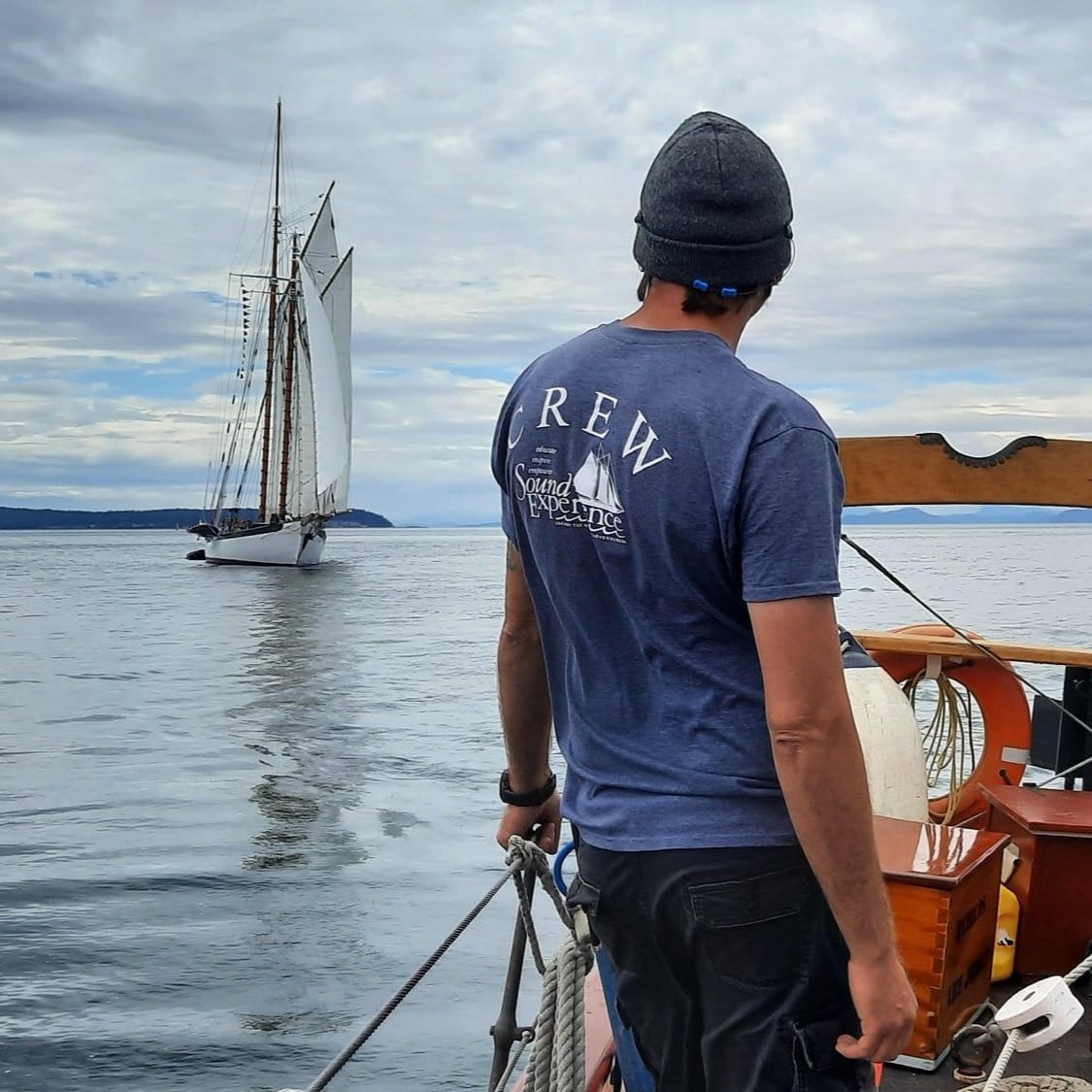
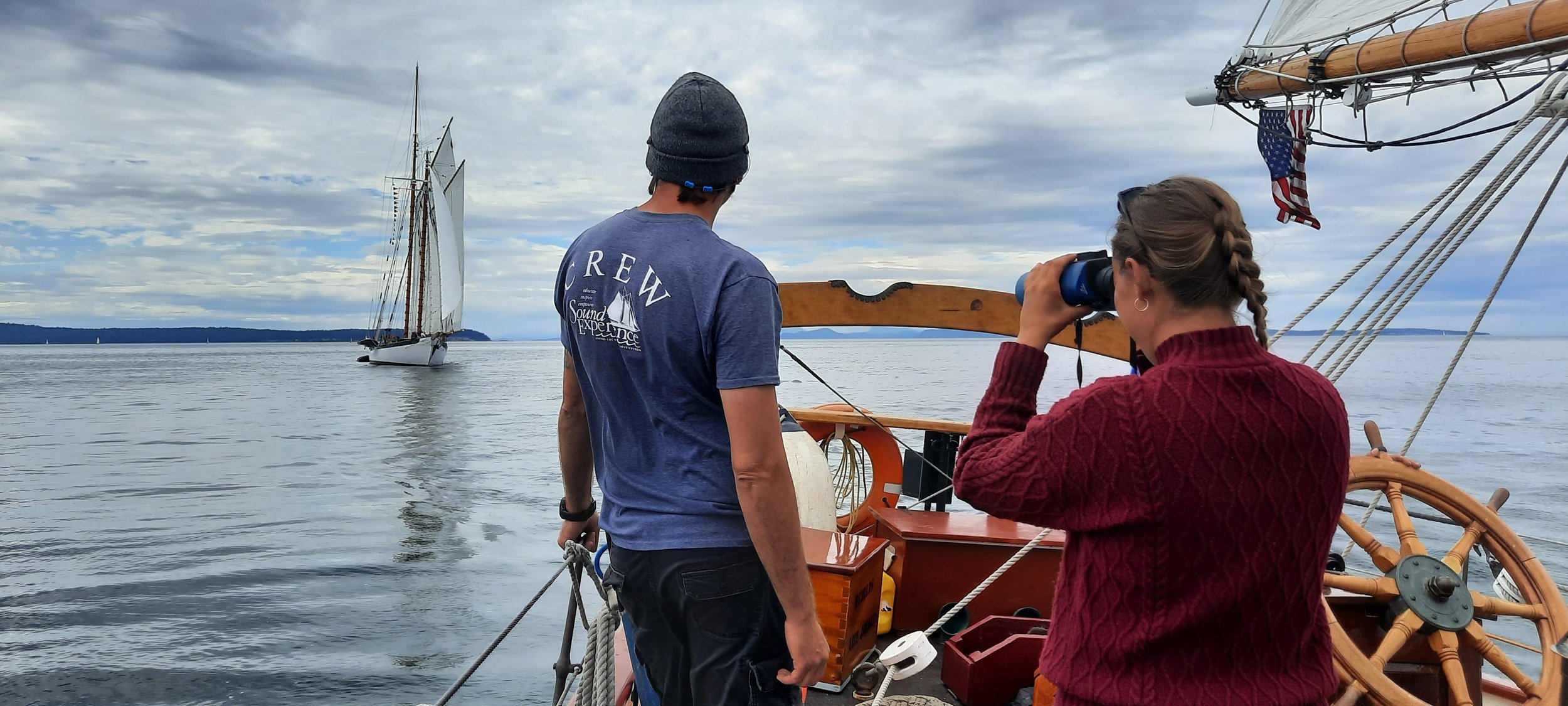
Adventuress crew checks out Zodiac, its competition for CRISR 2024. [/caption]
By Kathie Meyer
When an invitation was extended to join Adventuress (soundexp.org) in the Captain Raynaud International Schooner Race (CRISR; pronounced “chris-er”) (crisr.org), June 21-23, it was impossible to refuse. Especially when two other participating schooners are ones I have long admired – Martha and Pleiades. Alcyone and Anse La Roche had also signed up to participate.
Friendly competition? Adventure in the San Juan Islands? It sounded challenging but not as cold and wet as R2AK. I’m 66 years old and arthritic. There might be whales.
Of course, I went.
“Cap” Raynaud
Ironically, Adventuress rarely ever races in this race, named for marine surveyor Captain “Cap” Raynaud, a major player in her 1950s restoration project. Adventuress was never a racing vessel at all. First launched in 1913, wealthy Chicago businessman John Borden II built her for “luxury and adventure” to travel from Maine to the North Pacific Arctic and bring back a bowhead whale specimen for the American Museum of Natural History. With him was Roy Chapman Andrews, the museum’s naturalist, the man they say the fictional Indiana Jones is based upon.
Later, we are humbled to learn that only a crew of about five brought this 133-foot-long, gaff-rigged schooner through the Strait of Magellan, a difficult route between the southernmost tip of mainland South America and the Tierra del Fuego archipelago.
The trip produced valuable research on northern fur seals but failed to bring home a whale. In 1914, Borden sold Adventuress to the San Francisco Bar Pilots, who modified her for their purpose. You can still see evidence of her service to this stamped on her bell on the deck. For decades, until after WWII, when she also served for the U.S. Coast Guard, she guided vessels through the congested and hazardous waters outside the Golden Gate Bridge.
The bar pilots eventually retired her, which meant she might have rotted to nothing if it weren’t for O.H. “Doc” Freeman of Seattle. True to Seattle’s everlasting entrepreneurial spirit, Doc figured he could flip the boat he paid $7,800 for if he could just get her home, which he barely did. The trip north in February 1952 nearly destroyed her.
A few more owners gave her a shot until finally, Monty Morton purchased her, founded a nonprofit called Youth Adventure, and her restoration and mission as an educational vessel began. In 1963, Ernestine “Erni” Bennett followed Morton as director, and the ship’s transformation back to its original lines took full sail. The efforts of many, including a tenacious Girl Scout troop, paid off when, in 1989, the National Park Service granted Adventuress National Historic Landmark status. Port Townsend itself is also a National Historic Landmark, as is Fort Worden. Adventuress is the third one here in Jefferson County. There are 24 total in Washington State.
In the late 1980s, Bennett turned the nonprofit over to Sound Experience, a nonprofit founded by Barbara Wyatt and Morley Horder. Now, Sound Experience is led by Executive Director Catherine Collins along with the staff, crew, and board of directors.
[caption id align="alignnone" width="1800"]
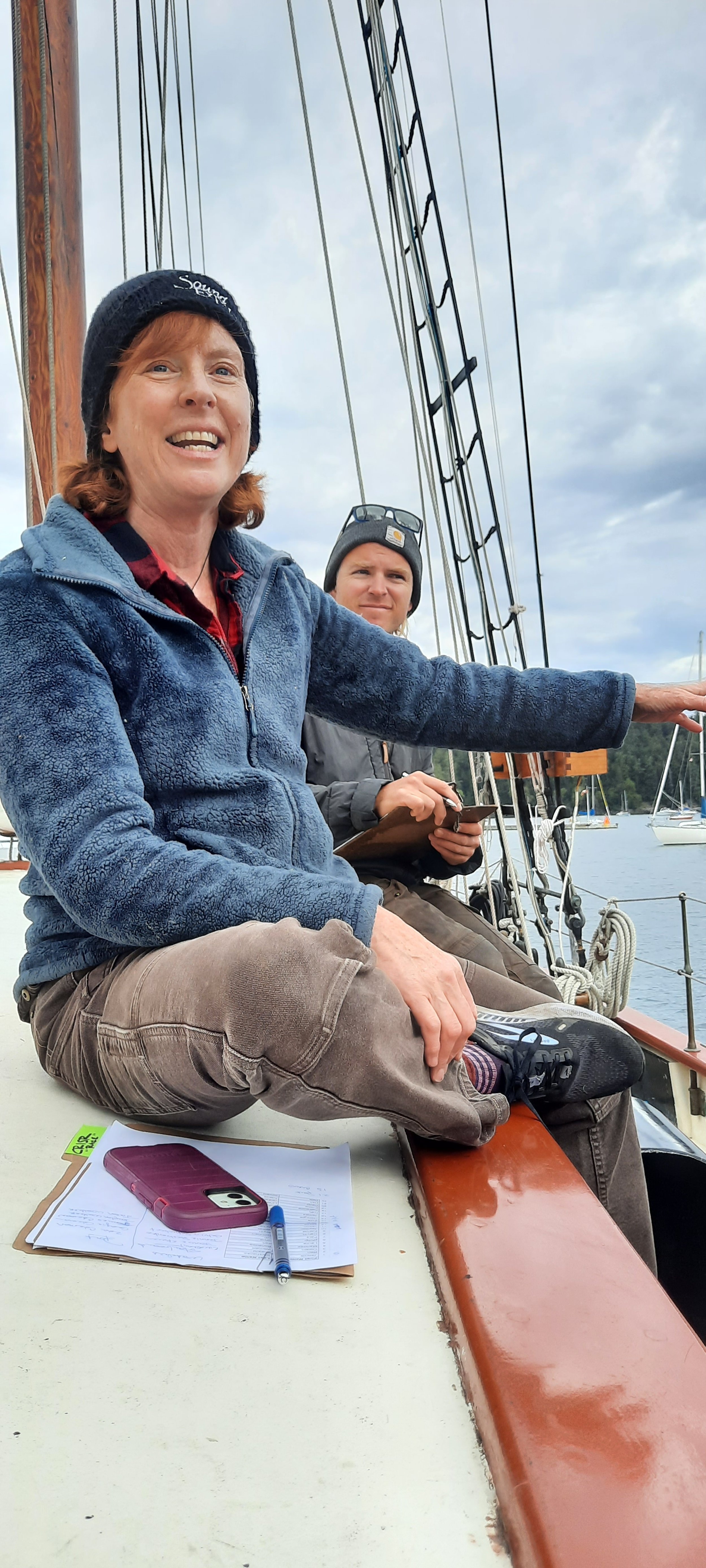
Sound Experience Executive Director Catherine Collins (left), shown with crew member David, has been steering the nonprofit for 18 years. [/caption]
This is all to say that the reason why Adventuress rarely races in CRISR is because it’s usually busy carrying out its mission to educate youth in the marine environment while giving them a classical sailing experience at the same time. Every year, Sound Experience serves thousands of youths in various groups from all over the Salish Sea region and beyond – the disadvantaged and privileged are universally welcomed. Inclusiveness is a core value, and the entire season for the crew lasts from March into October, with kids onboard overnight for a few days at a time, as we will be.
This year though, Collins said, there was a gap between programs that made it possible to participate in the last two days of this three-day race, so why not open Adventuress up to people age 12 and above for a three-day and three-night trip and combine some teaching with the racing for those aboard with only a little to no sailing experience.
“It’s something we’ve never done before,” she said.
Day One – Friday Harbor
The anticipation leading up to this was intense. I’d been invited by Hali Miller, Sound Experience’s new Development Director, and we were both beyond excited. We’ve been colleagues and dear friends for almost two decades now, and she said she invited me because I’m “always up for adventure,” she said.
For Hali, it was a work trip to get a feel for what the crew does since her job is mostly done remotely. For me, it was a work trip too, but I approached it like going to summer camp, which I did at 8 years old at Fort Flagler. At 29, I rafted Idaho's Upper Selway River. Growing up, we tent camped and picked blackberries in the summers up in the Hama Hama (rhymes with “mama”).
I figured the accommodations weren’t going to be luxurious. For one thing, Adventuress doesn’t have showers, and we’d be at anchor for two nights. I had to be shown how to operate the poop head a second time because it’s a little more interactive than regular plumbing with more steps. Sleeping accommodations are tight, you’re in a sleeping bag, and it’s hostel-style, where you share space with others. You can have your phone, but airplane mode is encouraged. The menu is vegetarian, and no alcohol or marijuana is allowed on board. This is the cleanest living I will experience in years, and I don’t even care.
When I finally set foot on board, Mallory, a recent environmental science graduate from Western Washington University, greets me. It’s her first season on Adventuress. She didn’t really know what she’d be doing this summer after graduation, so she went to a job fair at school, she said. She almost passed the Sound Experience table by at the end, but then she turned around, listened to the pitch, and was hooked. She went through the application process and was hired.
That’s right. Everyone on the crew is paid. It’s a real job with real responsibilities.
“And this is my mother, Jamie,” Mallory says. I sit by Jamie, and she tells me all about this kid of hers she is clearly proud of and how excited they both were when Mallory got the job. Jamie has sailed before, but this will be a chance for her to experience exactly what her middle child is clearly in love with. Mallory is so thrilled to be here, she never stopped smiling the entire trip. There are a couple of people that, if I’m feeling insecure about my place on Adventuress, I figure I’ll just sidle up to them and soak up their energy. Catherine and Mallory are those two people.
We gather to receive berth assignments. Hali and I get the two in the fo’c’s’le (contracted from “forecastle”), furthest up the bow on the bottom. It’s the tightest squeeze of them all, but there is an emergency exit above us where the fresh air comes through. Catherine assures us that during the first night on a ship, one might not sleep well, but the second night, you crash.
[caption id align="alignnone" width="4000"]
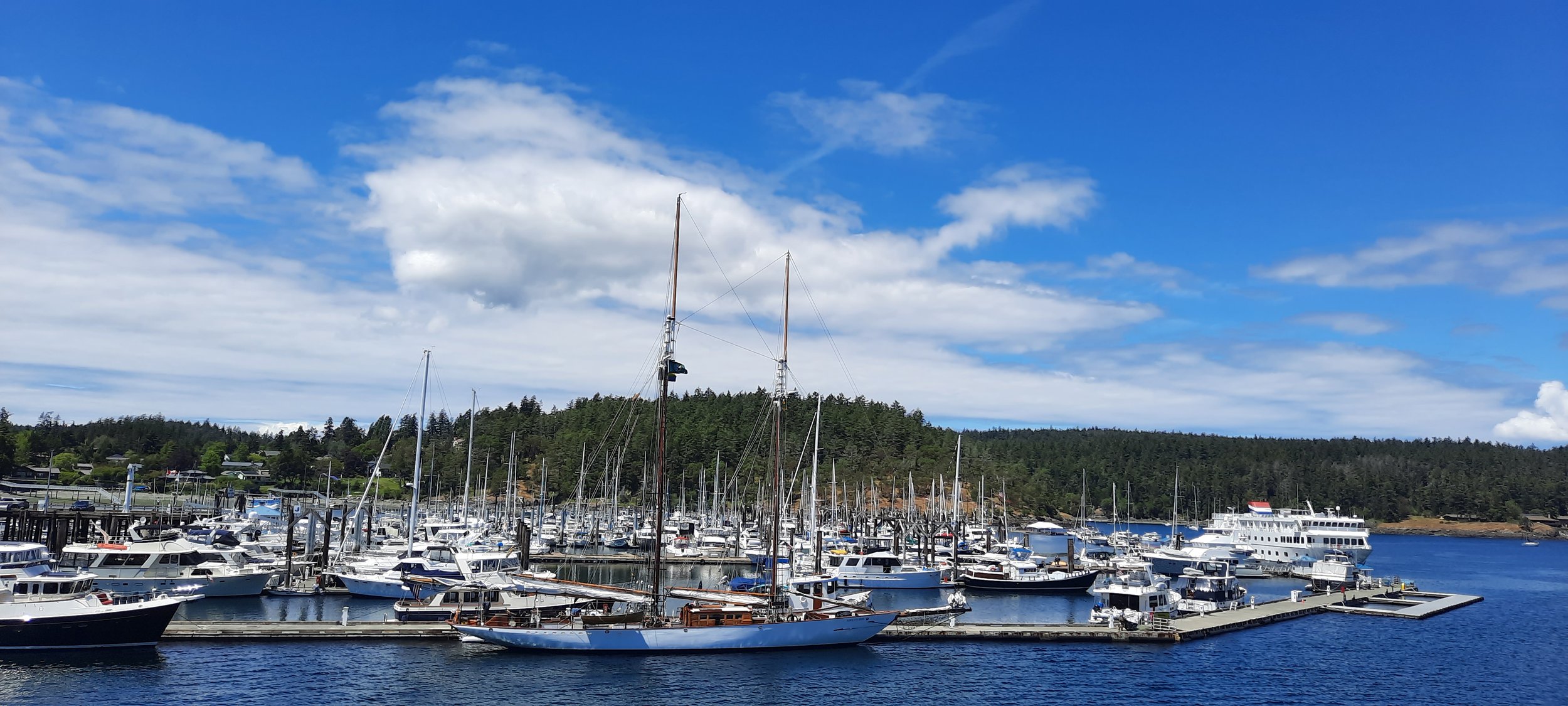
Adventuress is an educational vessel that sails all over the Salish Sea with youth groups from schools and other organizations. [/caption]
Since we are docked for the night, we have choices: eat the provided pizza or go up the hill to downtown Friday Harbor and choose a restaurant. Jennie, a redhead with a nice smile, invites Hali and me to accompany her to dinner up the hill. Owain (pronounced “Owen”) comes along too, and over dinner, we learn that Jennie grew up in Israel, and Owain is working on a master’s degree in creative writing at Iowa State. They are both “guests” on the sail like us.
Back on board, we slip into our sleeping bags. I read in bed with a flashlight – a mystery by Hansville, WA, author D.D. Black. In it is an annoying reporter. I hope I’m not like that, but the truth is, what I know about sailing is quite minuscule, and I’m bound to make mistakes. The cultural language is already intimidating to me.
As 10 pm rolls around and quiet hours begin, we hear two female voices softly singing to us in the dark. It is the most comforting sound made by a human I have heard in an exceptionally long time.
All photos are by Kathie Meyer for The Beacon.
This is only part one! Catch part two of Kathie Meyer’s high-seas adventure next week.