Reimagining Justice: Restorative Approaches Offer Healing Over Punishment

News by Angela Downs.
Prison may seem to solve some conflicts, but it falls short as a solution for many civil issues. Restorative Justice offers solutions that, contrary to fears, do not mean being “soft on crime.”
Restorative Justice means the creation of pathways of healing through referencing the diversity of people, the relationships between the people, what's happened, where it happened, and what has happened since. In a theft case, the perpetrator may say what needs are not being met and why. The victim may want to say what they need to feel safe again through a victim impact statement. But in restorative justice, there is an opportunity to have an open dialogue between perpetrator and victim. This is a completely voluntary process.
Brandon Mack, the Superior Court Judge at Jefferson County, and Stephanie Burns, Director and Co-Founder of Healing Courage, have come together with a vision for our criminal legal system.
Burns believes justice is defined by those who are most impacted– survivors, those who have been harmed, and those who are connected to both of them. Asking survivors about their needs for recovery and perpetrators what they need to find inner healing. Both could be needing reassurance, resources, healthcare, or therapy.
“When we talk about what restoration means, it often talks about returning something to the state it was; however, restorative can also mean making whole,” Burns said.
“I look at justice as an acknowledgment of the harm one causes and accountability towards that harm, towards the goal of preventing future harm. When I think of restorative, I think of healing. Restorative Justice is partly about healing, partly about accountability, and justice is partially defined by the needs that folks have.” Judge Mack said.
“It’s important to start with recognizing we are all in a system that makes it very hard to find common humanity.”
— Stephanie Burns, Director and Co-Founder of Healing Courage
It all begins with community accountability. The community that’s been harmed, the victim, and others who have been affected decide if they would like to charge the person or connect them to service agencies.
The landscape of who is harmed and who does the harming matters. With 80% of survivors knowing the person who harmed them, crime is a community issue. Context matters; 70% of victims don't report the crime, and 80% of those who do are white women. The system as it is isn't designed for most people who are experiencing harm, so most people who are harmed are not using the system.
“So how do we make sure we are providing access and resources and healing and accountability to that 70% who aren't reporting?” Asks Burns.
Restorative justice can create opportunities for accountability and healing within the system and separate processes outside of the criminal legal system with the goal of acknowledging the harm caused.
This is what Judge Mack refers to as preventative care. “A place where you're striving for people to be able to spend time and have positive connections to the community so that when they struggle, they have people to turn to for support. Like having counselors in schools or if somebody's not going to school, you're addressing the root cause as to why they're not going to school instead of just putting them in jail. It’s about community, relationships, resources, housing, healthcare.”
It’s typically community organizations like Healing Courage, The Nest, law enforcement organizations, or prosecuting attorney's offices where restorative justice programs are held. The courts tend to be about an adversarial process versus having infrastructure designed for collaboration.
“ I can see from the bench just how not victim-centered our criminal system is,” Mack said, “ I'm all ears on what's a better way to serve those that have been harmed.”
Justice can look different depending on community demographics, history, and intended lifestyles (agrarian, urban, industrial).
“I think the most powerful processes and approaches are those that are really, truly founded in the community and the community needs,” Mack said.
Burns said, “It's important to start with recognizing we are all in a system that makes it very hard to find common humanity.”
Prosecuting attorneys will often ask survivors what they need, and they’ll say a lot of the things a prosecuting attorney can't do because of the inherent system design. The shift depends on people in the system helping drive that change.
Privatization of prisons means there is money to be made off of prisoners. It costs $65,000 a year per person that we send to prison, more than the average person makes in one year. Statistics have shown that the more ACEs (Adverse Child Experiences) you have, the more likely you are to be incarcerated.
This is called the victim-offender overlap. Data also shows that 46% of federal prisoners are there for drug-related crimes. We can send somebody to prison, or we can treat their drug addiction and ideally keep them in our community.
The criminal legal system conflates punishment with accountability. “There are specific laws and policies that you are held to in sentencing laws that make approaching harm with a more humanistic perspective really hard.” Burns said, “Our culture can be very binary.
There's a traditional binary of victim versus offender in the adversarial process. And there are other folks in community who don’t understand trauma or sexual violence and therefore continue harm by what they say or how they respond. There's also a social betrayal that can happen.
“You end up with two people who need a lot of support and access to resources. But it's not that easy. At least currently,” Burns explains, expanding the concept of “the system” to include all those who participate in community affairs.
“I think that our systems are only as good as the people that work within them, who their lawyer is, whether they have a lawyer, who their judge is, whether there's a social worker involved, whether there's a counselor, what their community is like,” Mack said.
With the intention to push the needle towards a humanistic criminal system, Mack applied for a program implementation grant specific to restorative justice within the criminal legal system. Healing Courage and other courts have also applied for grants. The National Center on Restorative Justice and the CJI (Center for Justice Innovation) offered the grant. CJI sent the trainers out, but it's in partnership with the National Center on Restorative Justice, and the funding came from the Department of Justice.
They offered it to Jefferson County, along with four other communities around the country including, Worcester, Massachusetts Prosecuting Attorney's Office, the Sheriff's Department in Richmond, Virginia, and the King County Executive Branch. Now part of the cohort of five of the four other entities across the country, they will be learning over the next year how to implement restorative justice within the court system.
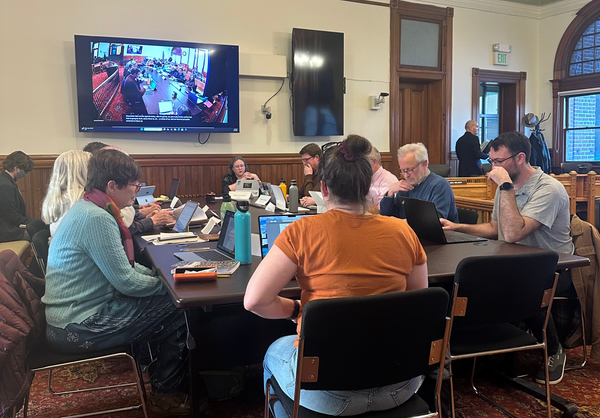
Twenty participants represented the county through entities and organizations such as the Superior Court and Jamestown S'Klallam Tribe, Healing Courage, the Prosecuting Attorney's Office, the Jefferson County Sheriff's Office, and the Port Townsend Police Department, as well as Dove House Advocacy Services, Usawa Consulting, Jefferson County Immigrant Rights Advocates (JCIRA), Believe in Recovery, and others.
“We brought everybody in, all the stakeholders of our criminal system all showed up, supported their school district, juvenile services, and all supported the grant,” Mack said.
Lily Haight, who participated in the training, found it focused on a person’s rights post-conviction and offered non-prison alternative deals negotiated between their attorney and the prosecutors. No person has to participate in restorative justice.
“Regardless of what happens moving forward, it's pretty incredible. And we don't know what it might look like moving forward. Nobody knows.” Mack reflects.
“I think there is some building, dare I say, excitement and interest and intrigue around what this is and what it could do for our community,” Burns said.
They are now applying for a $250,000 two-year grant to keep the momentum of learning and change going.
“I want our community to know that there is a need to improve the way in which we support those that are harmed and those that harm people. We can’t just accept the status quo. In that group, everybody acknowledged their shortcomings. One of the things it strives to do is to not put innocent people in jail. That's why you have that burden of beyond a reasonable doubt. Nobody is looking to take that away,” Mack said.
“This work does require deconditioning, dismantling what we think we know around crime and harm and punishment. A lot of work has been deconstructing how I've been conditioned. Our most complicated community issues require commitment, creativity, and capital, but not necessarily in that order.” Burns said.
If you are able, you can donate to help support continued training, or if you’d simply like to learn more, you can visit these resources:
Healing Courage Overview - who, what, how, why
Concentric Circles Overview - Sample overview of our Concentric Circles conversation & culture