Salish Sea Butoh Festival Celebrates Cultural Diversity and Connection to Nature

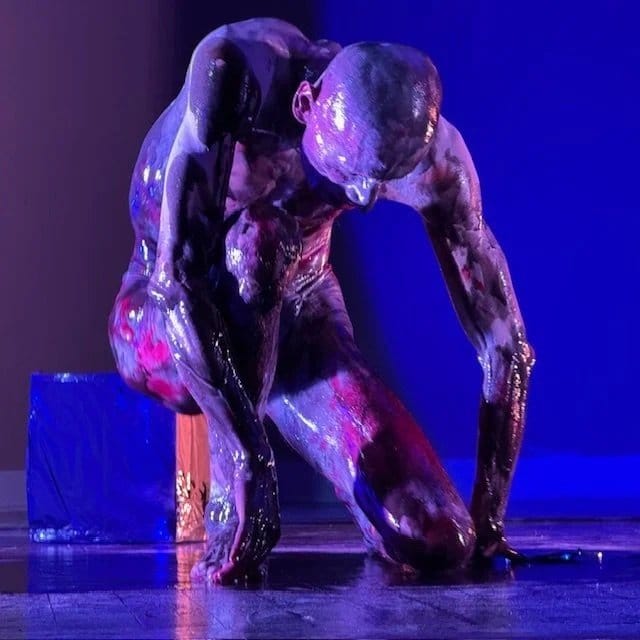
[caption id align="alignnone" width="640"]
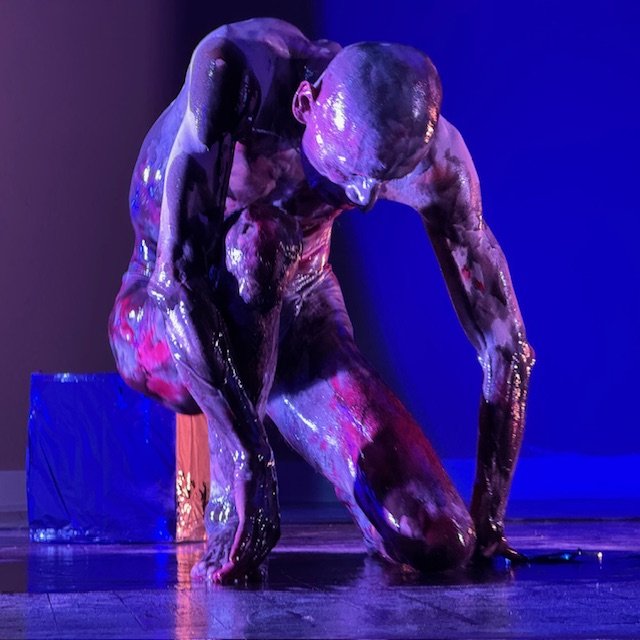
Photo by Nels Peterson [/caption]
Arts news by Angela Downs
This year marked the 5th annual International Salish Sea Butoh (舞踏, Butô) Festival, held in Port Townsend. The 9-day festival features student workshop performances with live music, outdoor site-specific dances in nature, artist talks, and stage performances open to the public, presenting international teaching artists. The festival also includes academic lectures from historians and scholars of Japanese studies, examining the history and philosophy of Butoh.
Butoh emerged post World War II. As an isolationist country during the imperial era, the Japanese had never experienced Western exposure before. With the military occupation of Japan after the atomic bombs, there was an influx of American corporations and capitalistic enterprises, but also American culture and music.
Throughout the 1950s and 1960s, Western dance forms, performance art, and experimental music were embraced by Japanese avant-garde artists, who drew inspiration from European Surrealism, German Expressionism, and French existentialist and absurdist literature.
They combined these influences with the aesthetics that stem from classic and traditional Japanese Kabuki and Noh theater and East Asian spiritual thought forms with origins in Shintoism and Zen Buddhism.
Dr. Rosemary Candelario and Dr. Bruce Baird are among the scholars correcting the archives from incorrect portrayals of Butoh and dismantling past assumptions by Western critics of the 1970s, as a Japanese nationalist dance instead of the multicultural revolution. They shared their work this year at the festival during the evening Lecture Series, free to the public.
Salish Sea Butoh has become one of the largest active Butoh festivals in North America. Since the arrival of Butoh in the US in 1976, American Butoh festivals have almost always been held in urban metropolitan areas, such as New York City, San Francisco, Boston, and Chicago.
Many of those festivals no longer exist, having been wiped away by the pandemic or the effort required to put them on. Salish Sea Butoh is the only annual festival in the United States that consistently offers an extensive international lineup featuring multiple Japanese master teachers from the senior generation of Butoh as well as world-renowned Butoh performers from countries all over the world.
This year, Salish Sea Butoh presented performers and teachers from Mexico, Indonesia, Australia, Japan, and the United States.
“Butoh is about going into the depths of the darkness and grabbing issues of shame and fear and then bringing them, with reverence, with compassion, with equanimity, into the light,” said Executive Producer of Salish Sea Butoh, Iván-Daniel Espinosa. “It's about acknowledging death and maybe eventually embracing death, and finding some beauty in it.”
[caption id align="alignnone" width="480"]
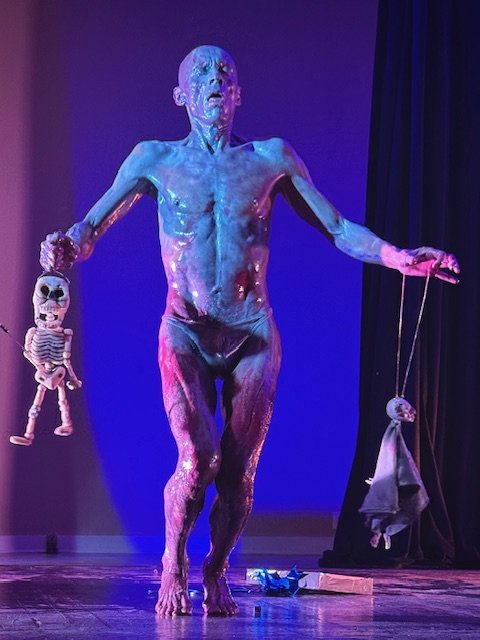
Photo by Nels Peterson [/caption]
Ecological themes, including primordial connection to the earth, earthly animism, the body's connection to the subterranean realm, decay, and decomposition, are particularly important in Butoh, especially to the co-founder of Butoh, Tatsumi Hijikata.
New generations of dancers around the world have taken up the invitation of the founder, Hijikata, to activate the primordial body and “crawl towards the bowels of the earth.”
Dancers have taken these philosophical and ontological imperatives literally, starting Butoh schools and Butoh training centers in rural areas, including mountains and forests. Making the Salish Sea Butoh festival part of a cultural and artistic immersion experience.
“I wanted to create a festival that was an arts in nature retreat, somewhere lush, green, verdant, to inspire the students and connect to those ecological themes of the art,” Espinosa said. “Port Townsend is perfect because it's on the northeastern tip of the Olympic Peninsula, famous for its natural beauty.”
Espinosa also sees Port Townsend as the perfect place to host the festival because it is well known for having a community that has long supported multicultural arts. With a grant from the Port Townsend Arts Commission every year to produce the festival, and the community coming out in large numbers, the festival has created a home here.
Espinosa said, “Butoh can be a very compelling art form for encouraging both the dancer and the audience to deepen their intimacy with nature and deepen with other species that share this fragile planet with us, and deepen our collective intimacy to the earth.”
The wind and windstorms are also a very important theme, as performed by Seisaku from Japan in the final main stage performance. Using classic Butoh facial stretching techniques to perform a meeting of the disturbances brought by the wind.
Salish Sea Butoh also produces an outdoor forest performance every year on the beach or at Fort Warden in the bunkers as part of the festival.
Butoh practitioners worldwide celebrate and express gratitude for traditional approaches and techniques, but it's not dogmatic. It encourages experimentation, radical freedom, and for Butoh students to take the classic techniques of veteran teachers and make them their own. Today, we see Butoh Hip-Hop, Butoh Flamenco, Butoh cabaret, and many other multidisciplinary mashups.
An example of this at the Salish Sea Festival was Yumi Umiumare’s performance. A Japanese-born dancer living in Australia since the 1990s, Umiumare performed an exploration of the ancient Japanese tea ceremony with hip-hop-inspired music on the main stage, poking fun at the commodification and capitalization of matcha tea.
“We get a lot of Port Townsend community members that come watch the performances, and we're so grateful for that, because those ticket sales keep us alive,” Espinosa said. But the vast majority of the workshop students are people coming from Seattle, Portland, Vancouver, Canada, San Francisco and other places around America.
They all need a place to stay. With now over 80 workshop students, and growing every year, it's challenging to find a centralized location where they can pitch up their tents, camp for the nine-day festival, and also have access to a shower and restrooms.
“If anyone out there in the Jefferson County community has a property that could support even half, that would be really helpful,” said Esponosa. “It's a great opportunity as a property owner to meet multidisciplinary artists from all over the world, have a drink with them, and break bread. I am hoping that some folks may know of a farm, or they know of a place that regularly rents out. That could be a great support.”