Strategies for Tackling the Affordable Rental Void Part Two: Community-Led Housing Strategies


[caption id align="alignnone" width="6016"]

Photo by Elena Mozhvilo on Unsplash [/caption]
News Commentary by Viki Sonntag
Washington’s Growth Management Act requires the city and county to plan for an additional 2,900 units of affordable housing over the next twenty years, with 1400 units in the city alone. In Part 1 of this two-part commentary, I discussed why market solutions to the affordable housing crisis are a dead end, in particular, failing to deliver on the desperate need for affordable rentals. I also argued that to make steady progress on housing everyone who needs a safe and secure place to live requires locally rooted strategies focused on the people most at risk of homelessness and displacement – low-income renters.
Alternatives to market housing do exist in a variety of forms. In the U.S., the two main ones are non-profit housing and public housing. Both depend on government funding via insufficient-to-the-need public subsidies. Local non-profit housing developers, such as OlyCAP and Bayside Housing Services, have stepped up to build affordable rental housing.
Last year, Bayside secured $8.6 million in state funding to build a 24-unit apartment building. However, as the current federal administration seems hell-bent on shredding the social safety net, public funds are likely to become even more scarce, putting this type of development strategy at risk.
The other not-for-profit alternative to market development is social housing. Social housing aims to do three things: provide permanent affordability, self-governance, and equitable access to housing. It exists outside of the speculative real estate market under community stewardship. The units in social housing projects are allocated by either need, that is, the percentage of units needed by income level, or share in the population.
As projects are mixed-income, it mitigates the negative effects of income eligibility requirements that keep families trapped at low-income levels for fear of losing their subsidized housing. In the last election cycle, Seattle voters overwhelmingly approved a tax on excessive executive compensation to fund social housing development.
In most countries, social housing is rental housing. In Jefferson County, Habitat for Humanity and Olympic Housing Trust (OHT) provide social housing in the form of affordable home ownership. Habitat’s work on institutionalizing permanent affordability is groundbreaking. While not rental homes, each time a renter qualifies and moves into a permanently affordable Habitat or OHT house, they free up a rental unit (although it may not be affordable).
The other standout locally is Community Build’s amazing program of leveraging volunteer hours to provide affordable tiny homes at around $40,000 per unit, which is rumored to be less than the subsidy for a single Evans Vista unit. (Evans Vista is the city’s proposed neighborhood of 240 apartments, 25% of them affordable). The Community Build tiny homes also carry deed restrictions to prevent them from being flipped for profit.
What Habitat, Olympic Housing Trust, Community Build, Bayside Housing and others are doing to provide affordable housing is to be celebrated, but we must do more to deliver the 2,900 affordable units needed in Jefferson County. Here are three community-driven housing strategies that have already proven their mettle.
Incremental Small-Scale Development
Imagine dozens of small-scale apartment buildings in and around Port Townsend, collectively built by local builders and investors, evolving over time in response to neighborhood needs. Historically, this is the way larger cities evolved. In the 1960s, local developers built thousands of small apartment buildings in cities around the country. Such projects do not involve the high-stakes financing typical of building at larger scales or face the economic uncertainty or bureaucratic hurdles that result in costly delays.
A key policy to set small-scale development in motion is as-of-right permitting, which means that as long as a project follows building and zoning codes, they are permitted without being subject to a discretionary approval process.
Local governments can also do more to cultivate and coordinate the local network of builders, developers and community members to work together to meet the need for multifamily buildings. One way is to simplify the zoning code and make it more predictable. Another is to provide staff to coordinate these efforts. Island County has five people dedicated to housing support on their staff, while we have none in either the city or county. Instead, we are paying outside consultants big sums to provide generic market solutions.
Finally, what if the city and county were to recognize the contributions of some of our community’s landlords to providing below-market-rate housing? It seems strange that non-subsidized units rented at affordable prices are not encouraged or counted in Comprehensive Plans. Let’s make it easy for community-centric developers to claim incentives for building affordable housing, such as utility discounts. Even prioritizing their permitting could benefit such developments greatly. A couple in the county spent three years planning a tiny home village to be told in the end that it wasn’t allowed contrary to what they had been told three years earlier.
Resident Owned Communities (ROCs)
The news of 4 Corners/Olympic Village mobile home park going up for sale last September sent a shock wave through the housing provider network: the loss of 110 units of affordable housing would be devastating to the people living there, many of whom are seniors and/or disabled, and add to the community’s affordable housing woes. There was a moment of hope that the residents could form a cooperative with the assistance of the non-profit ROC Northwest and purchase the park. The park owner rejected ROC Northwest's offer, holding out for a higher bid, which has yet to materialize. If the park does sell at the current owner’s desired price, the new landlord is likely to be an outside corporation.
To be clear, any change in ownership, even one on behalf of the tenants, will necessarily cause a rise in rents. However, the ROC model of tenant ownership stabilizes rent over a long period. For example, in Bellingham, the lot fees in a community that formed in the 80s have not gone up over 3% a year. It also puts management of the park under the residents, who have a stake in seeing that the parks are maintained.
Over 350 mobile home parks have successfully converted to the ROC limited equity cooperative model. Now, in addition to mobile home parks, ROCs are gaining traction as a solution to stopping subsidized apartments whose tax credits are expiring from being converted to market-rate housing. In Jefferson County, there are 491 units of subsidized affordable rentals. Over half of those will have their tax credits expire in the next twenty years. This means we need a strategy for preserving these apartments as affordable housing.
At the state level, we need to advocate for tenants’ opportunity to purchase subsidized units. At the local level, the city and county can partner with non-profits to advance community-based models with a focus on securing grants and financial support for community-owned developments. The criteria for approving developments should include permanent and deeper affordability, stronger tenant protections, and eventual community ownership.
Permanent Real Estate Cooperatives
Ultimately, the goal for public investment in affordable housing should be community stewardship of real estate for long-term community benefit. The Sustainable Economies Law Center pioneered the Permanent Real Estate Cooperative (PREC) model to permanently take land off the speculative market and into community stewardship for community wealth-building. In effect, the community takes democratic control of community development.
PRECs are designed to engage community initiative and investment. The cooperative’s members self-organize, search for properties, raise capital, and build self-run communities, with the PREC staff serving in a supportive role. Unlike intentional communities, which are self-owned, PRECs are a financial vehicle for any member of the community who wants to invest in affordable rental housing. Many PRECs invest in historically marginalized communities as their goal, such as the recently formed Kitsap PREC, which prioritizes investing in People of the Global Majority.
Unlike non-profits, PRECs are not dependent on charitable giving. Their cooperative structure transforms the ownership relationship, empowering groups of people to work together to meet long-term housing needs collectively. Perhaps the greatest strength of PERCs is their equity lens, which has the power to stop the pattern of displacement of under-resourced communities.
What the city and county need to do to support PRECs is to ensure zoning codes do not unnecessarily restrict cooperative living by placing an undue burden on the development of cooperative communities. They also need to make all the forms of support that they give outside developers accessible to make PREC development happen, including staff time and consultant dollars.
How You Can Make a Difference
Jefferson County and Port Townsend deserve a future where everyone is housed regardless of income. For a start, let’s make sure that policies and strategies that prioritize access to affordable housing are enshrined in our long-term plans.
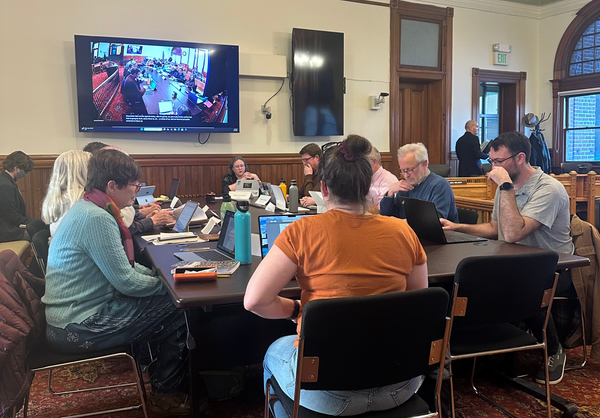
I encourage you to come speak for community-based policies and strategies in our city Comprehensive Planning meetings. Public input to the housing element of the Comprehensive Plans is happening now. You can find the agendas for upcoming meetings on the city’s and county’s websites. Public comments on topics not on the agenda are welcome at the beginning of all meetings.
Viki Sonntag has a PhD in economics. She is a Port Townsend Planning Commissioner and a member of the Joint City/County Housing Fund Board responsible for developing the 5-Year Homeless and Affordable Housing Plan. The views (and research) provided in this article are her own.