Telling Port Townsend’s Story—“If you can’t stop injustice, document it”

Art news by Diane Urbani de la Paz
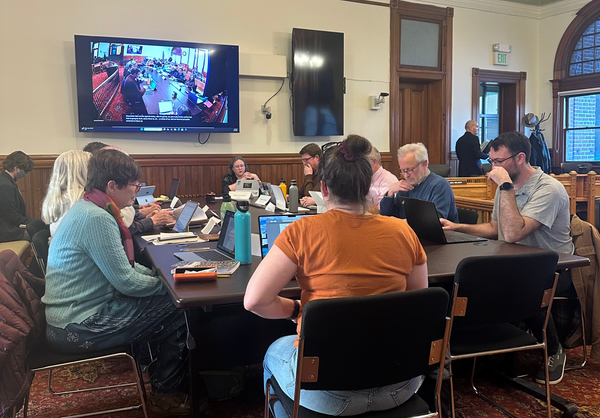
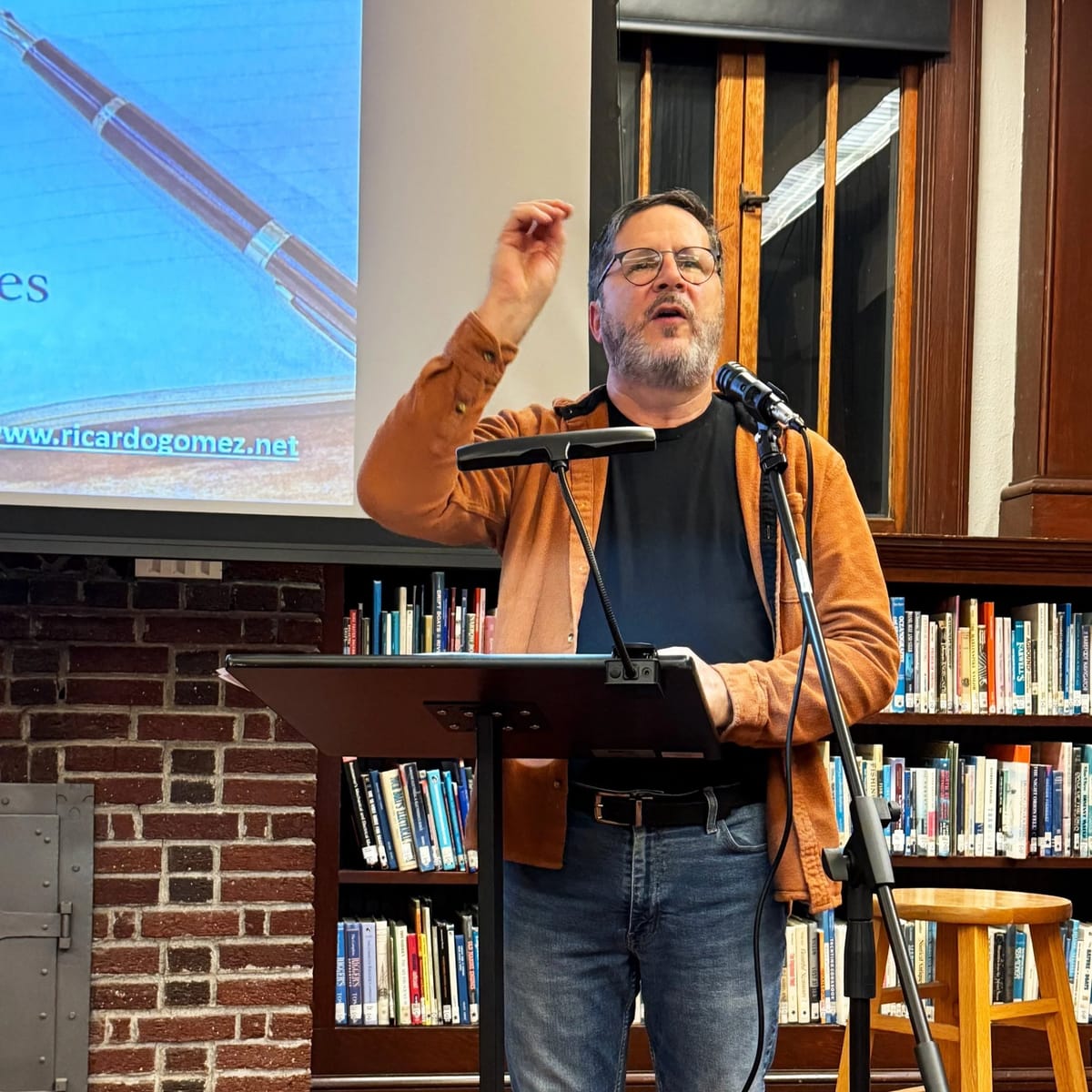
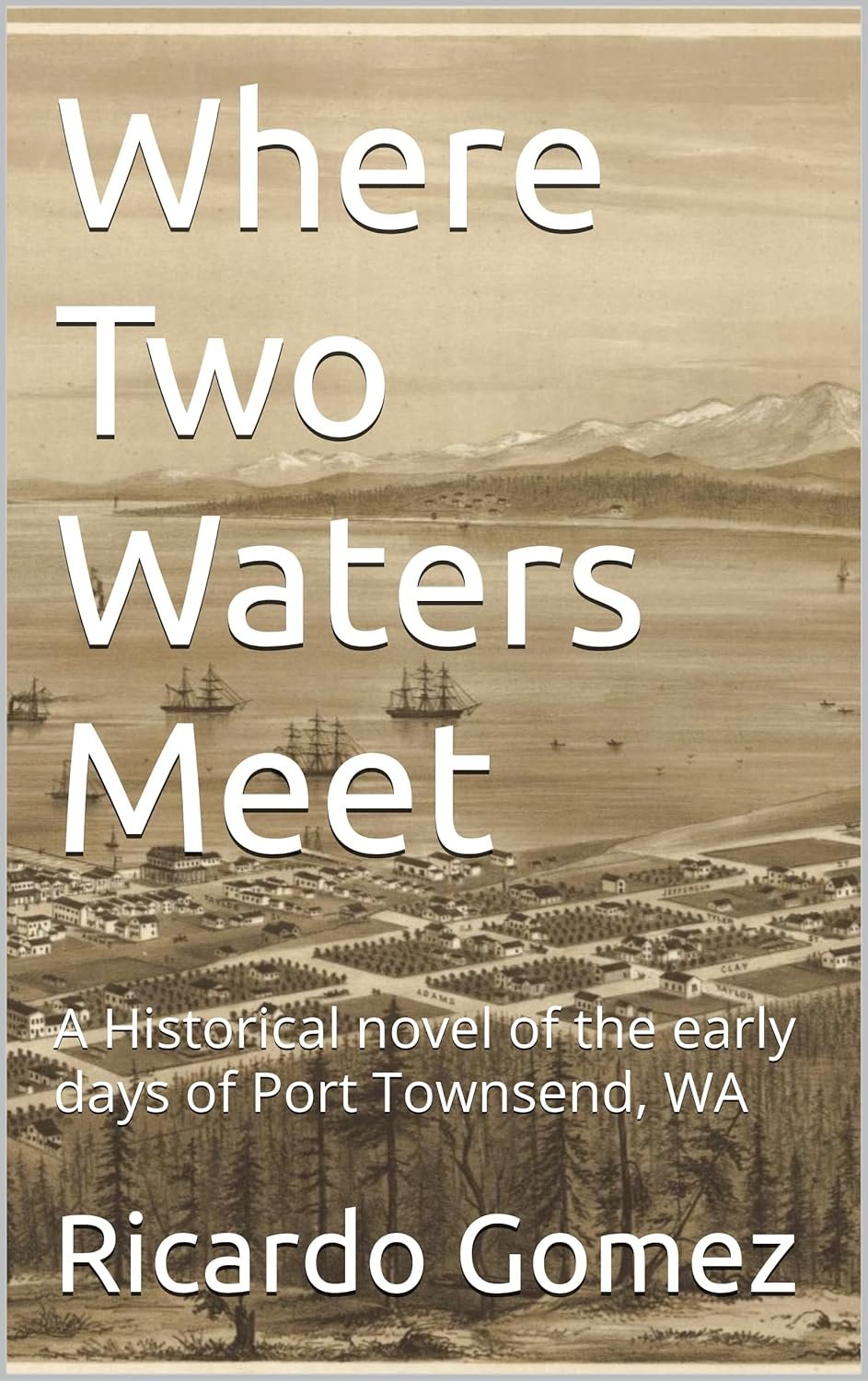
Ricardo Gómez faced a jam-packed Port Townsend Library reading room before his Thursday evening talk. Scores of people had come to hear about “Where Two Waters Meet,” his historical novel of Port Townsend—a story about a S’Klallam chief and a white woman who sought to document what happened when settlers came to transform this place.
Gómez, a recently retired University of Washington information science professor, has self-published a slew of novels and sells them on Amazon; this one came out in 2025 after his dive into research about his adopted community.
Gómez, who has lived in Canada, Colombia and Nicaragua, moved to Port Townsend after teaching at the UW’s Information School for 18 years.
“What I did not expect was how living here would transform my retirement project,” said Gómez, who said he used to write “academic papers that nobody reads.”
In “Where Two Waters Meet,” the author invents Elizabeth Morrison, a businesswoman who keeps careful journals of what Gómez describes as “the dispossession.” This includes the “paper promises” in treaties that were not honored, and the expulsion and burning of the S’Klallam village in 1871.
In a parallel record, Elizabeth preserves the truth that official histories prefer to forget, Gómez said. In the process, Elizabeth gets to know Chetzemoka, the S’Klallam chief whose life spanned the arc of dispossession.
Gómez writes of August 23, 1871, the day of the village burning:
“Chetzemoka was the last to leave. He stood at the doorway of his family’s longhouse. . . Fowler gestured to the constables. They moved forward with their axes. Chetzemoka placed his hand on the carved post. Held it there for a long moment. Then he turned and walked to join his people.
“The first blow fell. Cedar that had weathered a century of storms split under the blade.” Elizabeth writes that the fire started at 8 a.m., sending smoke, thick and dark, into the air. At noon, the constables reach Chetzemoka’s longhouse, and hesitate. Then they torch it.
“By evening, the village was gone. Elizabeth stood on the bluff as the sun set, looking down at the beach. Nothing remained but charred posts and scattered debris and a haze of smoke that hung over the water.”
The library was silent as Gómez read the passage about the burning.
The Elizabeth and Chetzemoka in “Where Two Waters Meet” share the belief that when you can’t stop injustice, you must document it. Those words were a refrain during Gómez’s talk; he also reminded his audience that it may take generations for vindication.
In a way, the author added, the 1974 landmark case United States vs. Washington, known as the Boldt decision, restored some justice. The ruling required the state to keep its treaty promises with tribal nations, and affirmed the tribes’ fishing rights and sovereignty.
“We need to be honest: the entire country of the United States was built on land taken from native peoples,” Gómez said. The prosperity and the cities we take for granted exist on that foundation—“it’s an uncomfortable truth.”
The author also sought to be honest about his use of artificial intelligence, specifically Claude AI, in writing “Where Two Waters Meet” and his other books. AI is a “writing partner and research assistant,” Gómez said, that helps with character development, the sense of time and place, continuity and copy editing. He called on it, for example, to research what the weather would have been like in his novel’s various historical events, and to test the flow of his dialogue.
“I use AI like a power tool for woodworking,” he said.
One audience member asked about tapping AI to write the story of his own life: It will only generate prose from what I tell it, right?
No. If you let it, AI will create your life for you, Gómez said, to laughter in the audience.
His advice to writers considering the use of AI: “Be smarter than it,” and revise what it gives you. Don’t just accept what appears on your screen.
Writing historical fiction with AI assistance, Gómez added, was for him a way to learn more about the story of this place — a way to humanize the timeline and make it more immediate.
“Where Two Waters Meet,” Gómez said, is an attempt to honor history’s complexity. All of the history is still here in front of us, in Port Townsend’s harbor and streets, and on the beach where the S’Klallam village lay.