The Long Run: It’s My (Third) Party, and I’ll Vote if I Want To

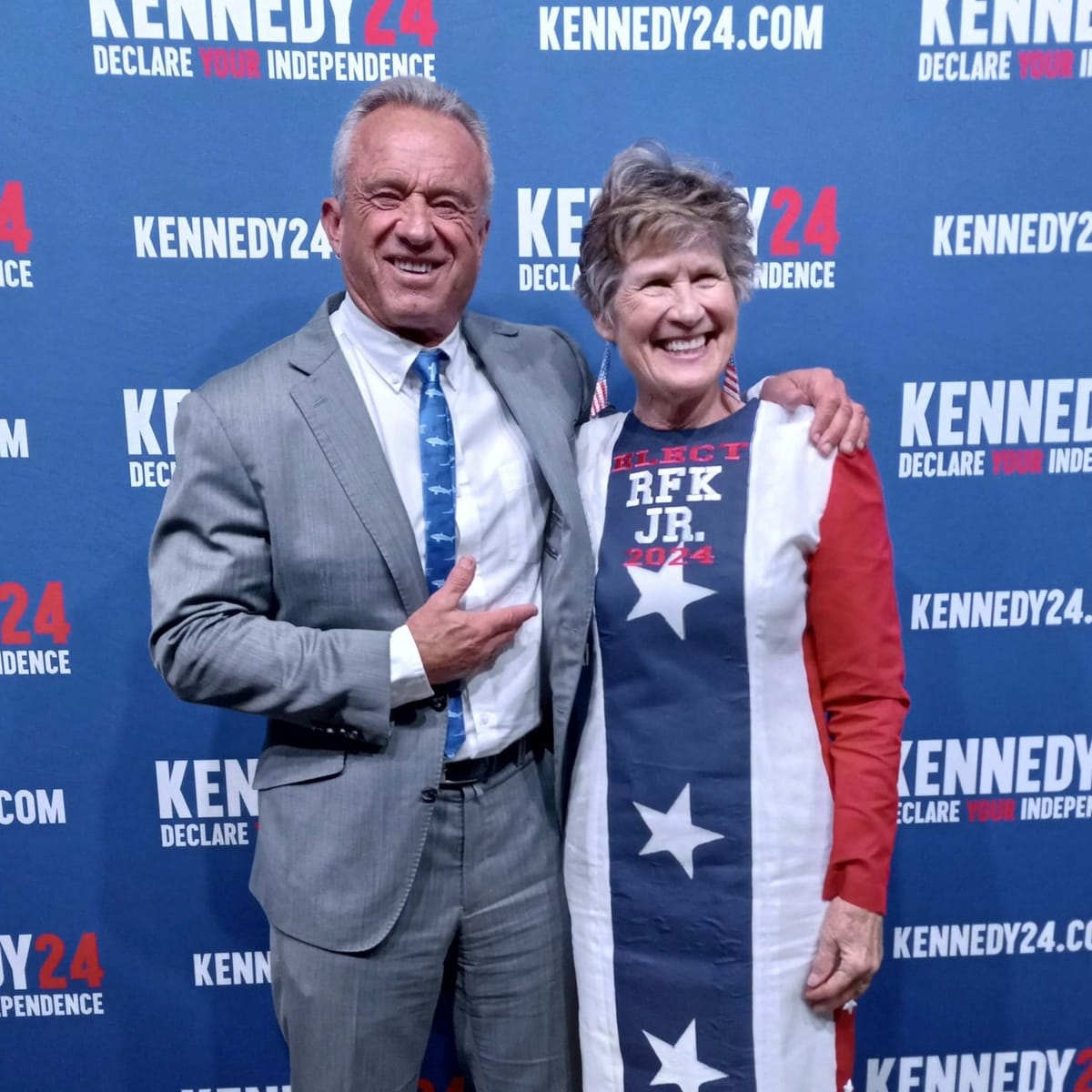
Robert F. Kennedy Jr. poses with supporter Kim Vogley of Quilcene during a campaign stop this spring. Vogley created her dress, to show support for the candidate. (photo courtesy Kim Vogley) [/caption]
Election Analysis by Charlie Bermant
Supporting a third-party presidential candidate is risky, especially in a year with a razor-thin margin and the belief that democracy is at stake. But all of our recent elections are like that, with a majority of us unwilling to leave the two-party path. Maybe next time, we say, but not today.
From another perspective, alternative parties will need to grow local support before attempting the national stage. Parties aside, true political change will often trickle up from grassroots voters and not trickle down from those in power.
We criticize the presidential election process every four years. First, there is the notion of abolishing the Electoral College in favor of the direct vote, an unlikely occurrence because it has benefited whatever party is in power. On the other hand, there is a portion of the electorate who won’t line up behind either party and will vote for an alternative candidate, as neither of the major parties offers them a palatable choice.
These issues are connected. As long as the Electoral College is in place, it will be nearly impossible for a third-party candidate to gather enough delegates to win.
Still, they persist. There are perennial candidates like the Green Party nominee Jill Stein, making her third run for the office. And we can’t forget Robert F. Kennedy Jr., still pointing at the presidential windmill despite repeated rejection.
Kennedy began his campaign as a Democrat, switching to independent status when he couldn’t get any traction. He dropped out of the race and sort of endorsed Donald Trump last week, perhaps in exchange for a cabinet post or a position of importance (this after he approached the Harris campaign with the same deal).
Steadfast RFK supporter Kim Vogley of Quilcene will not follow her candidate down the Trump path.
“I will not support Trump,” she said. “I will not vote for Harris. If Kennedy is not on the ballot, I will cast a write-in. I think we need a third party, and I think people need to wake up that that choice has been taken away from us.”
The idea that a voter will switch from one candidate to another after an endorsement underestimates their unpredictability. But it’s clear that many of RFK Jr.’s supporters won’t join him in supporting Trump.
I spoke to several Kennedy supporters in June for a potential Beacon story,
“People say that a third-party candidate will never win, but there is a first time for everything,” one said. Added another “We're in a very cathartic time. There are a lot of secrets being revealed about the corruption of our government. And he's a perfect person to help unpack all that.” Or this: “He's got the strongest support with younger people who don't have the memory of his father and uncle being killed. The Kennedy legacy isn't part of their past. So the Camelot thing doesn't really impact him very much.”
“The Camelot thing” matters to Port Townsend resident and famed mountaineer Jim Whittaker. A close friend of RFK Sr., the two scaled the Canadian mountain named after JFK.
“I have known Bobby Kennedy, Jr. since he was a child,” Whittaker told the Beacon. “He was bright, likable, and I appreciate the good work he has done on environmental issues. But it seems he has become increasingly irrational in recent years and, like most of his family members, I do not support his candidacy.”
Elections for city council, PUD, and others that fall in odd-numbered years are expressly non-partisan, although many candidates affiliate with one party.
An exception is County Auditor Brenda Huntingford, who expressed no party preference on the ballot. This wasn’t an issue since offices like auditor, treasurer, court clerk, and assessor are skilled positions where party is less important than qualifications.
Jefferson County Treasurer Stacie Prada said party affiliation is less important for county positions. To evaluate the candidates “you need to examine their record and see who is endorsing them.”
County elections provide an entry-level path for an independent candidate. An open county commissioner’s seat offers such an opportunity, but candidates usually align themselves with a party. This year, all of the candidates have aligned with the Democratic party.
The State Legislature is a theoretical opportunity for independent candidates to prevail, but they often need party support to get any attention.
Port Townsend residents Doug Millholland and Tyler Vega both ran against US Representative Derek Kilmer with little success but said their campaigns helped call attention to their issues.
“The best advice I got was to run for a smaller office first, city council or county commissioner,” Millholland said. Those are legitimate ways to become known to people, And if you're a successful city council member or a county commissioner, then people have a chance to say, ‘Yes, I know this person. I've seen them in action. I trust them.’"
Vega favors the establishment of Ranked Choice Voting or another system that allows voters to select their second choices. The system currently exists for state primary, congressional, and presidential elections in Maine and Alaska, with dozens of other municipalities using it in varying degrees. Seattle is scheduled to implement RCV for all city elections in 2027.
This year an independent candidate, Port Angeles Attorney J. Graham Ralston, entered the race to succeed Derek Kilmer in the House of Representatives. He placed last with three percent of the vote, but winning wasn’t the point.
“The win, to me, isn't just winning the election,” he told the Beacon in May. “It's the opportunity to have a discussion with people on larger stages to talk about the importance of not being stuck in party politics. Instead, focus on issues more than the party.”
This doubles back to the Electoral College. Since Washington is assumed to favor Democrats, a vote for Trump might not count because he’ll be in the minority, and a vote for Harris might not count because she won’t need it here. But people on both sides will still vote, as its most gratifying aspect is supporting someone you believe in, win or lose.
Vega said this lopsidedness provides an opportunity for third-party candidates.
“So right now, it's Harris and Trump,” he said. “It seems pretty clear-cut. And to vote for a third party this year might not be wise. But it’s all about our perspective. Washington is considered a safe state because so many people are going to vote for Harris that we don’t need to.”
“Supporting Jill Stein and the Green Party doesn’t cost anything,” Vega said. “If she gets enough votes, the party will qualify for funding and ballot access in the future. “
For many people, this race represents a referendum on democracy, with no tolerance or understanding for those who choose to sit this one out. But there will always be outliers; those who earnestly support an alternative, those who vote to spite the frontrunners with a frivolous choice, and people who sit it out entirely. In order to prevail, any successful party will need to motivate these people to get off the couch.