The Transformative Power of an Artist Residency
[caption id align="alignnone" width="1065"]
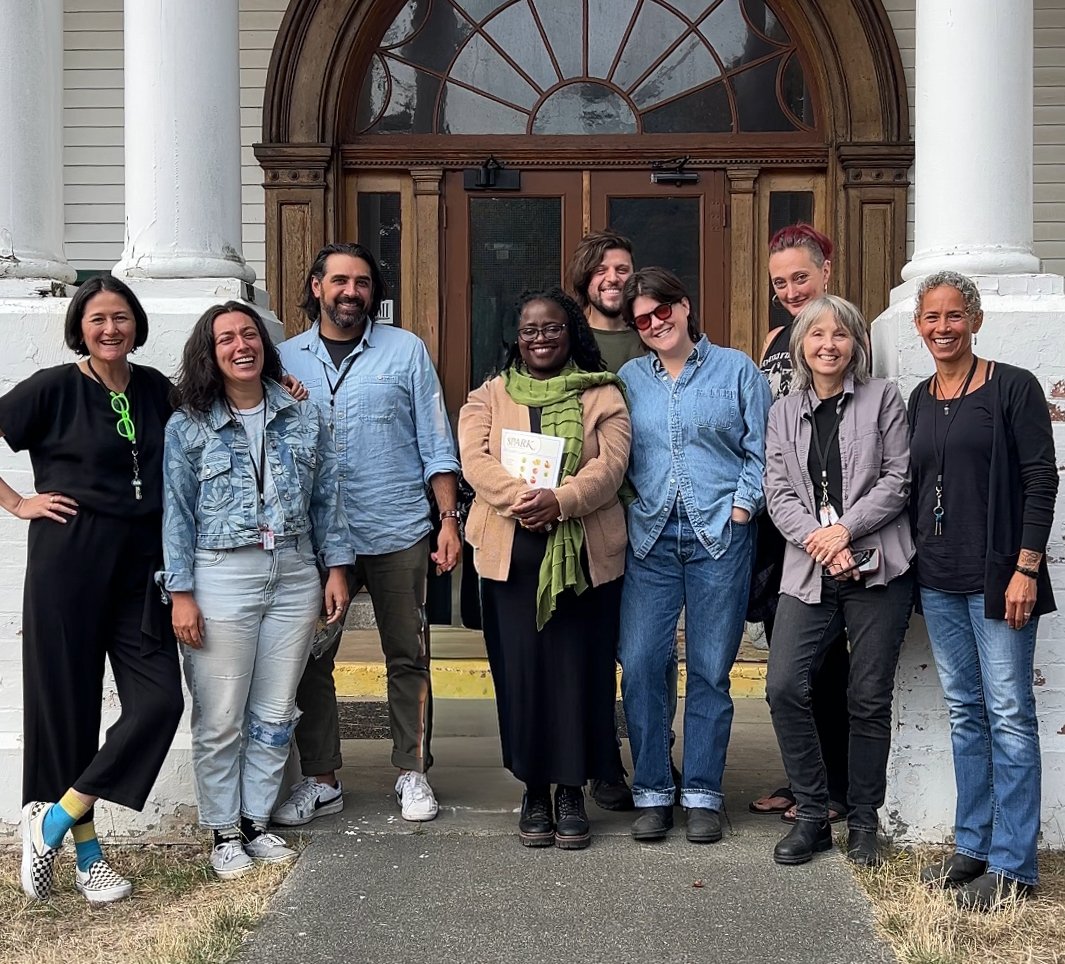
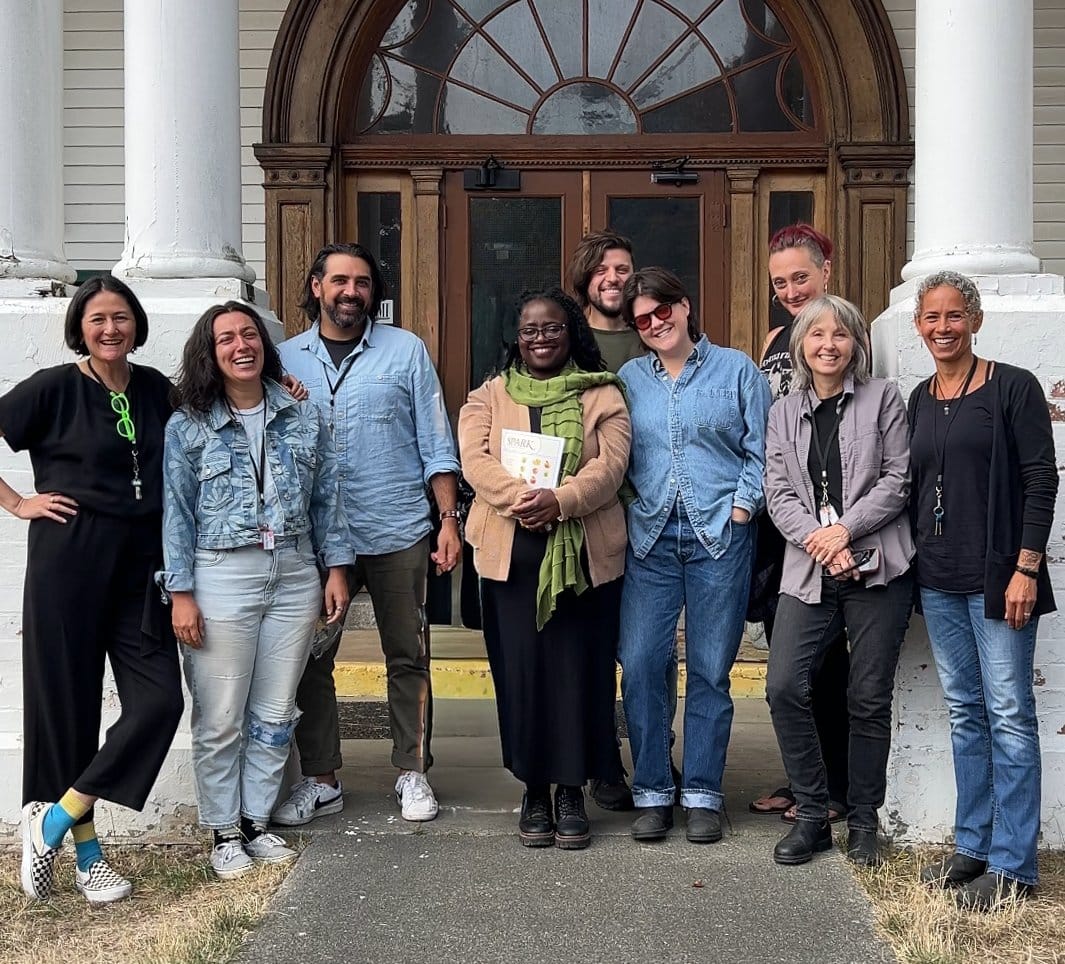
From left to right, Libby Pratt, Leila Block, Ryan Christopher Jones, Lynette Ngulube, Connor Colbert, K Van Petten, Lara Messersmith-Glavin, Emily Ross, and Melissa O'Neil. Photo courtesy of Centrum [/caption]
A Centrum Residency Column by Melissa O’Neil
Every Tuesday morning at 11 a.m., my colleague Libby Pratt, the program manager of Artist Residencies at Centrum, and I gather with artists and writers who have come to Centrum for the residency program. There are poets and writers, performance artists, photographers, and visual artists of all ilk who bring themselves to this little town off the Salish Sea in an attempt to remove themselves from the distractions of the world and singularly focus on their artistic endeavors.
One of the first artists that I met after starting my job as the program coordinator of the residency program at Centrum was Sarah Grimm. She is an interdisciplinary artist, a painter, writer, and photographer. What I was fascinated by was the many, many tubes of paint. For me, paint tubes are like seeds.
When spring rolls around, I sit on the edge of it, both relieved it has come and frozen with my seed packets. What will happen, I worry, if I plant the seeds? Nothing nefarious, but I hem and haw about where things should go.
Inevitably, around Mother’s Day, I scatter those suckers everywhere in a panic. What grows is always a delight, though it ends up being guerrilla gardening every year. I scatter seeds, willy nilly, just to get them in the ground before winter rolls back around. Last year, I did a disjointed dance as I sprinkled them in our front bed, then I saw, too late, my three children watching me from inside the house, laughing.
“What is she doing?” they asked each other.
I was planting seeds.
I was opening a tube of paint.
When I saw Sarah’s tubes of paint, some squeezed so tight to be nothing but a wrinkled skin of aluminum, it lit something in me. What happens when we plant something? Even if we don’t tend to it well, something might grow. If you open a tube of paint, something could emerge.
I remember a children’s book I used to read to my kids when they were younger called The Dot by Peter H. Reynolds, where we find Vashti, our main protagonist, stymied by her art class. Her art teacher encourages her to make any mark, and when Vashti makes a singular dot, her teacher says, “Sign it.” Vashti then becomes a prolific dot artist, making dots in various sizes and colors. Sometimes it only takes one mark to spark something.
I had a four-week residency with Centrum several years ago, before I knew much about the organization, before I knew it served both local and non-local artists, writers, and musicians. A mother of small children, I slept at home, but during the day, I had a space where I spread out the contents of the box that served as my desk/office/workspace.
I separated all of the things that were Life (forms to be filled out, lists of tasks to run a household, etc., etc.), Work (from a job I was doing at the time that I loathed), and Writing (scraps of thoughts, so many scraps, plus my ever-packed journal). Is it hyperbole to say that I couldn’t fit everything back in the bin at the end of the four weeks? You’ll never know. But it reframed things for me. I introduced myself as a writer after my residency, not just as a mom, an activist, or a worker bee.
I created this special lean-to inside of me that sheltered the writer in me, that protected my time differently, that prioritized writing in a way I hadn’t before, not since my undergraduate degree in college, where we sat in our turtle necks and critiqued and imagined ourselves as very serious writers.
I have come back to the time I had in a Centrum residency over and over. It’s the reason I applied to work there. This capitalistic world will tell you to grind, to hustle. It will yell that painting, that photography or sculpting, that building something beautiful or strange, that sitting on a bench and looking out over the Salish Sea and writing a poem or painting en plein air isn’t feeding the beast, because artists are notoriously underpaid or undervalued or under-whatever.
But when we find a surprise bench for moms everywhere on the edge of a bluff and it’s raining, and there is a squeegee attached to the bench, so that we don’t have to sit in a puddle, when we allow ourselves the level of care or tending that we usually only provide for others, something is sparked.
If you feed the spark a little, not too fast, just a smidge of duff here, eventually, small pieces of kindling, something can grow. Like seeds scattered willy nilly, like a tube of paint opened, full of possibility. What a gift, what a radical, transformative gift we can give ourselves.
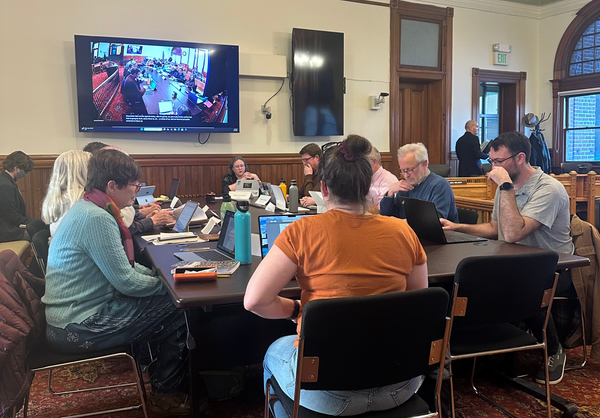
During our Tuesday meetings with residents, we go over logistics for staying in old cabins and apartments (“Things break,” we say, “and it probably won’t be your fault. And even if it is, we won’t judge.”). We invite people to rest and decompress (“The world,” we say and sigh. “The world,” they say back).
We encourage people to gather if they want to, or to hermit if they want to. We go around and give our names, what type of art we do, and what we may or may not plan to do during the residency.
The Tuesday meetings bring something very unexpected: community. I know, Centrum’s tagline is "creativity in community”, but it’s not just a tagline. The Centrum residents embody a tapestry of people doing creative work. The longer people are here, the more in-depth the Tuesday meetings get, the more we know each other, see each other, love each other.
We are creating lasting connections with people who maybe don’t live near us, maybe don’t look like us, maybe don’t come from the same background as us. We are building a safety net that can catch us on a hard day, but also on a good day. A place where people have come to write or dance or paint, but really they are laughing and grieving and living in community, and they are allowing themselves some grace to open a tube of paint, to write a word on a page. We are growing something. In this world that will try to tear us down, we are growing something.