Visibly Trans: Learning to Navigate Port Townsend as a Woman in Transition

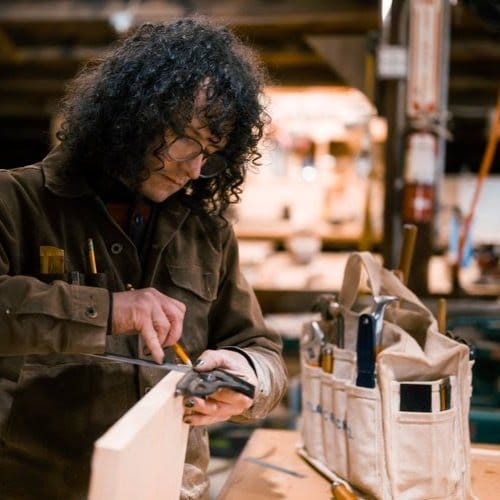
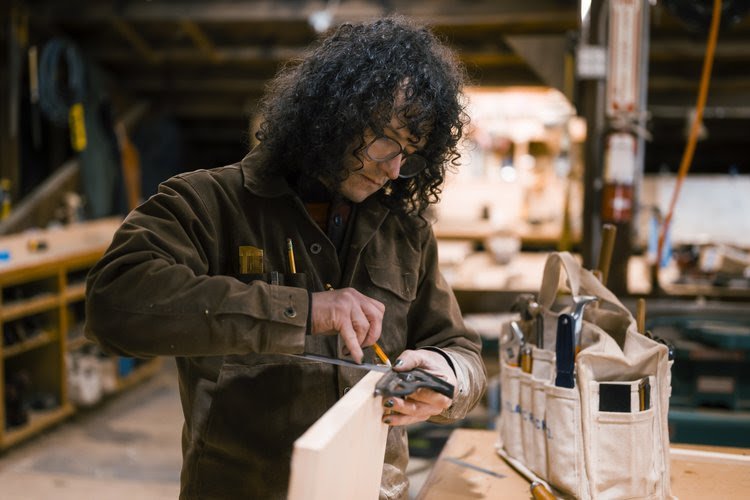
Haven Boatworks: Nic works on building a custom bookshelf. Photo by Heather Johnson. [/caption]
A column by Heather J.
I could almost convince myself that everything in the world will be fine, that I’ll be fine, if the news feed could just be shut off. In this fantasy, I completely disconnect from the internet and live in a pre-digital age nostalgia.
One look at the news and the hits keep coming; the uncertainty is, at times, nearly unbearable. Some people seem completely oblivious to what’s happening with gender rights via Executive Order fiat. There is tremendous uncertainty about the future for women’s and LGBTQIA+ rights. Meanwhile, entire agencies are being taken over by teams of malicious 20-something idiots; traitor tots. My partner isn’t sure if she’ll have a job next year. Chaos is everywhere and we’re all being forced to triage what to keep track of, care about, fight for.
We had a few days of rare January blue sky. A new friend and I walked through the boat yard - them looking for their next employer, me using the excuse to see friends and allies. I’ve spent a lot of time here watching and listening. As a photojournalist, my role has been to get in and then fade into the background as much as possible. People have been shocked, lately, to learn that I have kids. The subject of children rarely comes up in this environment, and besides, my work is more often on the receiving end, watching and listening and trying my best to share an honest interpretation of this community.
At Haven, I introduced my friend to Blaise, the owner, and then went to check on the furniture Nic is building for me on Haven’s behalf. As fellow practitioners of the “beer economy”, Blaise and I traded work — photos for furniture. I’m in love with the continuity of people in the trades providing material support for my ongoing projects. Nic is a brilliant furniture maker who was on the build crew of Tally Ho. That they are also queer/non-binary made it feel like I’d met my woodworking soulmate. We have a lot in common, I just want to hang out with them all the time and spill my soul — oh dear, do I have a crush?
The thing about being visibly trans is that you become a mirror for people’s insecurities. Whatever prejudices or ‘isms are rooted have a tendency to come foreword, though I think most people try desperately to hide them. I can almost see in real-time people deciding if they’re going to recognize my basic humanity or if they’re fighting back internalized transphobia. The more experience people have had with gender variant folks, the easier it is for them to see us as we see ourselves.
Port Townsend is a very “gay” town and when I started coming out, I knew I’d continue to find a home and community here. I knew there would at least be pockets of acceptance in the boatyard. My work and reputation over the years had earned me what felt like an “all access” badge to most (all?) of the shops. With no master and no true home, I came and went like a stray dog looking for pats on the head and maybe a good photo. Everywhere was my home.
Shaving off my beard felt like losing that pass. I’ve had to re-introduce myself and start anew in navigating the same people and spaces. The privilege of being a white cis-gendered/heterosexual dude is that people assume you belong in these spaces — it is inconspicuous. As a trans femme, I feel very conspicuous, in that there are very few places that feel truly ours. Everywhere else is a potential battleground.
The photos I traded with Blaise have done well for Haven’s advertising, though the set (like my archives) lacks much representation of systems, machine, and composite work. Blaise asked for more coverage and photos of the “missing” trades for advertising options, so I asked him to give me a tour of the spaces and people he’d like photographed. It’s good to be seen with the boss so that everyone is on the same page about who I am and what my purpose is. My freedom to roam the yard has always started with an initial negotiation and then a process of trust building by taking the time to show up.
There are a few people in my life who have been absolute rock stars with respect to my new name and pronouns. My partner, Tiffany, gets extra-credit for not only a perfect record but also the “double duty” she pulls helping other people get accustomed to the transition. Blaise is another star. He asked for grace when I first shared the change with him, in the event he made a mistake. Despite this ask, he has consistently used the right name and pronouns every time I’ve been around him; noticeably, it has been without hesitation or a trace of judgment.
Being the computer nerd I am, I started to think about coming out as being like an update to people’s communications software for interacting with me. Those who’ve stayed current with their updates take the patch easily. Those who’ve stuck their head in the sand and haven’t updated in years or decades find it a bit more … difficult.
Blaise introduced me around the side of Haven I’m less familiar with. First in composites, then finish, then machine, then systems, all with a casual “hey, this is Heather, she is going to be taking photos around here for us” and I couldn’t help but notice they were all men with the exception of the finish workers. That’s the nature of this industry. No, not “nature”, it’s just not natural, as it’s generations of prejudice and discrimination that have punished or disincentivized women from pursuing this kind of work. Anyway, Blaise was introducing me, a visible trans woman, into these spaces and I found my own prejudices creeping in about what the men might be thinking about me. To be clear, there wasn’t a hint of judgment from anyone, which is what made my own biases so visible — I couldn’t mask them in righteous judgment.
In 2021, Esther, a seasoned shipwright, shared with me her frustrations about men who have no experience shipwrighting yet presumed to tell her how to do her job. The subtle assumptions we all make about people’s roles and experiences came into sharp focus. Some of them expressed their disbelief with Esther, asking aloud “women can be shipwrights?” As if she had broken an insurmountable barrier.
From that moment on, I started paying more attention to the subtle assumptions my own mind wanted to jump to. If I saw a woman working on a boat, my learned instinct might be to wonder if she was doing finish work. I would recognize this thought and then override it with an assumption that she was the owner or project lead. The result was that my interactions started with the presumption she was in charge, and if not, she may tell me so. Not only did this mental trick help me overcome learned and sexist mistakes in judgment, it communicated the possibility, the reality, that women hold these roles.
After leaving Haven, I wrestled with the prejudice I was feeling about the people I had just met. The truth is that most cis men do make me nervous. Of my experiences over the past few months, the negative ones have always included a man. The hard stares, the comments within earshot, that one guy who grabbed my hips and pulled me into his body at a dance (“Welcome to being a woman,” my therapist said sardonically), all by men. Which isn’t to suggest “all men” behave this way but the odds are that if there’s going to be an uncomfortable or dangerous interaction, it will be with a man.
I wrestle with how hard to override these prejudices, I know plenty of amazing cis guys who I feel incredibly safe with. Some of them have trans friends or trans kids, some of them are family members, many are just outstanding dudes and allies. And yet, I can’t help but recognize how this prejudice might protect me from violence.
Returning to the boatyard to continue photographing the trades as a trans woman requires me to be vulnerable. There is a shift in the expectations and understanding that I ask people to make when I re-introduce myself as Heather, she/her. My presence can challenge people’s assumptions and that can be uncomfortable experience. The upside of being visibly trans femme in male-dominated spaces is to be a real life representation of what it means to be trans and challenge stereotypes and caricatures of our existence in real-time. Cis women often feel the same way. In male-dominated spaces, we become examples for an entire class of people while unsure of our own safety, whether it’s social, financial, or physical.
The more diversity there is in a space, the more comfortable I feel. It signals a culture of acceptance and respect, that it is possible and socially acceptable to be different and still be treated with dignity. Most women and queer people don’t last long in blatantly sexist and misogynistic places. It’s exhausting to be on guard all the time and constantly worry about our standing and whether or not we will be respected and acknowledged on a given day.
As my mind returns to national issues, I’m not sure what to do about the FedGov literally erasing trans existence from all their paperwork, websites, and even retracting scientific studies that include “banned” words like “woman.” It is a digital book burning on an epic scale. At the Washington State level, I’ve continued to connect with folks in policy and advocacy and with other affinity groups. My writing will continue with hopes of giving a glimpse into the life of a woman in transition without the drama or caricature. Some days, being visibly trans is all I have the energy for, some days I don’t even have that. On the hardest days, my mind wonders if this is all really worth it: trying to justify the loss of excessive privilege by presenting as a cis/het male. Then, I shudder at the thought of growing a beard and check the calendar for my next appointment to zap the remaining hairs away for good.
The idea of donning a blatantly masculine appearance makes my skin crawl. To quit HRT and go back to being testosterone dominant and feeling the constant dysphoria and disassociation would be a return ticket to a living hell, especially after feeling the whole-bodied happiness and joy I’ve been able to experience these past six months.
To answer my own question, no, I would not trade cis-gendered white male privilege for the relief of feeling embodied for the first time in my life.
Heather J. is a writer, photographer, and filmmaker. Her work is place-based and explores what it means to live with meaning, purpose, and community. She is a native of the Pacific Northwest and is most at home playing in the landscape where the mountains greet the sea.
This column is reprinted with permission from Heather J.’s excellent newsletter. People can subscribe by visiting olympicheather.com