Caswell Brown Village is Expanding, Prepares for Congregate Shelter
Olympic Community Action Partnership plan for property renovations, location changes, and new builds.

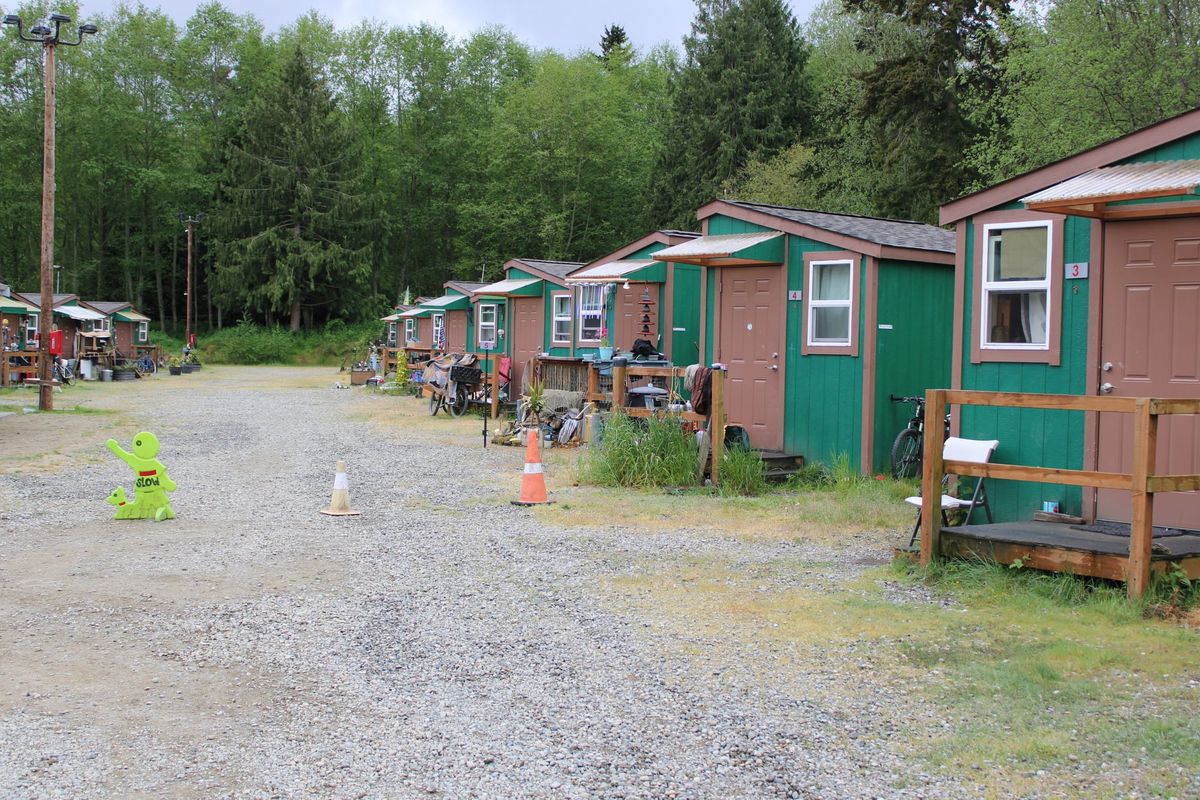
PORT TOWNSEND, WA—The journey out of homelessness is rarely a straight line. It often involves navigating a patchwork of temporary solutions, from fairground ad-hoc camps to overnight shelter spaces that feel transient at best. But at Caswell Brown Village, a new model has taken shape—one that blends pragmatic housing solutions with a deep recognition that the people experiencing homelessness are not a monolith, but individuals with unique stories, struggles and strengths.
Caswell Brown has evolved significantly since its start in 2022. What began as a transitional step from the fairgrounds encampment has grown into a multi-faceted campus managed by Olympic Community Action Partnership (OLYCAP), complete with tiny shelters, RV spaces, a new sanitation building and a planned 31-bed congregate shelter.
As Olycap Housing Project Manager Peggy Webster explained, the project has required constant creative problem-solving. “The original plan had a congregate shelter attached to permanent housing for people in recovery,” Webster recalled. But after years of struggling with a multi-million-dollar financing gap to include permanent units, the decision was made to pivot. “End of 2024, I sat down with management, looked at it, and just said, ‘We should build a 31-bed congregate shelter.’” These top-down delays have caused a domino-effect on the local unhoused community and strained other local shelters like Bayside Housing and the Warming Center.
The congregate shelter project was just awarded a $3.1 million grant on Friday, May 1. Webster expects the modular units to be transported up from Idaho in late fall, though she cautions that construction timelines are always unpredictable.
That shelter, to be built using a modular construction model with models coming from Idaho, will include a commercial kitchen, laundry, bathrooms and four rooms of approximately eight beds each. While awaiting state permit approval and from Labor and Industries, the team is already preparing the site.
More than just a roof
One of the defining features of Caswell Brown is its refusal to apply a one-size-fits-all approach. While the incoming congregate shelter will serve many, village leadership recognized that not everyone can thrive in a crowded, dormitory-style setting.
“There are some people who should not be in a congregate setting,” Webster noted. “If you’re really sick or if you have a child with you.” To address this, Caswell Brown plans to retain three or four of its existing tiny shelters as alternative emergency overnight placements. They did not clarify what will happen with the remaining units.
Caswell Brown also recently completed a major sanitation building, funded and built in partnership with Anderson Homes. The facility provides on-site bathrooms, showers, and laundry—essentials that many residents had gone without for years. Webster recalled the building’s Christmas Day opening: “I ran into two little girls, maybe seven and five, and I said, ‘Bathrooms are now open.’ The oldest one said, ‘I’m going to the bathroom.’ Imagine using porta-potties as a kid for three years.”
Additionally, what residents call “the PUD building,” donated by the local Public Utility District, now offers a food prep area with sinks, cabinets, microwaves, a refrigerator and meeting rooms. On-site manager, Terry Strickland, meets with residents in the PUD building.
Learning to coexist
For Jacob Powell, the supervisor at Caswell Brown and a man who once experienced homelessness himself, the most important work happens in the daily interactions between neighbors.
“Definitely the biggest surprise is bringing people out of homelessness and helping them learn community and social norms,” Powell said. “When you’re living in the woods, struggling, in survival mode, and you come into a community, sometimes there is a transition period.”
Powell, who has been with Caswell Brown for five years, is intimately familiar with that struggle. He originally moved from rural California to Washington with his father, only to have their motorhome break down in Sequim. When his father got it running again, he kicked Powell out. “I was in an area where I didn’t know anybody, wearing shorts and a t-shirt,” Powell recalled. For five years, he camped, worked as a day laborer, slept in his pickup truck and pieced together a life.
That experience informs his leadership style at Caswell Brown. “When someone is on the verge of being removed from the program, Terry [Strickland] and I will try to find ways to help them succeed before it goes to that next step. That’s why we don’t have a lot of people getting removed.”
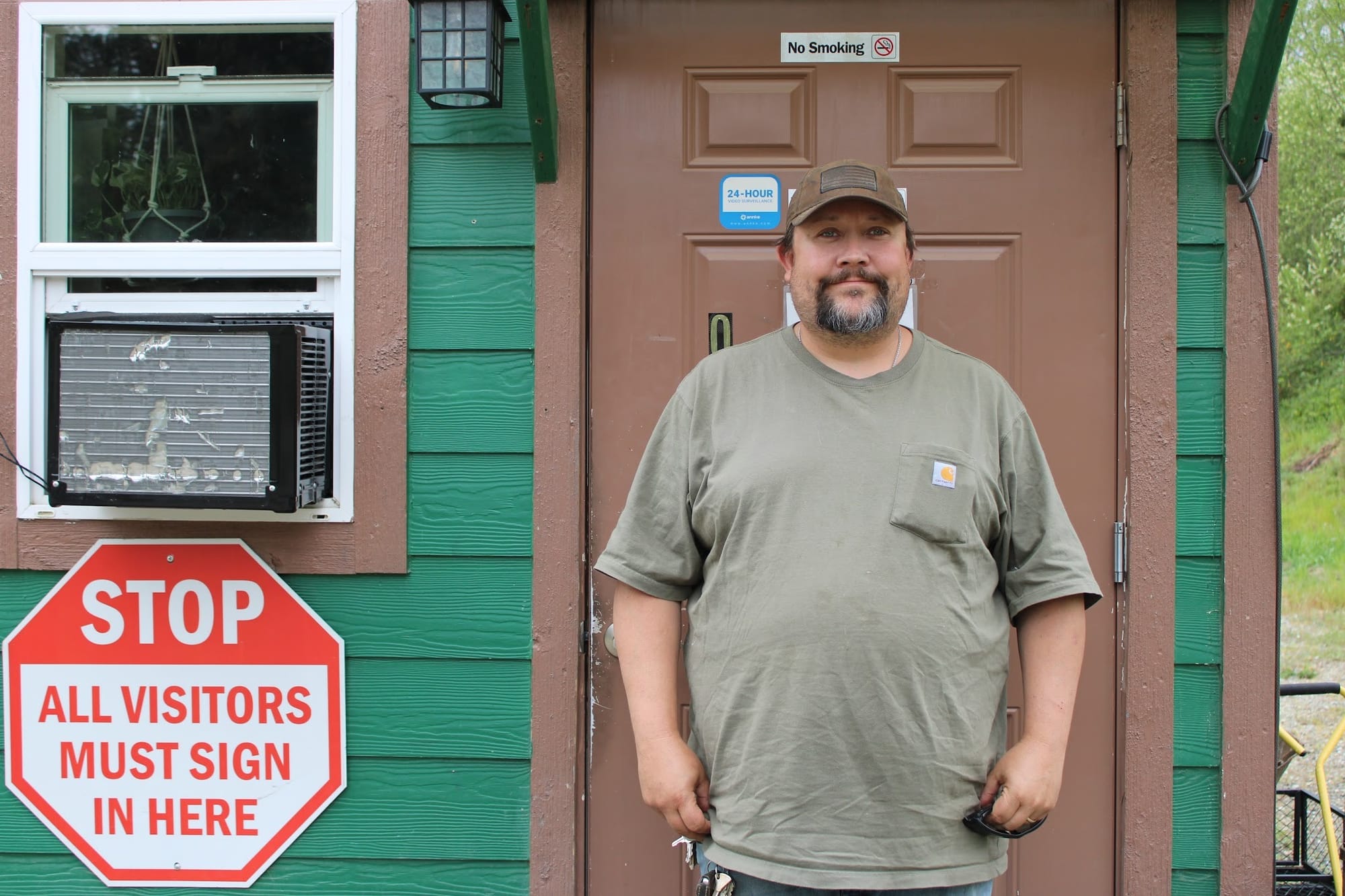
He added, “I’ve seen a lot of successes here. The people who don’t succeed, there’s obviously something further they probably need more help with. But that’s not for me to say. My main goal is seeing people succeed.”
A landlord, not a case manager
A critical distinction that Webster emphasized is that Olycap’s Property Management team acts primarily as a landlord, not a social service agency. The organization manages 76 housing units across multiple properties, with extensive compliance requirements due to state and federal funding. Yet the reality of running a village for newly housed individuals means that boundaries are constantly negotiated.
“We have a significant number of people with supportive housing needs, but the property management team are not case managers,” Webster stated. “We are landlords.” When tenants struggle, the team pulls in outside advocates—including the REAL (Recovery, Empowerment, Advocacy, Linkage) Team from Discovery Behavioral Health—and sometimes other Olycap staff to provide targeted support, particularly for older residents facing dementia or isolation.
“We have this discussion frequently: this county doesn’t have a great set of resources for older people,” Webster admitted. “Especially going into dementia. Given the [demographic of the] population, it is a little surprising we have no resources for that issue.”
Looking forward
Despite the challenges, Caswell Brown is continuing to expand its vision. Olycap is exploring the redevelopment of the Haines Street Cottages, eight transitional cabins built in 1941, into 24 permanent units on the same site. They have also applied for a grant to rehabilitate Northwest Passage, a 30-year old building of permanent apartments in Jefferson County that need new windows, doors, porches, and exterior work.
Caswell Brown is proving that the path out of homelessness can be built one tiny shelter, one laundry load and one neighborly hello at a time.
Caswell Brown Village is a project of Community Build / OLYCAP. For more information, visit community-build.org.