Driving Mr. Greenfield: What Happened When I Said Yes
Foraging together brings out more than just a connection with nature.

By Cara Leckenby
A couple of weeks ago, I signed up for Robin Greenfield’s foraging class being held at Finn River Farm and Cidery—this was my first “yes.” I didn’t realize then what kind of a side-quest I’d be saying yes to as a result of this small gesture of connection, but when an email came calling for support, I raised my hand. And then Robin emailed, asking for a ride to the ferry. Again, yes. That final yes became several days of shared adventure, and quiet conversation, and reflections about childhood, relationships, care and stewardship in our everyday and work-lives, and, as any good adventure and conversation goes, created a delightful map of more meaning than expected. And to be clear, I expected meaning—being drawn to sign up for this class as a means of furthering curiosity about sustainability and systems that are outside of “the box.”
When I picked him up from the ferry the following day (again, “yes”), he had already expressed some interest in foraging on the shoreline, and in seeking some opportunities there, we went on a 2 hour gathering sesh. As Robin turned on a practiced teacher persona, providing small educational tidbits, I found myself picking fennel from the dockside brambles, cherries (loads!) from what appeared to be an orchard of bird-planted trees.
I noted interesting foraging areas that I'd known of all my life, but not thought about in years. Seeing the world clearly, and somehow re-connecting to childhood—the little girl who delighted in plant-magic. "I would have been up in these trees" I said, as we talked about what it meant to revisit childhood.
We gathered seawater so that Robin could boil that down to salt. Robin found dinner, and was delighted in having stocked up enough cherries for his travels homeward at the end of this class-week.
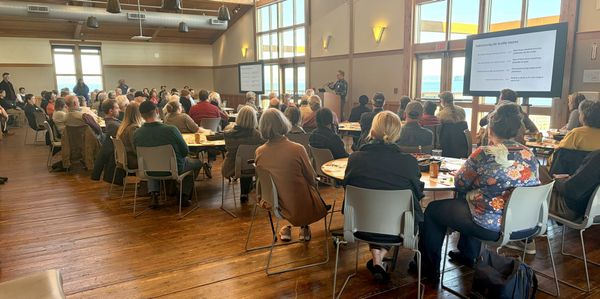
On Sunday, the class itself was even more deeply connected to something I hadn't thought about in so many years—the food under our feet and around us, as 70ish of us walked within a 5 minute radius of our gathering space, were all delights that I relished in as a child: wild chamomile, wild mustard, blackberries, etc, and one that I've learned of through my gardening efforts (trying to tame): dock. Seeing dock as food rather than weed is a shift in perspective that feels right. I noticed that I was a bit more loving toward it this morning, as I noticed that it was indeed sending up tender shoots from the 3 places I’ve been (fruitlessly) pulling it for the last 15 years.
In this wider adventure, I was struck most by the impacts of humans on our ecology, and how directly they impacted Robin's ability to feed himself, and be in the world (he's doing a year of eating only foraged food). First, he was thwarted from shellfish foraging, due to our historic vibrio outbreak. Then, in PORT TOWNSEND, in the PORT, we weren't able to find a bait shop, despite asking in two marine businesses. It's probably there—it just wasn't obvious. Which made me say, "what?!?!"—we're known here for seafood caught off a dock. How can this be so hard?
Then, as if that weren’t enough, there's also a red tide that is affecting large swaths of the shoreline of Port Townsend—for Robin's salt adventure we had to hunt and peck to find water that wasn't affected. And THEN (yes, there was MORE), when I picked him up in the morning, and drove to our classroom, Robin hoped to take a refreshing wake-up dip in Anderson Lake. Nope. Closed due to biotoxins. It was illuminating to both see how readily food is available, when we look—many we call weeds and invasives, and also to see how deeply impactful these water issues were to someone who is relying on them for well-being.
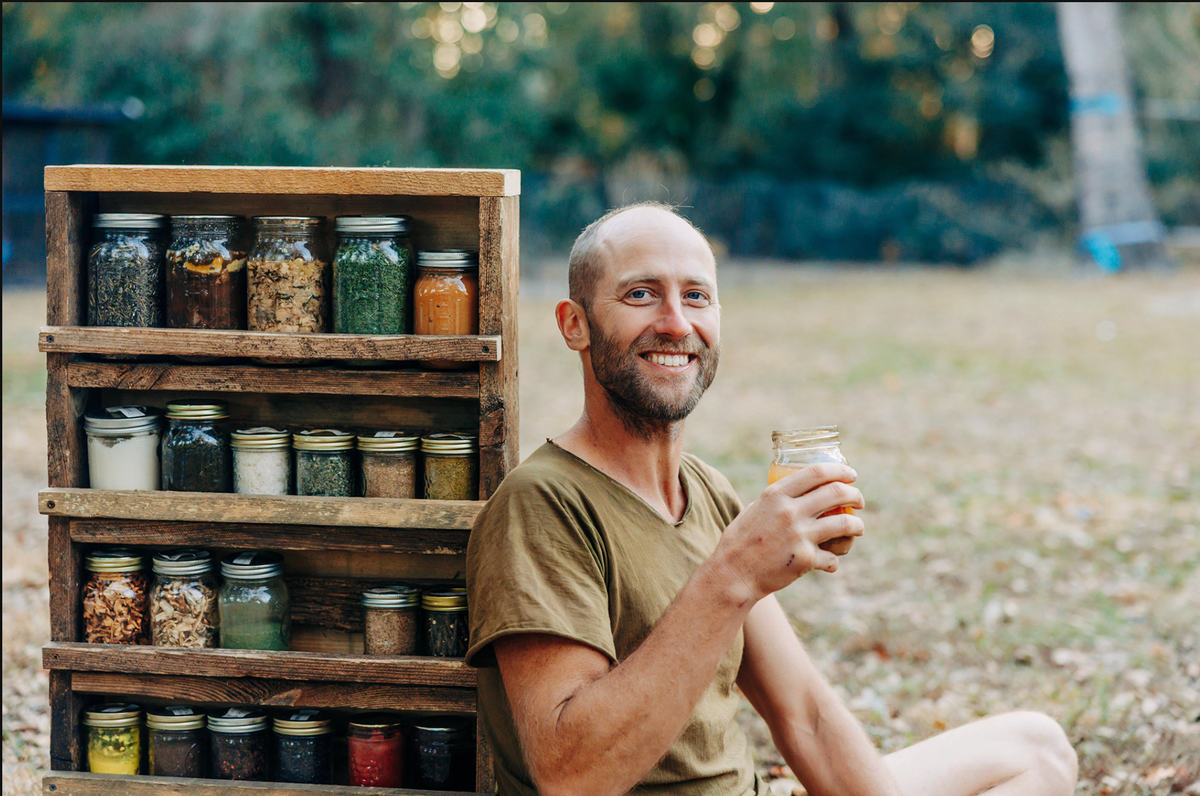
Robin has been on a decade+ long radical journey toward living lightly on the earth, and calling people into that work and conversation. I won’t even try to list it all here, but his voluminous work has included writing books, living-as a disciplined steward of the food systems especially and educating others. With his foundation, Regeneration, Equity and Justice, Robin currently has a mission to plant one million fruit trees, and is also immersed in a year-long activism campaign of foraging 100% of his food and medicine, traveling the country extensively sharing the message that Earth provides us with everything we need.
His ready smile—always lingering there on his tanned face, accompanies a perspective that doesn’t include outrage, or guilt. “Come taste this” he says. “What do you notice?” he asks. “Where do you find your place in the work?” He asks us to see more clearly—in the class, he tells us that he hopes our take-away is a deepening individual relationship with one plant—any given plant. Even that one expanded perspective can make a difference.
Robin takes care in showing us the possibility around us. He points out the nettle, reviewing the benefits of the plant—including its value with garlic and olive oil as a pesto—pointing out that our fear of the sting can become a beneficial lesson about wild plants, which we tend to fear, and causes us to separate ourselves from the plant and our surroundings. In this case, the nettle sting has shown promise in alleviating joint pain and invigorating blood and lymph flow. Fear becomes the plant's strength. Surprisingly, Gallium Aparine, or the more aptly named “cleavers” (how can you miss them—their long tendrils and spiky little seed heads stick to your socks), too, when tender in the spring makes a delicious pesto.
We’re living in interesting times. It’s easy to look around and become overwhelmed, and to feel powerless in situations that seem so much bigger than us. Those problems seem impossibly large. It’s something I hear often from Jefferson County citizens, who care so deeply for our neighbors and the wider world: “how can one person possibly make a difference?” But “yes” is there, too. Robin Greenfield, one person, helped a large group of us understand that hope is literally under our feet. He started conversations, made people smile, asked questions, encouraged our questions. This is how change begins. Sometimes change happens with a thunderclap moment, but most times it’s a small awakening, leading to other small awakenings, leading to connection and understanding and shared growth.
I watched quietly as Robin pulled a fishing line through the water on a walk down toward a curve on the beach “if I’m walking, I might as well be fishing,” he says. And I captured the delight in his face as he pointed out that he’d found dinner—a plant whose name I’ve forgotten, which he enjoys eating steamed to diminish the oxalic acid effects. And today I can say that “yes” was an adventure that connected me both to the very real impacts of our activities on our water environments, and the impacts of those impacts on humans and animals who rely on those environments for food or sanitation. Now, if you need me, I’ll be up in a cherry tree with cleavers still clinging to my socks.