Furloughs on the Table as County Leaders Grapple with Budget Deficit
Department heads attempt to balance fair distribution of the pain with preserving county services and their employees’ paychecks.

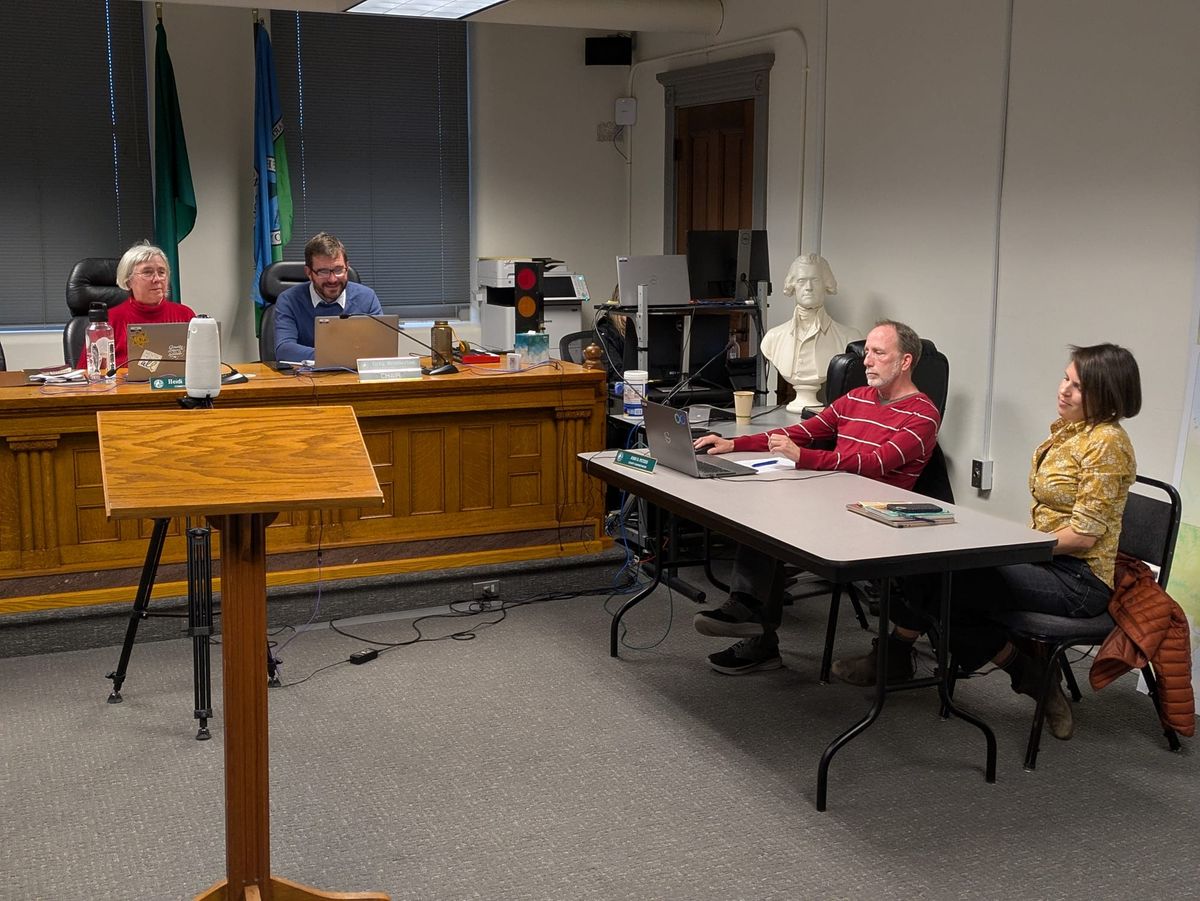
JEFFERSON COUNTY, WA — Jefferson County is inching toward finalizing its 2027 budget, which county leaders agree will continue to strain its workers and the services they deliver to residents.
The Jefferson Board of County Commissioners voted November 23 to move ahead with a 2027 budget that asks general fund-paid employees to take 12 furlough days or find equivalent savings, as the County tries to rebuild a cash cushion that has shrunk by nearly $1 million in a year.
County Treasurer Stacie Prada said the 2026 general fund began with about $5.3 million, and now it stands closer to $4.3 million. The County's policy of holding a 15% reserve works out to roughly $4.5 million. Finance Director Judy Shepherd said that keeping that amount as a baseline through the upcoming year would likely prevent the cash flow problems the County has had this last year. The County needs about $2 million more than it has now to avoid a repeat.
“We’re in a no-win situation, or it feels like it right now,” Commissioner Heather Dudley-Nollette said.
How the hole opened
County Administrator Josh Peters pointed to a few significant causes—each totaling about $1 million. Costs have climbed, Peter said, beyond what anyone expected when the County and the City of Port Townsend entered into a criminal justice interlocal agreement. Peters said that the County has effectively subsidized the City’s share by roughly $1 million over five years, halfway through a 10-year deal.
“We need to renegotiate that deal,” Peters said.
The second is sales tax. Even with a conservative estimate, collections are about $1 million below what the County budgeted, Peters said.
Another pressure is insurance. Assessments from the risk pool have risen sharply in recent years and show no signs of abating. Municipal risk pools primarily cover property and liability exposures for cities, towns, counties and special purpose districts.
Considering furloughs and reduced workweeks
Commissioners discussed other Washington counties’ experiences with implementing furlough days or 32-hour workweeks. A shorter workweek used by another county drew interest, but officials said our county needed a year or more of bargaining with unions and could not do that within its timeline.
The Board steered toward a plan that would set a total number of furlough days for the general fund, and ask each elected official or department to decide how to meet it. This will likely result in most county employees being furloughed roughly one day a month, or with departments proposing equivalent savings instead. Peters said if departments choose another route, to tell him, and the budget presented December 7 would reflect it.
Upon hearing that her staff would be furloughed 12 days per year, Jefferson County District Court judge Mindy Walker said, “I have a big problem with that. My staff is extremely taxed.”
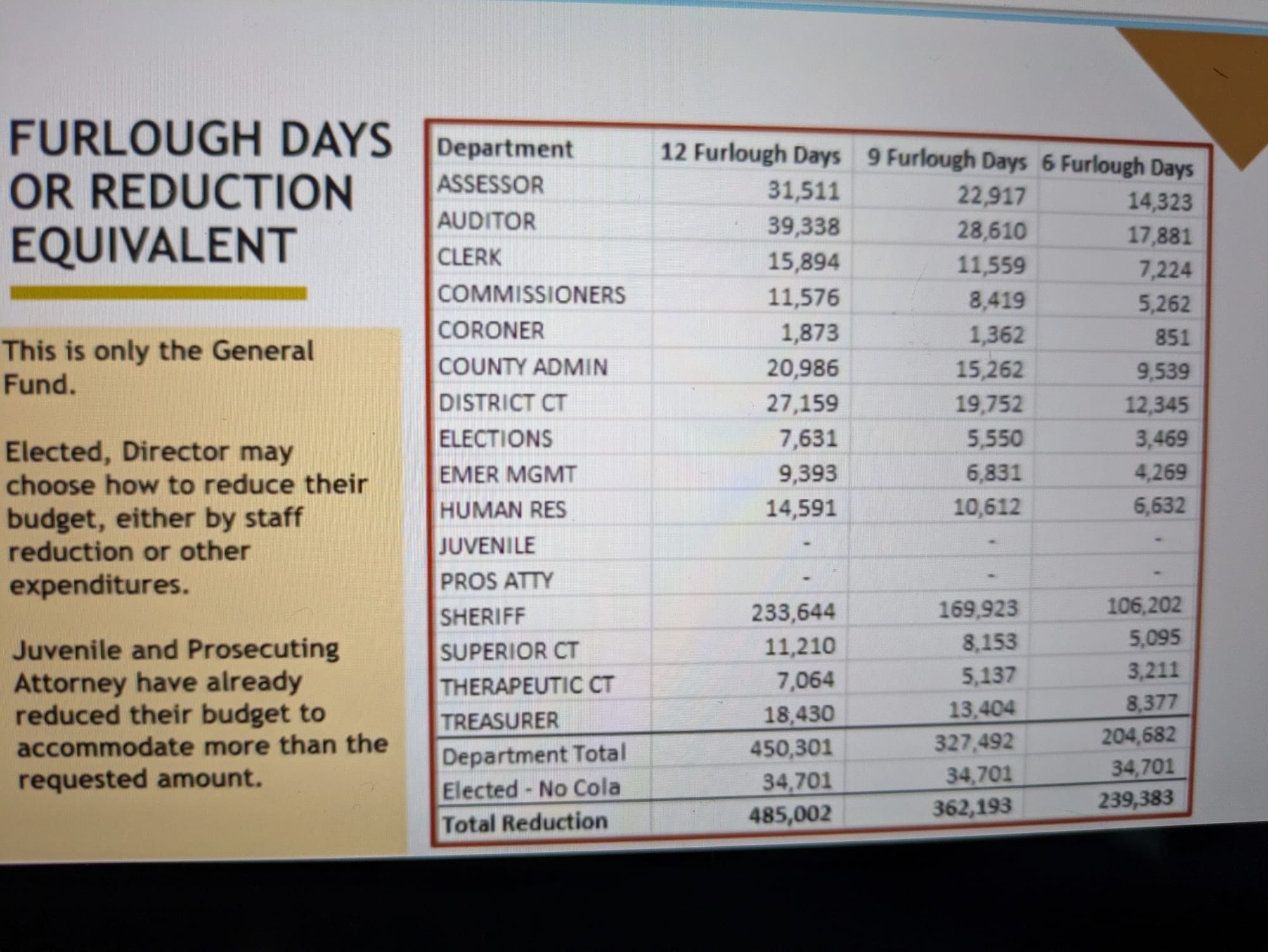
Walker pointed out that other justice partners, such as the Superior Court, the sheriff, the prosecutor and juvenile services, are also significantly understaffed, as they operate around the clock with no one to cover for them. She added that the parks department is even more understaffed than most.
Philip Hunsucker of the Prosecutor’s Office said additional cuts, especially furloughs, would make it impossible to manage the changes underway in that department. Recent unfunded mandates and caseload changes from the state have strained our local judicial system.
Sheriff Andy Pernsteiner said that his department could not implement furloughs, but would find other places to cut.
The Extension debate
The sharpest debate was over approximately $200,000 in general fund money that supports non–mandated services at the Washington State University (WSU) Extension office, including small farms and master gardener programs.
”You’re asking us to take further cuts, while unmandated services, such as those under the WSU Extension, are being funded at a level of $200,000, which would cover some of the cost, said Judge Walker. “You are asking us to take [it] in our budget. I just want to point that out.”
Commissioner Heather Dudley Nollette said the Board committed last year to consider possible cuts to non-mandated services, while Commissioner Heidi Eisenhour said the small farms and other programming the Extension administers are important to her and the county.
Kelly Henwood, the regional small farms coordinator for Extension, told the group that “the programs are potential revenue-generating infrastructure, so let’s look at our return on our investment. [The] County Extension is by far one of the highest leveraged partnerships in local government. The core of our programs is economic development.”
What comes next
The motion, which was approved without dissent, leaves room to adjust. The December 7 hearing will take public comment before the budget is final. Peters said if state lawmakers change the rules for a sales tax that funds juvenile services, the County could begin collecting more by midyear, which would shift the picture.
The discussion surfaced phrases familiar to participants and observers of recent BOCC budget talks: “Keeping me up at night,” and “I’m not sleeping well,” have crossed the lips of most of the County leadership.
”This is awful,” Eisenhour said. “I’m a super sensitive person, and I’m having a really hard time with it. I care about all of you, and know that I’m going to be affecting the lives of people I care about. This sucks.”