Should hunting be allowed for mountain goats?
The Washington Department of Fish and Wildlife’s game management plan provides new guidance for conserving the iconic Western Washington animal.


By Sam Fletcher, Salish Current
The past century has shown stark decline for Washington mountain goats, with abundance once estimated at 10,000 to the most recent estimate — 2012 — of 2,800 and some estimates much lower. With the recent publication of the Department of Wildlife Game Management Plan, which provides assessments and recommendations valid for six years, some local environmentalists worry no hunting is viable at this time for goats’ long-term success.
Native to the North Cascades, mountain goats have adapted to the harsh conditions and steep terrain. The game department lists their climate vulnerability as moderate-high, citing harvest, predation, disease, habitat fragmentation and intense summers and winters as contributors to their decline.
Historically, mountain goats served as an important food source for Coast Salish tribes, who used their wool, horns and bones to make clothing, blankets, tools and ceremonial items.
Martha Hall, an Anacortes resident who ran a wildlife rehab center in San Diego for 18 years and served as chair on the Sierra Club Wildlife Committee, feels that hunting of mountain goats should not be allowed at all.
“That’s an iconic species in the Cascades and one that I always love to see,” she said. “Most of the populations are not doing well at all, and it’s because probably my guess is that it’s climate change and a whole lot of human disturbance by hunters and non-hunters in habitats that they depend on.”
Hall was quick to point out that the most recent statewide population assessment is 14 years old.
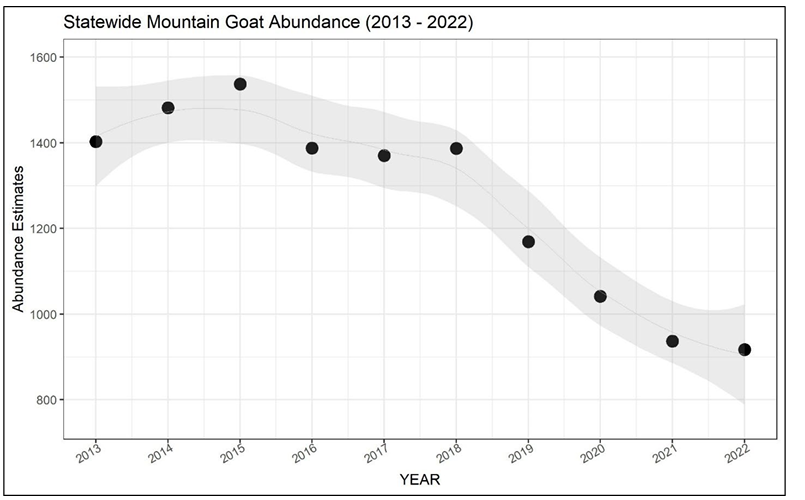
Since 2012, the department has conducted surveys on small portions of available habitat outside areas managed by the National Park Service. These incomplete surveys indicate a steep decline in the last two decades, with statewide numbers estimated in 2022 to be at 917.
Kyle Garrison, an ungulate specialist with the Department of Fish and Wildlife, said the department is “very cognizant of the sensitivity of mountain goats to harvest” and incorporates this data into the number of hunting permits granted. A survey for the 2027-2029 hunting season settings is currently available.
“Our system is inherently built to be adaptive,” Garrison said. “As populations signal trends in one way or the other, our system adjusts to it. So, where populations are performing poorly, they can’t sustain any harvest. We don’t harvest in those populations. Whereas there are populations in the South Cascades, for example, where our harvest is only occurring now and restricted. Those are areas where we can offer some harvest at very conservative levels.”
Hunting of mountain goats is currently allowed in Naches Pass, Goat Rocks Wilderness, Mount Margaret backcountry and south of Mount Saint Helens. While the impact of hunting in these areas on the North Cascades population has not been studied, goats likely move seasonally into Forest Service lands, and overhunting is suspected by the Forest Service to be one contributor to their decline statewide.
According to the 2015-2021 Game Management Plan, hunting opportunity has decreased with the population trend, and current permit levels represent about 4% of the state goat population. Mountain goat permits are considered a “once in a lifetime” opportunity for avid hunters.
Richard Harris, a researcher at the University of Montana who studied the survivability of Western Washington’s mountain goats, cast doubt on hunting being a major contributor of the statewide decline.
“The number of hunting permits is very conservative, so very unlikely to be a cause, or even a contributor, to the recent declines,” he said. “I understand that it might seem counter-intuitive to some to continue hunting populations that have declined. However, the current funding system makes it very difficult to support research into the causes of decline — which, again, are almost certainly not caused by hunting at current levels — without the income stream provided by hunters.”
According to Michael Ouellette of White Pass Outfitters, who guides goat hunts in the Goat Rocks Wilderness, there is an “excessive” number of goats in his area.
“I am not a biologist or a politician, but I also don’t know anyone who spends more time in the woods than I do,” he said. “As far as goat hunts in my area, in the last eight years or so, the amount of goats restricted to be harvested each year has slowly dwindled down year after year. And from what I have seen, the (permits have) always been filled.”
He describes the goat population in Goat Rocks to be “healthy and thriving.”
“I believe allowing more harvest tags is a good thing to maintain proper conservation efforts. Most hunters that draw the one or two goat tags available in my area are in their 70s or 80s. They have waited 30 years to draw the one single tag they are allowed in their lifetime, and more often than not, their age or health denies them the opportunity to experience their hunt in the way they had hoped for.”
As for the outdated surveys, Garrison said, “You use the science you have available to you. The math and the knowledge around mountain goat population ecology hasn’t necessarily evolved so much. I would push back to say that I think that the resources that we’re using in terms of informing our harvest guidelines is the best information out there.”
According to Hall, aerial surveys are inadequate, as they do not include counts of first-year kids, exact ages and sexes. Hunted populations are monitored more closely than non-hunted populations.
Garrison agreed that aerial surveys are imperfect. The department uses a “site ability correction model” analysis, which he said compensates for imperfect detection.
“Aerial surveys, especially in an alpine environment like that, there’s no competitor in terms of standard,” he said. “Aerial approaches are the gold standard because your view is better; you can cover greater ground. You can imagine trying to do ground-based air backpacking to count mountain goats would take an incredible amount of resources and time, and there’s all sorts of issues with kind of doing ground approaches and bias. A helicopter eliminates a lot of those problems.”
Unlike mountain goats, Washington’s elk are monitored population by population, which provides much more information and survivability indicators. According to Garrison, this is necessary because of the nexus of elk and humans — elk cause a lot of damage. Because mountain goats don’t have the same issues and management complexities, such surveys aren’t financially feasible.
Representatives of the Stillaguamish and Tulalip tribes, who place GPS collars on mountain goats to monitor population, declined to respond in time for publication.
According to Harris, it is unclear that putting radio collars on goats to see where they go would indicate much about why some populations have dramatically declined.
One objective of the new plan is to “consider animal translocation as a tool to augment or establish mountain goat populations where appropriate.”
From 2018–2020, over 325 mountain goats were translocated from Olympic National Park to the North Cascades to re-establish native populations. By May 2024, of the goats tracked, just four were known to have survived.
According to Garrison, the management plan provides guidance on a broad level but isn’t prescriptive. Decisions around translocations would be made in collaboration with local partners.
Harris said that the Washington game department and tribes use the most reliable survey methods of any jurisdiction in North America.
“Of course there is always uncertainty, even with the best possible method,” he said. Difficult as it is to understand populations trends, it is even more challenging to understand the reasons for those trends.”
According to Garrison, the Game Management Plan — while imperfect — has been greatly improved over the years, with more information and better conservative plans.
“I think how management can be improved is through more science and through more information,” he said. “We’re trying to go and deploy radio collars, understand mountain goat movement, understand recreation impacts, understand climate impacts, understand survival, understand reproduction. Those are all important questions that we’re going to work on to better inform management but also just to better inform our understanding of what it is causing trends and dynamics in mountain goat abundance.”